
Spectacled owl
The spectacled owl (Pulsatrix perspicillata) is a large tropical owl native to the neotropics, found in forests from southern Mexico and Trinidad to southern Brazil and northwestern Argentina. It is distinguished by its blackish-brown upperparts, white facial markings, and whitish to yellowish-ochre underparts, with yellow eyes being a unique characteristic among its genus. This owl is primarily nocturnal and a solitary hunter with a varied diet.
Key Facts
- ›Native to tropical rainforests and adjacent habitats in the neotropics.
- ›Has distinctive white facial markings, blackish-brown upperparts, and yellow eyes.
- ›Preys on a wide range of mammals, invertebrates, and birds.
- ›Largely nocturnal, with hunting activity commencing at dusk.
- ›Nests in unlined tree cavities or tree crotches, laying 1-2 eggs.
- ›Classified as Least Concern by the IUCN due to its large range.

Murucututu
Tropical Rainforests, Dense, Old-Growth Forests, Forest Edges, Dry Forests, Planted Forests, Savanna Plains, Subtropical Montane Cloud Forests
Mexico, Central America, Trinidad and Tobago, South America
Mammals, Invertebrates, Frogs, Birds
About Spectacled owl
The spectacled owl (Pulsatrix perspicillata), also known locally as the Murucututu, is a large tropical owl species native to the neotropics. Its geographic range extends from southern Mexico and Trinidad, through Central America, and south to southern Brazil, Paraguay, and northwestern Argentina. This owl is primarily found in tropical rainforests, especially in areas with dense, old-growth forests, but it can also adapt to forest edges, dry forests, plantations, and semi-open areas with trees. In some higher elevation areas, they inhabit subtropical montane cloud forests.
Physical Description
One of the most striking features of the spectacled owl is its distinctive plumage. It has blackish-brown upperparts, head, and upper breast, which contrast with white facial markings and whitish to yellowish-ochre underparts. A unique characteristic among its genus, the spectacled owl possesses yellow eyes. The beak is pale. Juvenile spectacled owls are exceptionally distinctive, being entirely white except for a chocolate brown facial disc. There are six recognized subspecies, which can vary slightly in plumage coloration and size, particularly in the shade of the head and the breast band.
Diet and Behavior
As a largely nocturnal hunter, the spectacled owl begins its activity around dusk and returns to its roosts by dawn. It is a solitary bird, generally only interacting with others of its species for breeding purposes. The spectacled owl is often the largest and most dominant owl in its territory. Its diet is broad and includes a wide variety of prey. Mammals form a primary food source, encompassing rodents, climbing rats, mouse opossums, bats, and even smaller monkeys. Remarkably, this owl is capable of taking prey significantly larger than itself, including sloths weighing over 4 kg. Invertebrates such as caterpillars, large insects, and spiders are also consumed, as are frogs and medium-sized birds.
Reproduction
Reproduction in spectacled owls typically occurs during the dry season or at the beginning of the wet season, with egg-laying noted between November and July in Costa Rica. They do not build nests, instead utilizing unlined tree cavities or the crotches of large trees, laying their eggs on the bare wood surface. The clutch size is usually one to two eggs, incubated by the female for approximately five weeks. If two chicks hatch, survival of both is uncommon, with the smaller chick often succumbing to starvation or aggression. Young owls fledge around five to six weeks but remain dependent on their parents for several months, potentially up to a year, which can affect the pair's ability to breed in consecutive years. Spectacled owls may begin breeding while still in immature plumage, as it can take up to five years to develop full adult coloration.
Conservation Status
The spectacled owl is classified as Least Concern by the IUCN, owing to its extensive range and presence across many areas. However, as a large, slow-maturing raptor with a strong territorial nature, it naturally occurs at low population densities. In regions where prey species are over-hunted by humans or where habitats are degraded, spectacled owl populations may decline. The extinction of one subspecies on Trinidad is attributed to such factors. Occasional automobile collisions also pose a risk when roads are built through their forest habitats.
Source: Wikipedia ↗
Frequently Asked Questions
What is the spectacled owl's habitat?
The spectacled owl primarily inhabits tropical rainforests, particularly areas with dense, old-growth forests. They can also be found in secondary habitats like forest edges, dry forests, savannas, plantations, and semi-open areas with trees. In some regions like Costa Rica, they inhabit subtropical montane cloud forests up to 1,500 meters.
What does the spectacled owl eat?
Its diet is varied and includes a wide array of mammals, such as rodents, mouse opossums, and bats. They also prey on smaller monkeys, and surprisingly, have been known to take prey much larger than themselves, like sloths. Invertebrates like caterpillars, crabs, snails, insects, and spiders are also consumed, along with frogs and medium-sized birds.
What are the distinctive physical features of the spectacled owl?
The spectacled owl is identifiable by its blackish-brown upperparts, head, and upper breast, contrasted with white facial markings and whitish to yellowish-ochre underparts. A key distinguishing feature is its yellow eyes, the only species in the Pulsatrix genus to have this eye color. Juveniles are entirely white except for a chocolate brown facial disc.
How do spectacled owls reproduce?
Spectacled owls typically nest in unlined tree cavities or the crotches of trees, laying one to two eggs. The female incubates the eggs for about five weeks. If two chicks hatch, often only one survives due to starvation or aggression from the larger sibling. Young owls leave the nest at 5-6 weeks but remain dependent on parents for up to a year.
What is the conservation status of the spectacled owl?
The spectacled owl is classified as Least Concern by the IUCN. This is due to its very large range and its continued presence in many parts of its distribution. However, habitat destruction and prey depletion can lead to population decreases in certain areas.
Related Owl species
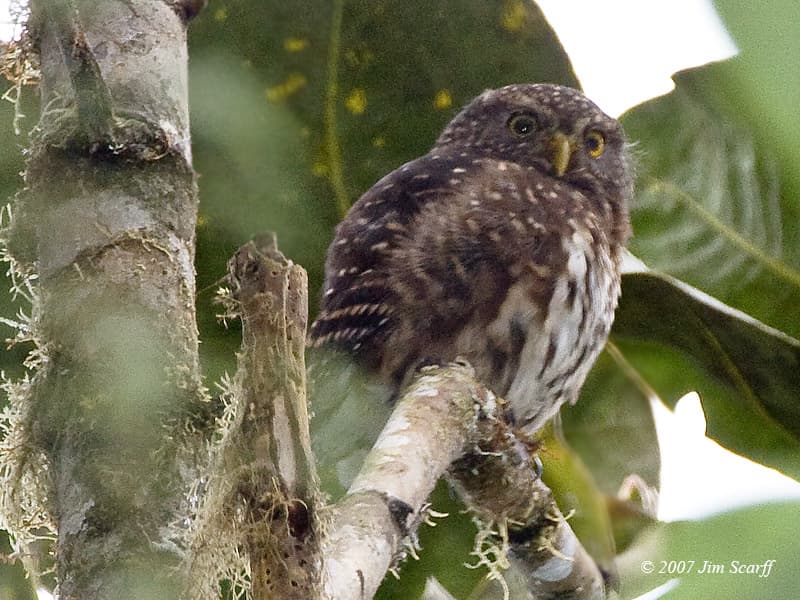
Andean pygmy owl
The Andean pygmy owl is a small owl species native to the Andes mountains of South America, found in countries like Colombia, Ecuador, Peru, and Venezuela. It is distinguished by its two color morphs, white facial markings including prominent "brows" and "moustaches," and a distinctive face-like pattern on its nape. This owl is an opportunistic predator, active both day and night, feeding on a variety of small invertebrates, birds, and mammals.
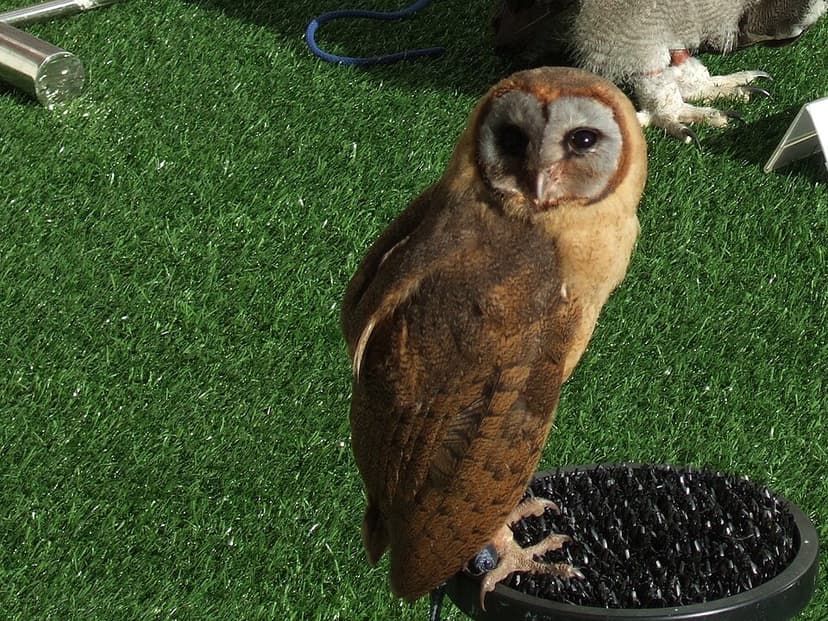
Ashy-faced owl
The ashy-faced owl (Tyto glaucops) is a species of barn owl native to Hispaniola and several islands in the Lesser Antilles. It is distinguished by its silvery-gray facial disc (in the nominate subspecies), a preference for a mix of open hunting spaces and canopy cover, and a varied diet of small vertebrates and invertebrates. This species plays a crucial role as a nocturnal predator in its island ecosystems.

Austral pygmy owl
The austral pygmy owl is a small owl species found in central and southern Chile and parts of southern Argentina. It is distinctive for its gray-brown and red color morphs and its ability to hunt both during the day and at night. This owl is known for its varied vocalizations, including contact whistles, territorial trills, and courtship calls.