
Spotted owl
The spotted owl is a species of true owl native to old-growth forests in western North America. It is distinguished by its cross-shaped markings on its underparts, differentiating it from the similar barred owl. Facing threats from habitat destruction and competition from barred owls, the spotted owl is classified as a near-threatened species.
Key Facts
- ›Nests in tree hollows, old bird of prey nests, or rock crevices, typically between 12 and 60 meters high.
- ›Feeds primarily on small mammals like northern flying squirrels and woodrats, as well as birds.
- ›Has three recognized subspecies: Northern, California, and Mexican spotted owls.
- ›Prefers closed-canopy, uneven-aged, late-successional, and old-growth forests with substantial tall shrub cover.
- ›Conservation status is near threatened, with populations declining due to habitat loss and competition from barred owls.
- ›Northern and Mexican subspecies are listed as threatened in the United States under the Endangered Species Act.
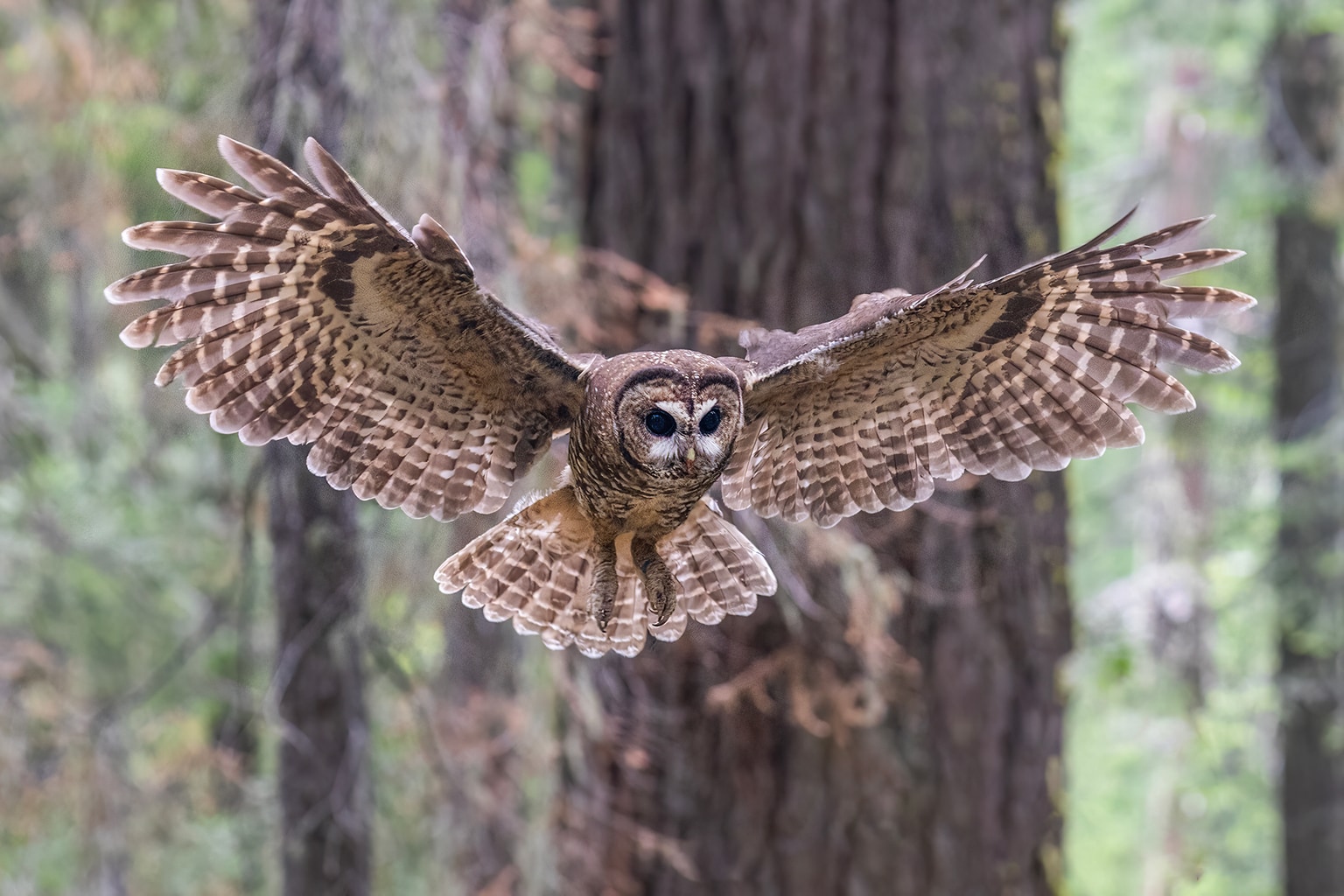
Spotted Owl
Old-Growth Forests, Hardwood Forests, Coniferous Forests, Closed-Canopy Forests, Uneven-Aged Forests, Late-Successional Forests, Chaparral, Pinyon Woodlands, Canyons
North America, British Columbia, Mexico, United States
Small Mammals, Birds, Northern Flying Squirrels, Woodrats, Deer Mice, Pocket Gophers, Voles, Snowshoe Hares, Rabbits, Squirrels, Bats, Amphibians, Reptiles, Insects
Fisher, American Goshawks, Crows, Great Horned Owls, Red-Tailed Hawks, Golden Eagles
About Spotted owl
The spotted owl (Strix occidentalis) is a species of true owl renowned for its presence in the old-growth forests of western North America. Its distinctive appearance includes dark eyes and underparts marked with a characteristic cross-shaped pattern, setting it apart from the similarly sized barred owl.
Habitat and Distribution
Spotted owls inhabit a range of forest types, with a strong preference for closed-canopy, uneven-aged, late-successional, and old-growth environments. They can be found from southwestern British Columbia down through California and into the mountainous regions of the Southwestern United States and western Mexico. Their preferred nesting sites are tree hollows, abandoned raptor nests, or rock crevices, typically located at significant heights from the ground. Proximity to water sources is also a valued aspect of their habitat.
Diet and Behavior
Primarily a nocturnal hunter, the spotted owl subsists on a diet that largely consists of small mammals, notably northern flying squirrels and various species of woodrats. Birds and other smaller prey are also consumed to a lesser extent. They are known to be sit-and-wait predators, often hunting from a perch. While generally active at night, they may occasionally hunt during daylight hours.
Reproduction and Lifespan
The breeding season for spotted owls spans from early spring to late summer or fall. Pairs are monogamous, and typically lay two eggs, though up to four have been recorded. The female incubates the eggs and cares for the young, with the male providing food. Young owls become independent after three to four months and may begin breeding after one year, though two years is more common. Spotted owls are long-lived, with maximum ages of 16 to 17 years documented.
Conservation Concerns
The spotted owl faces significant conservation challenges, primarily due to habitat loss stemming from timber harvesting. Competition with the barred owl, a more aggressive species, further exacerbates these pressures. Consequently, the spotted owl is classified as near threatened, with populations generally in decline across its range. The northern and Mexican spotted owl subspecies are listed as threatened under the U.S. Endangered Species Act, highlighting the urgent need for continued conservation efforts.
Source: Wikipedia ↗
Frequently Asked Questions
What distinguishes a spotted owl from a barred owl?
The spotted owl has distinctive cross-shaped markings on its underparts, while the barred owl has alternating bars on its breast and streaks on its belly. Barred owls are also generally larger and grayer than spotted owls.
What kind of habitats do spotted owls prefer?
Spotted owls favor closed-canopy, uneven-aged, late-successional, and old-growth forests. They also generally seek out areas with canopy cover greater than 40% and substantial tall shrub cover, valuing the proximity of water sources.
What are the main threats to spotted owl populations?
Habitat destruction, primarily due to timber harvesting, is a significant threat. Competition with the more aggressive barred owl, which has a broader diet and occupies varied habitats, also contributes to the decline of spotted owl populations.
What is the conservation status of the spotted owl?
The spotted owl is currently classified as near threatened by the IUCN Red List, with a decreasing population trend. NatureServe considers the species vulnerable. Several subspecies are also listed as threatened or proposed for listing under the U.S. Endangered Species Act.
How do spotted owls build their nests?
Spotted owls do not construct their own nests. Instead, they utilize existing cavities in trees, deadwood, and snags, as well as abandoned nests of raptors or squirrels.
Related Owl species

Chaco owl
The Chaco owl is a species of owl native to southern South America, inhabiting the Gran Chaco region of Argentina, Bolivia, and Paraguay. It is distinguished by its lack of ear tufts, pale facial disk with dark lines, and barred plumage. Primarily nocturnal hunters, they are vocally active during twilight hours.

Javan scops owl
The Javan scops owl (Otus angelinae), also known locally as Celepuk Jawa, is a small owl endemic to the high volcanic mountains of western Java. It is distinguished by its rusty-brown facial disc, prominent white eyebrows and ear-tufts, and a unique alarm call. This nocturnal predator primarily hunts insects and other small invertebrates in montane forests.

Mantanani scops owl
The Mantanani scops owl is a small owl species found on islands between Borneo and the Philippines. It is characterized by its buff facial disk, dark brown upperparts with pale markings, and pale underparts with dark streaks. The species is listed as "near threatened" due to its limited and fragmented range and the ongoing degradation of its forest habitat.