
Spotted owlet
The spotted owlet is a small owl native to tropical Asia, ranging from North Pakistan to Southeast Asia. It is a common resident of open habitats, including farmland and urban areas, often roosting in small groups. This nocturnal bird is distinguished by its stocky build, grey-brown upperparts heavily spotted with white, and yellow irises.
Key Facts
- ›Small and stocky, measuring approximately 21 cm in length.
- ›Upperparts are grey-brown with heavy white spotting; underparts are white with brown streaks.
- ›Inhabits open areas like farmland, human habitation, and cities.
- ›Primarily nocturnal but can be observed during the day.
- ›Feeds on insects, small vertebrates like rodents and bats, and occasionally scorpions and mollusks.
- ›Breeds from November to April, laying 3-5 spherical white eggs.
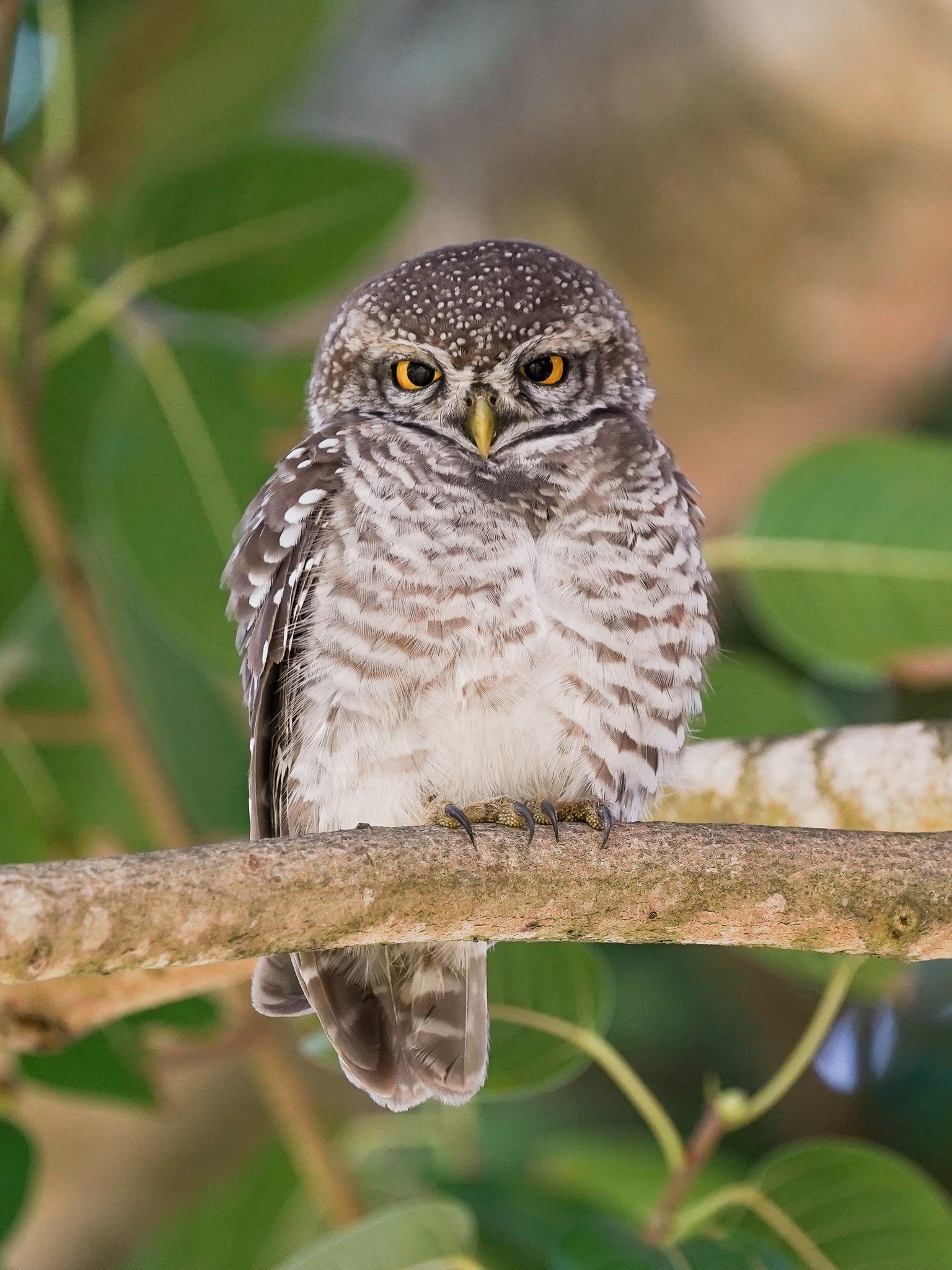
Little Spotted Owl
Open Habitats, Farmland, Human Habitation, Cities, Hollows of Trees, Cavities In Rocks and Buildings, Holes In Trees, Holes In Buildings, Holes In Vertical Embankments
North Pakistan, Southeast Asia, Iran, India, Myanmar, Thailand, Cambodia, Vietnam
Insects, Rodents, Bats, Toads, Small Snakes, Scorpions, Mollusks
About Spotted owlet
The spotted owlet (Athene brama) is a small owl that is a common resident across tropical Asia, with its range extending from North Pakistan to Southeast Asia. This species is well-adapted to a variety of open environments, including farmland and areas with significant human presence, and has notably adapted to urban living. Spotted owlets are often found roosting in small groups within the hollows of trees or in cavities found in rocks and man-made structures.
Description and Identification
Physically, the spotted owlet is a stocky bird, measuring approximately 21 cm in length. Its upperparts are characterized by a grey-brown plumage heavily speckled with white, while the underparts are white with distinct brown streaks. A pale facial disc and bright yellow irises are prominent features, further accentuated by a white neckband and supercilium. The sexes are visually similar, and their flight pattern is characterized by a deeply undulating motion.
Habitat and Distribution
This owl inhabits open habitats such as farmland and human settlements, demonstrating a remarkable ability to thrive in urban landscapes. Its geographic range spans from North Pakistan eastward through Southeast Asia, encompassing regions like India, Myanmar, Thailand, Cambodia, and Vietnam. They are known to nest in holes found in trees, buildings, and even vertical embankments.
Behavior and Ecology
Primarily nocturnal, the spotted owlet is frequently observed during daylight hours, particularly when disturbed from its daytime resting place. When alerted, they exhibit a characteristic head-bobbing behavior and intently observe intruders. Their presence is often betrayed by smaller birds that mob them while they perch in trees during the day. The call of the spotted owlet is a harsh, loud churring and chuckling sound, typically emitted during the early dawn or just after sunset.
Diet and Feeding Habits
The diet of the spotted owlet comprises a variety of insects and small vertebrates. In regions like Pakistan, insects form the bulk of their prey. In arid areas, rodents become a more significant food source, especially in the period leading up to the breeding season. They have also been recorded preying on bats, toads, small snakes such as Ramphotyphlops braminus, scorpions, and mollusks. Nests located near human settlements may benefit from increased rodent availability, potentially leading to higher breeding success.
Breeding and Reproduction
The breeding season for spotted owlets generally occurs between November and April. Courtship rituals involve behaviors such as bill grasping, allopreening, and ritual feeding. They construct nests in cavities, often competing with other hole-nesting species. A typical clutch consists of three to five spherical white eggs. Incubation begins with the first egg laid, resulting in chicks of varying sizes. The young are initially fed insects and later small vertebrates. Chicks gain weight in their early stages but tend to lose weight before fledging, with typically only one or two chicks successfully fledging about a month after hatching.
Cultural Significance
In some cultures, the spotted owlet has been associated with bad omens, though these beliefs are considered folklore with no scientific basis. In modern times, such superstitions are largely disregarded. The species name, 'brama,' is indirectly linked to its Indian habitat and is a homage to Brahma, the Hindu supreme spirit. Scientifically, the genus name 'Athene' honors the Greek goddess of wisdom, whose sacred bird was the owl, while 'Brama' acknowledges the species' wide distribution across India. In Hindu mythology, the owl is also recognized as the vahana, or mount, of Goddess Lakshmi, symbolizing wisdom and the perception of inner truth.
Source: Wikipedia ↗
Frequently Asked Questions
What is the scientific name of the spotted owlet?
The scientific name of the spotted owlet is Athene brama. The genus name, Athene, refers to the Greek goddess of wisdom, whose sacred bird was the owl. The species name, brama, is derived from the French name for this owl and indirectly pays homage to Brahma, the Hindu supreme spirit and creator god, reflecting its wide distribution in India.
Where can spotted owlets be found?
Spotted owlets breed across tropical Asia, with their range extending from North Pakistan eastward through Southeast Asia, including countries like Myanmar, Thailand, Cambodia, and Vietnam. They are common residents in open habitats such as farmland and areas with human habitation, and have successfully adapted to living within cities.
What does a spotted owlet look like?
The spotted owlet is a small, stocky bird, measuring about 21 cm long. Its upperparts are a grey-brown color heavily marked with white spots, while its underparts are white with brown streaks. It has a pale facial disc and bright yellow irises, with a noticeable white neckband and supercilium.
What do spotted owlets eat?
Spotted owlets have a varied diet consisting of insects and small vertebrates. In Pakistan, they predominantly consume insects. In arid regions, rodents become a more significant part of their diet, especially before the breeding season. They have also been known to eat bats, toads, small snakes, scorpions, and mollusks.
When do spotted owlets breed and how many eggs do they lay?
The breeding season for spotted owlets typically occurs between November and April. They nest in cavities, often in trees or buildings, and lay a clutch of three to five spherical white eggs. Incubation begins with the first egg, leading to chicks of varying sizes.
Are spotted owlets active at night?
Yes, spotted owlets are primarily nocturnal, meaning they are most active during the night. However, they are often observed during the day, especially when disturbed from their daytime roosting sites. Their calls are most frequently heard during early dawn or shortly after sunset.
Related Owl species
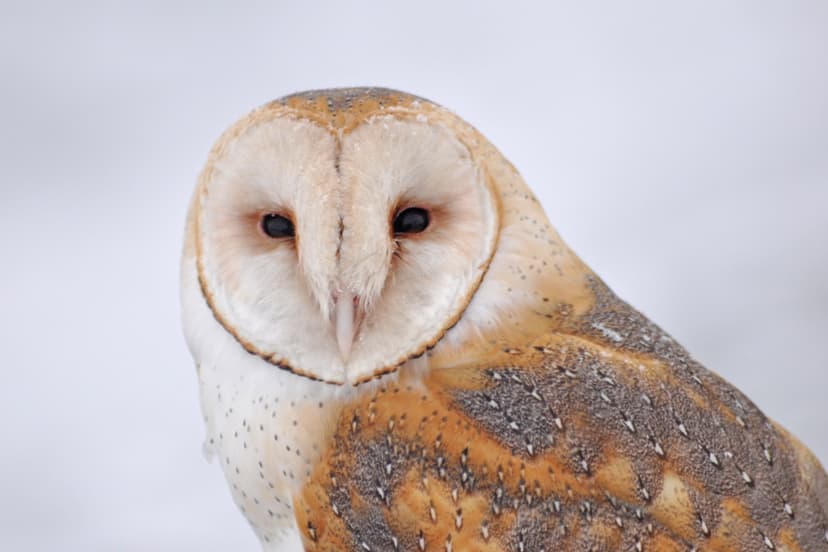
American barn owl
The American barn owl, scientifically known as Tyto furcata, is a widespread owl species native to North and South America. It is distinguished by its pale, heart-shaped facial disc, long wings, and undulating flight pattern, and plays a crucial role in rodent control due to its specialized diet.

Australian boobook
The Australian boobook (Ninox boobook) is the smallest owl species native to mainland Australia, also found in southern New Guinea, Timor, and the Sunda Islands. It is distinguished by its characteristic "boo-book" call and its predominantly dark-brown plumage marked with pale spots. This nocturnal hunter primarily preys on insects and small vertebrates, nesting in tree hollows and is considered of least concern by the IUCN.

Chaco owl
The Chaco owl is a species of owl native to southern South America, inhabiting the Gran Chaco region of Argentina, Bolivia, and Paraguay. It is distinguished by its lack of ear tufts, pale facial disk with dark lines, and barred plumage. Primarily nocturnal hunters, they are vocally active during twilight hours.