
Spotted wood owl
The spotted wood owl, scientifically known as Strix seloputo, is a member of the earless owl genus, Strix. This species is found in various regions around Borneo, though notably absent from the island itself, inhabiting diverse environments from lowland forests to urban parks. It is distinguished by its chocolate brown head, lack of ear-tufts, and a distinctive rolling "huhuhu" call.
Key Facts
- ›Reaches a length of 44 to 48 cm with a wingspan of 30 to 36 cm.
- ›Plumage features a chocolate brown head, coffee-colored upper parts with white spotting, and dull yellow underparts with barring.
- ›Diet primarily consists of mice and rats, supplemented by insects and small birds.
- ›Found in lowland forests, mangrove swamps, cleared woodlands, plantations, and parks in towns and villages.
- ›Has a wide distribution with a stable population, assessed as 'least concern' by the IUCN.
- ›Distinctive call is a rolling "huhuhu" followed by a long "whoo".

Spotted Wood Owl
Lowland Forest, Mangrove Swamps, Cleared Woodland, Plantations, Parks In Towns and Villages
Asia, Borneo Region
Mice, Rats, Insects, Small Birds
About Spotted wood owl
The spotted wood owl, scientifically classified as Strix seloputo, is a species of owl belonging to the earless owl genus, Strix. Its geographic distribution is notable for being disjunct, appearing in numerous regions surrounding Borneo without actually occurring on the island itself. This owl is characterized by its substantial size, reaching lengths of approximately 44 to 48 centimeters, with a wingspan ranging from 30 to 36 centimeters.
Physical Characteristics and Identification
Distinctive features of the spotted wood owl include a chocolate brown head, an orangish-buff facial disc, and the notable absence of ear-tufts, common to many other owl species. The nominate subspecies exhibits a yellowish throat band. The upper plumage is a coffee color, adorned with white bars and spots that are edged with black. Ventrally, the owl presents dull yellow underparts marked by broad white and narrow black bars. The eyes are a dark brown hue, and the beak is greenish-black. Its legs and toes are densely feathered, with the exposed parts appearing olive.
Distribution and Habitat
The spotted wood owl is found across a wide geographical area, with three recognized subspecies. S. s. seloputo inhabits South Myanmar, central Thailand, extending to Singapore and parts of Sumatra and Java. S. s. baweana is endemic to Bawean Island, situated off the coast of North Java, while S. s. wiepkini is found in the Calamian Islands and Palawan in the Philippines. The preferred habitats of this species are diverse, encompassing lowland forests, mangrove swamps, cleared woodlands, agricultural plantations, and even parks within towns and villages, demonstrating a degree of adaptability to human-modified landscapes.
Ecology and Diet
Ecologically, the spotted wood owl is a predator whose diet primarily consists of small mammals, such as mice and rats. Its diet is supplemented by insects and small birds. Information regarding its breeding season, nesting habits, and clutch size is not detailed in available records.
Conservation Status
The spotted wood owl boasts a very wide range and is considered common in many areas within its distribution. While its total population size has not been precisely quantified, it appears to be stable. Consequently, the International Union for Conservation of Nature (IUCN) has assessed the species' conservation status as 'least concern,' indicating a relatively low risk of extinction.
Vocalization
A defining characteristic of the spotted wood owl is its distinctive call, described as a rolling "huhuhu" sound followed by a prolonged "whoo."
Source: Wikipedia ↗
Frequently Asked Questions
What is the scientific name of the spotted wood owl?
The scientific name of the spotted wood owl is Strix seloputo. It belongs to the earless owl genus, Strix.
What does the spotted wood owl look like?
The spotted wood owl has a chocolate brown head with an orangish-buff facial disc and no ear-tufts. Its upper parts are coffee-colored with white bars and spots, while its underparts are dull yellow with broad white and narrow black bars. Its eyes are dark brown and its beak is greenish-black.
Where can the spotted wood owl be found?
The spotted wood owl's range is disjunct and includes South Myanmar, central Thailand, Singapore, Sumatra, Java, the Bawean island, the Calamian Islands, and Palawan in the Philippines. It is found in habitats such as lowland forests, mangrove swamps, cleared woodlands, plantations, and parks.
What is the conservation status of the spotted wood owl?
The spotted wood owl is listed as 'least concern' by the International Union for Conservation of Nature. Its population is considered stable and it has a very wide range.
What does the spotted wood owl eat?
The diet of the spotted wood owl primarily consists of mice and rats. It also supplements its diet with insects and small birds.
Related Owl species
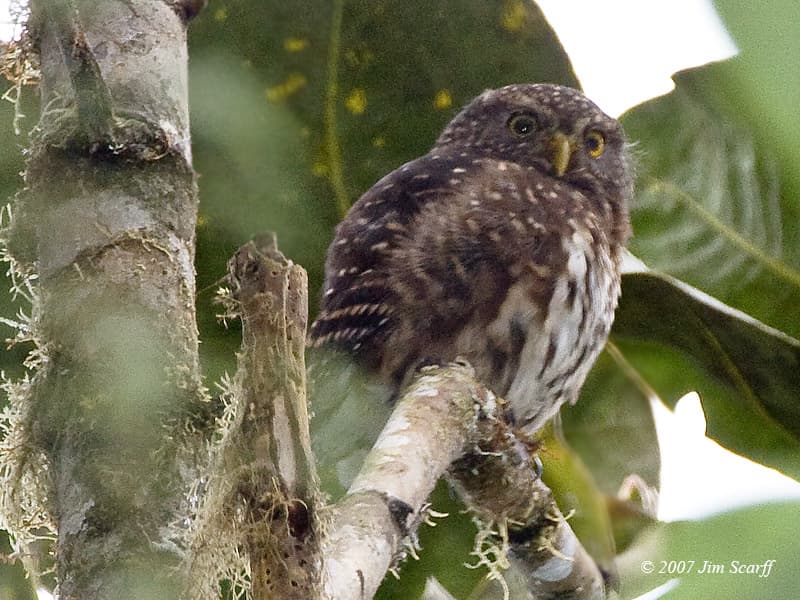
Andean pygmy owl
The Andean pygmy owl is a small owl species native to the Andes mountains of South America, found in countries like Colombia, Ecuador, Peru, and Venezuela. It is distinguished by its two color morphs, white facial markings including prominent "brows" and "moustaches," and a distinctive face-like pattern on its nape. This owl is an opportunistic predator, active both day and night, feeding on a variety of small invertebrates, birds, and mammals.
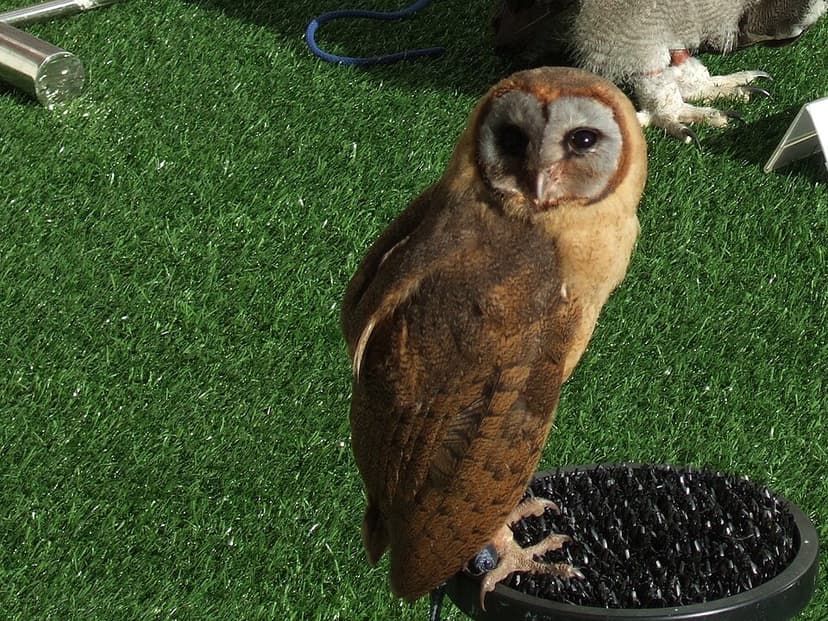
Ashy-faced owl
The ashy-faced owl (Tyto glaucops) is a species of barn owl native to Hispaniola and several islands in the Lesser Antilles. It is distinguished by its silvery-gray facial disc (in the nominate subspecies), a preference for a mix of open hunting spaces and canopy cover, and a varied diet of small vertebrates and invertebrates. This species plays a crucial role as a nocturnal predator in its island ecosystems.

Austral pygmy owl
The austral pygmy owl is a small owl species found in central and southern Chile and parts of southern Argentina. It is distinctive for its gray-brown and red color morphs and its ability to hunt both during the day and at night. This owl is known for its varied vocalizations, including contact whistles, territorial trills, and courtship calls.