
Subtropical pygmy owl
The subtropical pygmy owl (Glaucidium parkeri) is a small owl species native to the humid montane forests on the eastern slopes of the Andes in South America. It is distinguished by its small size, prominent white spots on its crown and face, and a distinctive vocalization consisting of short, low-toned phrases. This species is active both day and night and is currently listed as Least Concern by the IUCN.
Key Facts
- ›Inhabits humid montane forests on the east slope of the Andes.
- ›Found in Bolivia, Colombia, Ecuador, and Peru.
- ›Possesses a widespread brown morph and a rarer rufous morph.
- ›Active both during the day and at night.
- ›Its song consists of three or four short phrases of low tone.
- ›Assessed by the IUCN as Least Concern.

Humid Montane Forest
Bolivia, Colombia, Ecuador, Peru
Large Arthropods, Small Vertebrates
About Subtropical pygmy owl
The subtropical pygmy owl is a small owl species belonging to the family Strigidae. It is found in the humid montane forests located on the eastern slopes of the Andes mountain range, with its distribution spanning across Bolivia, Colombia, Ecuador, and Peru. The species is named in honor of Theodore A. Parker III, an ornithologist recognized for his extensive knowledge of Neotropical birds.
Description and Habitat
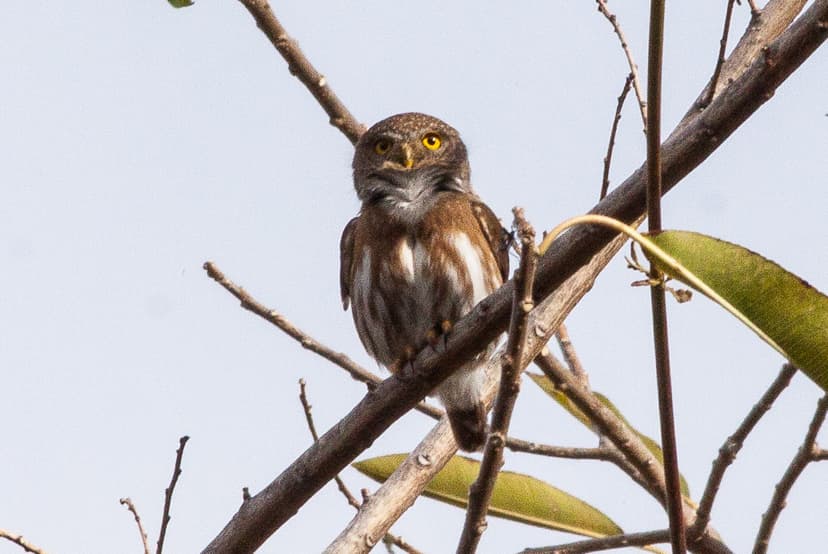
This owl measures approximately 14 to 14.5 cm (5.5 to 5.7 inches) in length. It exists in two color variations: a common brown morph and a less frequent rufous morph. Adults of the brown morph are characterized by a grayish-brown crown adorned with conspicuous white spots on both the crown and the sides of the face. Similar to other Glaucidium pygmy owls, its nape displays black "false eyes." The back and rump are dark brown, while the tail is blackish with irregular white bands. The underside is white, marked by broad, muted reddish-olive brown streaks. The specific characteristics of juvenile plumage have not yet been documented.
The subtropical pygmy owl inhabits humid montane forests. Its elevational range varies by country, from 1,100 to 2,000 meters in Ecuador, 950 to 1,600 meters in Peru, and 600 to 1,600 meters in Bolivia.
Behavior and Diet
This owl exhibits activity both during the day and at night. While specific details about its diet are not published, it is presumed to consume large arthropods and small vertebrates, a common feeding pattern for owls of its size.
Vocalization
The vocalization of the subtropical pygmy owl is described as consisting of "three or four short phrases," typically ranging from two to six phrases with several seconds between them. These phrases are of a low tone, with the final two notes, "hu-hu," increasing in pitch when ending, and a noticeable hesitation before the last note.
Status
The International Union for Conservation of Nature (IUCN) has classified the subtropical pygmy owl as Least Concern. Although its population size remains unknown, it is believed to be stable.
Source: Wikipedia ↗
Frequently Asked Questions
What is the scientific name of the subtropical pygmy owl?
The scientific name of the subtropical pygmy owl is Glaucidium parkeri. This binomial name is used to classify the species within the scientific community.
Where is the subtropical pygmy owl found?
The subtropical pygmy owl is found on the east slope of the Andes mountains, ranging from southwestern Colombia through Ecuador and Peru to central Bolivia. It inhabits humid montane forests within these regions.
What does the subtropical pygmy owl look like?
Adults typically have a grayish-brown crown with prominent white spots on the crown and sides of the face. Its back and rump are dark brown, and its tail is blackish with spotty white bands. The underparts are white with broad, dull reddish-olive brown streaks.
What is the conservation status of the subtropical pygmy owl?
The subtropical pygmy owl is listed as Least Concern by the IUCN. Its population size is currently unknown but is believed to be stable.
What is the typical size of a subtropical pygmy owl?
The subtropical pygmy owl is a small owl, measuring about 14 to 14.5 cm (5.5 to 5.7 inches) in length. Male individuals have been recorded with an average weight of approximately 61.6 g (2.17 oz).
What does the subtropical pygmy owl eat?
While nothing has been formally published on its diet, it is presumed to feed on large arthropods and small vertebrates. This assumption is based on the feeding habits of similar owl species.
Related Owl species

Central American pygmy owl
The Central American pygmy owl (Glaucidium griseiceps) is a small owl species native to the humid tropical forests and secondary growth areas of Central America and northwestern Colombia. It is distinguished by its small size, spotted crown, and the presence of dark "false eyes" on its nape, which are thought to deter predators. This owl is known to hunt both during the day and at night.
Colima pygmy owl
The Colima pygmy owl is a small owl species endemic to western Mexico, found in various forest types and coffee plantations. It is characterized by its brown plumage with white spots, distinctive "eyebrows," and a unique hooting song. While primarily nocturnal, it also exhibits daytime activity.

Cuban pygmy owl
The Cuban pygmy owl (Glaucidium siju) is a small owl species endemic to Cuba, recognized for its two color morphs: gray-brown and rufous. It inhabits various forest types and open areas across the island, from sea level to high elevations. This owl is notable for its active hunting during both day and night, feeding on a varied diet of insects, reptiles, small mammals, birds, and frogs.