
Verreaux's eagle-owl
Verreaux's eagle-owl, also known as the milky eagle owl, is the largest owl species in Africa, distinguished by its bright pink eyelids. This large, powerful owl inhabits dry, wooded savannas across sub-Saharan Africa and is a highly opportunistic predator with a diverse diet. Despite its size and territorial nature, it is considered of Least Concern due to its adaptability and wide distribution.
Key Facts
- ›Largest owl species in Africa.
- ›Distinctive bright pink eyelids are unique among owl species.
- ›Primarily inhabits dry, wooded savannas across sub-Saharan Africa.
- ›A highly opportunistic predator with a diet including mammals, birds, and insects.
- ›Considered of Least Concern by the IUCN due to its wide range and adaptability.

Milky Eagle Owl, Giant Eagle Owl
- Dry, wooded savanna
- Savanna with scattered trees
- Thorny vegetation
- Riverine forest adjacent to savanna
- Small, semi-open woodland surrounded by open country
- Floodplains
- Marshes
- Riparian woodlands
Sub-Saharan Africa
Mammals, Birds, Insects, Hedgehogs, Ungulates
None
About Verreaux's eagle-owl
Verreaux's eagle-owl (Ketupa lactea), also commonly known as the milky eagle owl or giant eagle owl, holds the distinction of being the largest owl species native to Africa. This imposing bird is primarily found in dry, wooded savannas across sub-Saharan Africa, where it is a resident species. Its appearance is marked by a generally grey plumage, but it is most famously and uniquely distinguished by its bright pink eyelids, a feature not shared by any other owl species.
Physical Characteristics and Size
Despite the common name 'giant eagle-owl,' Verreaux's eagle-owl is not the largest owl globally but is indeed the largest in Africa and the largest owl found in the tropics. It ranks as the fourth heaviest living owl worldwide. Total length typically ranges from 58 to 66 cm (23 to 26 inches). There is significant sexual dimorphism, with females being considerably larger and heavier than males, sometimes by as much as 35%. Wingspans can reach up to nearly 164 cm (5 ft 5 in) in females. Its plumage is a relatively uniform pale grey, with fine brownish vermiculations underneath and white spots on the back. The facial disc is paler, bordered by black, and its eyes are dark brown. The ear-tufts are present but are described as blunter and smaller compared to those of other African eagle-owls.
Diet and Hunting Behavior
Verreaux's eagle-owl is a highly opportunistic predator, a trait common among its genus. Its diet is remarkably diverse, with mammals constituting just over half of its known prey. However, it also hunts birds and insects in significant numbers, depending on local availability. Studies have identified over 100 prey species, ranging from insects weighing less than 5 grams to ungulates weighing at least 10 kg (22 lbs). Hedgehogs are a particular favorite, with the owl being one of the few predators that routinely tackles these spiny mammals. Hunting typically occurs at night, with the owl often perching and then gliding down onto its unsuspecting prey. It is also capable of hunting on the wing and ambushing prey in dense foliage or shallow water.
Habitat and Distribution
This species inhabits a vast area of sub-Saharan Africa, though it avoids the deep rainforests. Its preferred habitat is savanna with scattered trees and thorny vegetation, often in rather dry or semi-arid regions. They require trees for nesting and hunting, thus avoiding completely open or true desert environments. Riverine forests and small, semi-open woodlands are also utilized. Verreaux's eagle-owls can be found from sea level up to elevations around 3,000 meters (9,800 ft), though they are less common in mountainous regions. While historically absent from the Kalahari Desert, the introduction of invasive trees and irrigation has led to their sporadic presence there.
Vocalizations and Behavior
The call of the Verreaux's eagle-owl is exceptionally deep, ranking among the deepest bird calls in the world. The male's song is a distinctive 'gwok, gwok, gwonk-gwokwokwok gwokwokwok gwonk,' which can be confused with the sound of a leopard. The female's call is similar but higher pitched. Alarm calls are typically a sonorous 'whok' or 'hook.' These owls are nocturnal, roosting in trees during the day, often on large, shaded branches. They are territorial, with breeding pairs defending large areas. Family groups, sometimes including young from previous years, have been observed roosting together.
Conservation Status
Verreaux's eagle-owl is classified as 'Least Concern' by the IUCN. This status reflects its wide distribution across sub-Saharan Africa and its demonstrated adaptability to human-induced habitat changes and variations in prey populations. Despite its large size and territorial nature, it maintains a healthy population across its range.
Source: Wikipedia ↗
Frequently Asked Questions
What is Verreaux's eagle-owl known for?
Verreaux's eagle-owl is most notably recognized as the largest owl species in Africa and is distinguished by its unique bright pink eyelids. It is a powerful, opportunistic predator found in savanna habitats.
Where does Verreaux's eagle-owl live?
This species is widespread throughout sub-Saharan Africa, preferring dry, wooded savannas with scattered trees. They are found from western Africa eastward to East Africa and southward through much of southern Africa, avoiding deep rainforests.
What does Verreaux's eagle-owl eat?
Verreaux's eagle-owl is a highly opportunistic predator with a varied diet. While mammals, particularly hedgehogs, form a significant part of its diet, it also consumes birds, insects, and other appropriately sized prey.
How large is Verreaux's eagle-owl?
It is the largest owl in Africa, measuring up to 66 cm (26 inches) in total length. Females are significantly larger and heavier than males, exhibiting pronounced sexual dimorphism.
What is the conservation status of Verreaux's eagle-owl?
Verreaux's eagle-owl is listed as 'Least Concern' by the IUCN. This is due to its extensive geographic range and its ability to adapt to human-altered habitats and prey availability.
What makes Verreaux's eagle-owl stand out physically?
The most distinctive physical feature of Verreaux's eagle-owl is its bright pink eyelids, a trait not found in any other owl species. It also possesses dark brown eyes and relatively small ear-tufts.
Related Owl species
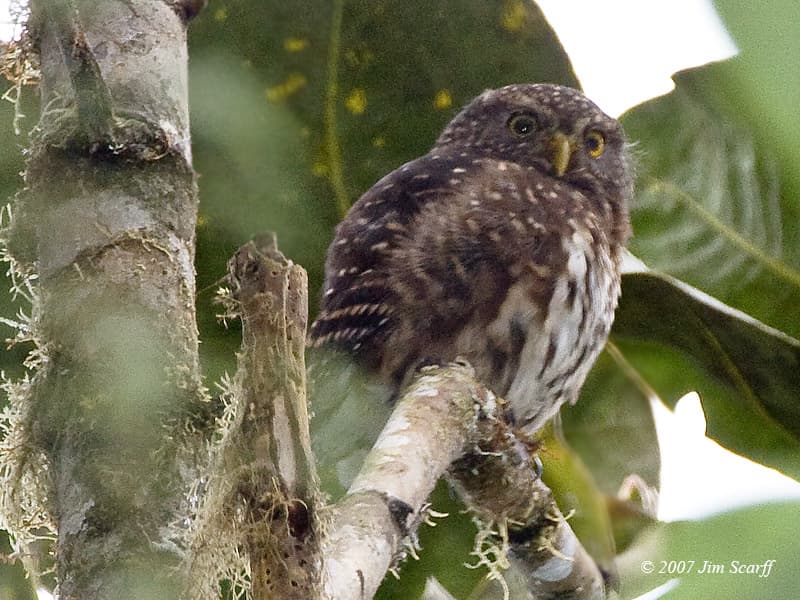
Andean pygmy owl
The Andean pygmy owl is a small owl species native to the Andes mountains of South America, found in countries like Colombia, Ecuador, Peru, and Venezuela. It is distinguished by its two color morphs, white facial markings including prominent "brows" and "moustaches," and a distinctive face-like pattern on its nape. This owl is an opportunistic predator, active both day and night, feeding on a variety of small invertebrates, birds, and mammals.
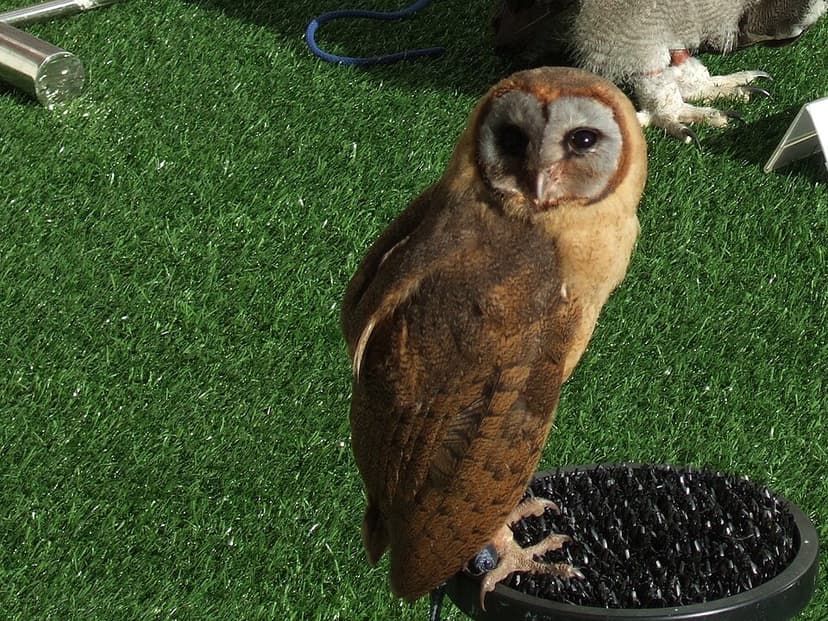
Ashy-faced owl
The ashy-faced owl (Tyto glaucops) is a species of barn owl native to Hispaniola and several islands in the Lesser Antilles. It is distinguished by its silvery-gray facial disc (in the nominate subspecies), a preference for a mix of open hunting spaces and canopy cover, and a varied diet of small vertebrates and invertebrates. This species plays a crucial role as a nocturnal predator in its island ecosystems.

Austral pygmy owl
The austral pygmy owl is a small owl species found in central and southern Chile and parts of southern Argentina. It is distinctive for its gray-brown and red color morphs and its ability to hunt both during the day and at night. This owl is known for its varied vocalizations, including contact whistles, territorial trills, and courtship calls.