
Western barn owl
The Western barn owl (Tyto alba) is a widely distributed owl species native to Europe, southwestern Asia, and Africa. It is distinguished by its characteristic heart-shaped facial disc and its lack of hooting, instead producing an eerie screech. This nocturnal hunter primarily preys on small mammals, locating them with its exceptionally acute hearing.
Key Facts
- ›Native to Europe, southwestern Asia, and Africa.
- ›Features a distinctive heart-shaped facial disc.
- ›Vocalizations include an eerie, drawn-out screech, not a hoot.
- ›Primarily nocturnal hunter of small mammals, located by sound.
- ›Typically mates for life.
- ›IUCN conservation status is Least Concern globally, though some subspecies are more threatened.

White Owl, Silver Owl, Demon Owl, Ghost Owl, Death Owl, Night Owl, Rat Owl, Church Owl, Cave Owl, Stone Owl, Monkey-Faced Owl, Hissing Owl, Hobgoblin, Hobby Owl, Dobby Owl, White-Breasted Owl, Golden Owl, Screech Owl, Straw Owl, Barnyard Owl, Delicate Owl
Open Country, Interspersed Woodland, Holes In Trees, Fissures In Cliff Faces, Old Buildings, Disused Buildings, Chimneys, Haysheds
Europe, Southwestern Asia, Africa
Small Mammals, Insects, Bats, Birds, Lizards, Amphibians, Geckos, Termites, Orthoptera, Frogs, Snakes
About Western barn owl
The Western barn owl, scientifically known as Tyto alba, is a widely recognized owl species native to Europe, southwestern Asia, and Africa. This owl is easily identified by its striking, large, heart-shaped facial disc and its pale plumage, which ranges from mottled grey and brown on its upperparts to white or buff on its underparts. Unlike many other owl species, the Western barn owl does not hoot; instead, it vocalizes with a distinctive, eerie, and drawn-out screech.
Behavior and Ecology
Primarily a nocturnal and crepuscular hunter, the Western barn owl relies heavily on its exceptionally acute hearing to locate prey, which consists mainly of small mammals such as voles and shrews. Its hunting flights are characterized by an effortless, wavering pattern, and its flight feathers are adapted to be nearly silent, aiding in stealthy approaches to prey. While generally nocturnal, in areas like Great Britain, it has been observed hunting during the day, especially when weather conditions at night make foraging difficult.
Western barn owls are typically monogamous, forming pair bonds that often last a lifetime, though new bonds can form if one partner dies. They are cavity nesters, preferring to make their homes in hollow trees, cliff fissures, or abandoned buildings like old churches and farm sheds. The breeding season varies geographically, often coinciding with periods of abundant prey. Females lay clutches averaging around five chalky-white eggs, which are incubated by the female while the male provides food.
Conservation and Significance
Globally, the Western barn owl is listed as Least Concern by the IUCN, reflecting its widespread distribution and adaptability. However, some subspecies with more restricted ranges face greater threats. Due to their significant consumption of rodents, which are often considered agricultural pests, Western barn owls are considered highly beneficial to agriculture, playing a crucial role in natural pest control.
Source: Wikipedia ↗
Frequently Asked Questions
What is the scientific name of the Western barn owl?
The scientific name of the Western barn owl is Tyto alba. It was first formally described in 1769 by Giovanni Antonio Scopoli under the binomial name Strix alba.
What does the Western barn owl look like?
The Western barn owl is a medium-sized, pale owl with long wings and a short tail. Its plumage is mottled grey or brown on the back and head, and white to brown on the underparts. It has a large, heart-shaped facial disc with white plumage and black eyes.
What sounds does the Western barn owl make?
Unlike many other owls, the Western barn owl does not hoot. Instead, it produces a characteristic piercing screech, an eerie, long-drawn-out shriek. Both young and old can also hiss to deter intruders.
What does the Western barn owl eat?
The diet of the Western barn owl primarily consists of small mammals, particularly voles and shrews in Europe, and mice and rats in the Mediterranean region. They may also consume bats, birds, lizards, amphibians, and insects depending on local availability.
Where does the Western barn owl live?
The Western barn owl is found across Europe (excluding Fennoscandia and Malta), most of Africa (excluding the Sahara), and southwestern Asia east to western Iran. It prefers open country such as farmland and grassland with interspersed woodland.
How does the Western barn owl hunt?
The Western barn owl hunts by flying slowly at low altitudes, quartering the ground and listening intently for prey. Its hearing is extremely acute, allowing it to locate small mammals even in complete darkness. It also uses branches and fence posts as lookouts.
What are the nesting habits of the Western barn owl?
Western barn owls are cavity nesters, typically choosing holes in trees, cliff fissures, or old buildings like farm sheds and church towers. They do not use nesting material but form a carpet of regurgitated pellet material around the eggs and chicks.
Related Owl species

Australian boobook
The Australian boobook (Ninox boobook) is the smallest owl species native to mainland Australia, also found in southern New Guinea, Timor, and the Sunda Islands. It is distinguished by its characteristic "boo-book" call and its predominantly dark-brown plumage marked with pale spots. This nocturnal hunter primarily preys on insects and small vertebrates, nesting in tree hollows and is considered of least concern by the IUCN.
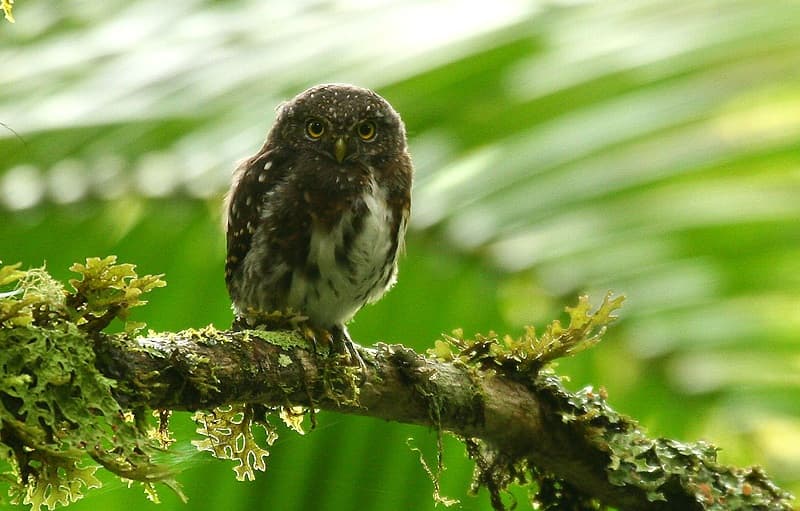
Costa Rican pygmy owl
The Costa Rican pygmy owl is a small owl species found in the montane forests of Costa Rica and Panama. It is known for its distinctive "eye spots" on the back of its head and its varied vocalizations. This species is a year-round resident and forages for prey both day and night.

Morepork
The morepork, also known by its Māori name ruru, is a small brown owl native to New Zealand and Norfolk Island, with a former presence on Lord Howe Island. It is distinguished by its dark-brown plumage with pale spots, golden-yellow eyes, and a distinctive "more-pork" call. This generally nocturnal owl hunts insects and small vertebrates by perching and pouncing, demonstrating excellent night vision and hearing.