
White-throated screech owl
The white-throated screech owl is a small owl native to the Andes mountains of South America, specifically found in Bolivia, Colombia, Ecuador, Peru, and Venezuela. It is distinguished by its overall dark plumage, round head with small ear tufts, and a prominent white area below its bill that can resemble large moustaches. This owl is nocturnal and primarily forages for insects and other arthropods in the forest canopy.
Key Facts
- ›Inhabits montane forests and cloud forests at elevations typically between 2,000 and 3,000 meters.
- ›Possesses a round head with very small ear tufts and a distinctive white patch below its bill.
- ›Prey consists mainly of insects and other arthropods, with potential for small vertebrates.
- ›Nesting behavior is unusual for its genus, with reports of ground nesting or using old nests of other species.
- ›Its primary male song is described as gruff, barked notes.
- ›Classified as Least Concern by the IUCN, with a presumed stable population.

White-Throated Screech Owl
Open Humid Evergreen Montane Forest, Cloud Forest, Semi-Open Areas With Scattered Trees
Bolivia, Colombia, Ecuador, Peru, Venezuela
Insects, Arthropods, Small Vertebrates
About White-throated screech owl
The white-throated screech owl (Megascops albogularis) is a small owl species found inhabiting the montane forests and cloud forests of the Andes in South America. Its native range spans across Bolivia, Colombia, Ecuador, Peru, and Venezuela, where it typically resides at elevations between 2,000 and 3,000 meters, though it can be found at lower and higher altitudes depending on the region.
Description and Identification
This owl is considered a large member of the Megascops genus. Adults typically measure between 20 to 26 cm in length and weigh between 130 to 185 grams. Its plumage is predominantly dark, featuring a round head with very small ear tufts and a relatively long tail. A distinctive characteristic is the prominent white area below its bill, which can give the appearance of large moustaches. The facial disc is dark, accented by whitish marks above and below its orange eyes. The chest is dark brown with tawny spots, while the belly is tawny with dusky bars and streaks. Juvenile plumage is paler, a buffy gray, and includes a black 'mask' and barring on the crown, mantle, and underparts.
Behavior and Ecology
The white-throated screech owl is a nocturnal hunter, foraging primarily in the forest canopy. Its diet consists mainly of insects and other arthropods, with the possibility of consuming small vertebrates. Information regarding its breeding habits is limited. Unusually for its genus, which often nests in tree cavities, this species has been observed nesting on the ground or utilizing old nests constructed by other bird species.
Vocalizations
Vocalizations are a key aspect of this owl's communication. The primary song attributed to males is described as a series of gruff, barked notes, often rendered as 'churrochurro-churro-chu chu chu chu', and can last for up to a minute. A secondary song involves evenly spaced hoots, approximately five per second. Pairs have been noted to sing in duet, with the female's calls being of a higher pitch than the male's. The female also employs various agitation calls.
Conservation Status
The International Union for Conservation of Nature (IUCN) has assessed the white-throated screech owl as being of Least Concern. While specific population numbers are not known, the species is believed to have a stable population. Its presence in varied Andean forest habitats suggests a need for continued monitoring of these environments.
Source: Wikipedia ↗
Frequently Asked Questions
Where is the white-throated screech owl found?
The white-throated screech owl is found in the Andes mountains of South America. Its range includes Bolivia, Colombia, Ecuador, Peru, and Venezuela.
What does the white-throated screech owl look like?
It is a large owl for its genus, typically dark plumaged with a round head and very small ear tufts. A distinctive feature is a large white area below its bill, which can appear like large moustaches.
What does the white-throated screech owl eat?
This owl is nocturnal and forages in the forest canopy. Its diet primarily consists of insects and other arthropods, and it may also consume small vertebrates.
What are the nesting habits of the white-throated screech owl?
Unlike many other owls in its genus that nest in tree cavities, the white-throated screech owl has been reported to nest on the ground or in abandoned nests of other bird species.
What sounds does the white-throated screech owl make?
Its vocalizations include a primary male song described as gruff, barked notes, such as 'churrochurro-churro-chu chu chu chu'. It also produces evenly spaced hoots and duet songs between pairs, with the female having a higher pitch.
What is the conservation status of the white-throated screech owl?
The white-throated screech owl is currently assessed as Least Concern by the IUCN. Its population is believed to be stable, though the exact numbers are not known.
Related Owl species
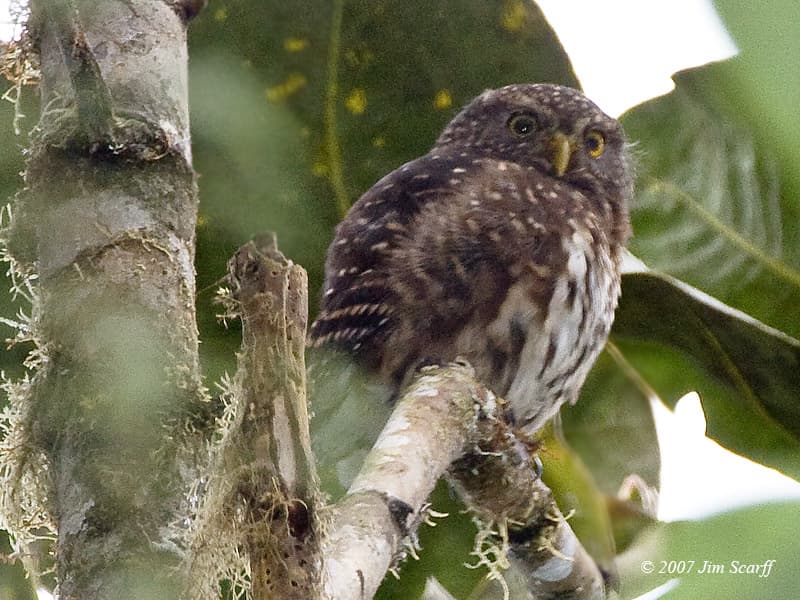
Andean pygmy owl
The Andean pygmy owl is a small owl species native to the Andes mountains of South America, found in countries like Colombia, Ecuador, Peru, and Venezuela. It is distinguished by its two color morphs, white facial markings including prominent "brows" and "moustaches," and a distinctive face-like pattern on its nape. This owl is an opportunistic predator, active both day and night, feeding on a variety of small invertebrates, birds, and mammals.
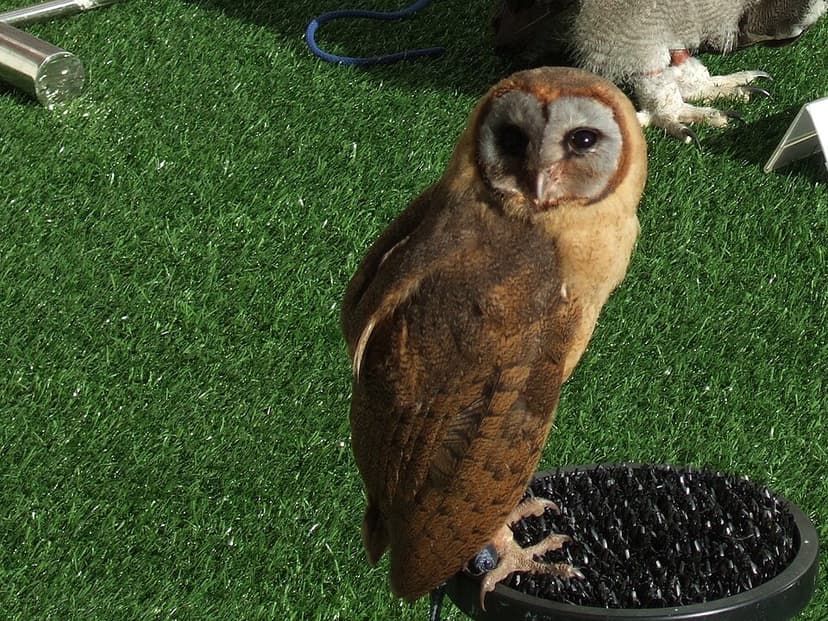
Ashy-faced owl
The ashy-faced owl (Tyto glaucops) is a species of barn owl native to Hispaniola and several islands in the Lesser Antilles. It is distinguished by its silvery-gray facial disc (in the nominate subspecies), a preference for a mix of open hunting spaces and canopy cover, and a varied diet of small vertebrates and invertebrates. This species plays a crucial role as a nocturnal predator in its island ecosystems.

Austral pygmy owl
The austral pygmy owl is a small owl species found in central and southern Chile and parts of southern Argentina. It is distinctive for its gray-brown and red color morphs and its ability to hunt both during the day and at night. This owl is known for its varied vocalizations, including contact whistles, territorial trills, and courtship calls.