
Yungas screech owl
The Yungas screech owl is a species of owl native to the montane forests of Bolivia and Argentina. It is characterized by its small size, distinct "ear" tufts, and varied plumage morphs. This owl is known for its unique duet vocalizations, which are crucial for pair bonding.
Key Facts
- ›Found in moist montane and cloud forests of Bolivia and Argentina.
- ›Measures between 23 to 24 cm in length.
- ›Occurs in brown, gray, and rufous plumage morphs.
- ›Diet primarily consists of insects and spiders, with occasional small vertebrates.
- ›Pairs engage in duet vocalizations, with the female having a higher pitch.
- ›Assessed by the IUCN as Least Concern.

Montane Forest Screech-Owl, Hoy's Screech Owl
Moist Montane Forest, Cloud Forest
Argentina, Bolivia
Insects, Spiders, Small Vertebrates
About Yungas screech owl
The Yungas screech owl (Megascops hoyi), also recognized as the montane forest screech-owl or Hoy's screech owl, is a distinct species of owl found in the high-altitude forests of South America. Its range spans from south-central Bolivia into northwestern Argentina, inhabiting moist montane and cloud forest environments characterized by tall trees and abundant epiphytes.
Description and Appearance
This owl is relatively small, measuring between 23 to 24 centimeters in length. It exhibits a striking polymorphism, appearing in brown, gray, and rufous plumage morphs, which likely aid in camouflage within its varied forest habitat. Key physical characteristics include a gray-brown facial disc, prominent white brows above bright yellow eyes, and small, pointed "ear" tufts. The upperparts are typically brown, with variations in gray or rusty tones depending on the morph, and are marked with fine dark vermiculation and streaks. A distinctive feature on the closed wing is a row of large white spots. The tail is striped and vermiculated with light brown. Its underparts are a lighter shade of gray to gray-brown, often with an ochre wash, and the breast and flanks are marked with noticeable black streaks.
Distribution and Habitat
The Yungas screech owl's geographic distribution is confined to the Andean montane regions of Bolivia and Argentina. It thrives in moist montane forests and cloud forests, typically found at elevations ranging from 1,000 to 2,600 meters, though it has been observed as high as 2,800 meters. These habitats are defined by the presence of tall trees and a rich growth of epiphytes. While largely sedentary, there is evidence suggesting that individuals nesting at higher elevations may undertake seasonal movements to lower altitudes during winter months.
Behavior and Ecology
The foraging behavior of the Yungas screech owl involves hunting on and near the ground, along forest edges, and within the upper canopy of the forest. Its diet is predominantly composed of insects and spiders, though it is also known to consume small vertebrates. Breeding is thought to commence at the start of the rainy season, during September and October. The owls primarily nest in natural tree cavities, often utilizing abandoned woodpecker holes.
Vocalization
A notable aspect of the Yungas screech owl's behavior is its vocalization, particularly the duet performed by pairs. The primary song is described as starting softly, escalating into a rapid staccato of 'u' notes, and then gradually fading. The female's vocalizations are distinctly higher in pitch compared to the male's. A secondary, shorter song is also part of their repertoire.
Conservation Status
The International Union for Conservation of Nature (IUCN) has assessed the Yungas screech owl as a species of Least Concern. This designation reflects its status as not uncommon in certain areas and the protective effect of the inaccessibility of parts of its natural range, which offers a degree of refuge from human disturbance.
Source: Wikipedia ↗
Frequently Asked Questions
What is the scientific name of the Yungas screech owl?
The scientific name of the Yungas screech owl is Megascops hoyi. This binomial name is used to classify the species within the scientific community.
Where is the Yungas screech owl found?
The Yungas screech owl inhabits moist montane forests and cloud forests in south-central Bolivia, specifically in the Cochabamba Department, and extends south into northwestern Argentina, reaching Tucumán Province and possibly Catamarca Province.
What does the Yungas screech owl look like?
This owl is 23 to 24 cm long and can be found in brown, gray, or rufous color variations. It features a gray-brown facial disc, white markings above bright yellow eyes, and small ear tufts. Its upperparts are streaked and vermiculated, while its underparts are lighter with dark streaks on the breast and flanks.
What does the Yungas screech owl eat?
The diet of the Yungas screech owl is believed to consist mainly of insects and spiders. It also occasionally preys on small vertebrates, foraging on or near the ground, at forest edges, and in the upper canopy.
What are the vocalizations of the Yungas screech owl like?
Pairs of Yungas screech owls perform duet songs. The primary song starts softly, builds to a rapid 'u' note staccato, and then fades. The female's voice is distinctly higher in pitch than the male's.
What is the conservation status of the Yungas screech owl?
The Yungas screech owl is listed as Least Concern by the IUCN. Its status is partly attributed to its local abundance in inaccessible parts of its range.
Related Owl species

Boreal owl
The boreal owl, also known as Tengmalm's owl, is a small owl found in the taiga forests of North America and Eurasia. It is distinguished by its pearly-white spots on brown plumage, remarkable confiding nature when encountered, and a unique asymmetrical skull structure that aids in pinpointing prey.
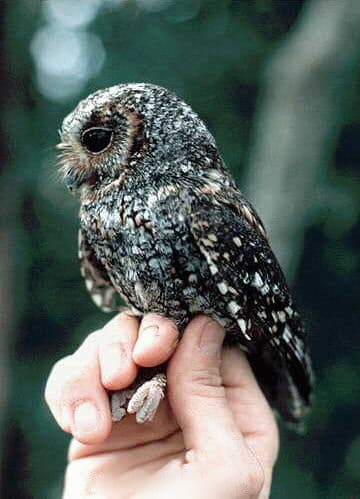
Flammulated owl
The flammulated owl is a small, migratory North American owl known for its flame-colored facial markings. It is the sole member of the genus Psiloscops and is distinguished from similar species by its small ear tufts, dark eyes, and unique hooting vocalization. Primarily an insectivore, it breeds in mature forests across western North America and migrates to Central America for the winter.

Northern boobook
The northern boobook (Ninox japonica) is a hawk owl species native to eastern and southern Asia, belonging to the family Strigidae. Previously considered a subspecies of the brown boobook, it is now recognized as a distinct species, though its taxonomy and subspecies remain subjects of debate. It is notable for being the most common breeding owl in Japan, despite limited research on its populations.