
Green-rumped parrotlet
The green-rumped parrotlet is a small parrot species native to northeastern South America and Trinidad. It is distinguished by its predominantly green plumage, with males exhibiting distinctive blue wing markings, and its preference for semi-open lowland habitats. These gregarious birds are known for their light, twittering calls and form strong pair bonds, though they can be opportunistic in seeking nest sites.
Key Facts
- ›Found in tropical South America, from Colombia and Venezuela east to the lower Amazon River in Brazil, and on Trinidad.
- ›Males have purplish-blue primaries and secondaries, while females lack blue but have more yellow-green on the head.
- ›Prefers open, semi-arid habitats such as dry scrubland, deciduous woodland, and farmland.
- ›Very gregarious, often seen in flocks of up to 100 individuals.
- ›Breeds during the rainy season (May-November) in unlined tree cavities or arboreal termite nests.
- ›Primarily feeds on seeds, flowers, buds, berries, and fruits.

Green-Rumped Parakeet
South America, Caribbean
Semi-Open Lowland Areas, Dry Scrubland, Deciduous Woodland, Gallery Forest, Farmland, Forest Edges, Deforested Areas, City Parks
Males have purplish-blue wing markings, Females have more yellow-green on the head, Zygodactyly
Seeds, Flowers, Buds, Berries, Fruits
Gregarious, Form Strong Pair Bonds, Can Be Opportunistic Regarding Nest Sites
Light, Twittering Calls, Louder, More Penetrating Calls In Flocks, Individually Distinct Contact Calls
Unlined Tree Cavities, Holes In Arboreal Termite Nests, Cavities In Wooden Fence Posts
About Green-rumped parrotlet
The green-rumped parrotlet (Forpus passerinus), also known as the green-rumped parakeet, is a small parrot species found in northeastern South America and the Caribbean island of Trinidad. Its natural range extends from northern Venezuela eastwards to the lower Amazon in Brazil, including Suriname, and it has also been introduced to islands such as Curaçao, Jamaica, and Barbados.
Description and Identification
Measuring approximately 12 cm (4.7 inches) in length and weighing between 20–28 grams, the green-rumped parrotlet is predominantly bright green. A key distinguishing feature is its sexual dimorphism: males display purplish-blue on their primary and secondary wing feathers, along with bright turquoise on the leading edges of their wings. Females, in contrast, lack the blue coloration and often exhibit more yellow-green on their heads. Both sexes have dark brown eyes and light peach beaks and feet. Like all parrots, they possess zygodactyl feet, meaning two toes face forward and two face backward.
Distribution and Habitat
These parrotlets inhabit tropical South America and have established populations on several Caribbean islands. They are common in open, semi-arid lowland environments. Their preferred habitats include dry scrubland, deciduous woodland, gallery forest, farmland, forest edges, and areas that have been deforested. While they are not migratory, they may move locally to find food sources, and they are not typically found at altitudes above 1,800 meters (5,900 ft).
Behavior and Ecology
Green-rumped parrotlets are highly gregarious birds, often seen in flocks of up to 100 individuals, and they roost communally. Their vocalizations consist of light, twittering calls, which become louder and more penetrating when in larger flocks. They have individually distinct contact calls, used for mate recognition, that vary in duration, frequency, and pitch. They form strong pair bonds and are generally monogamous, though they may take new mates if widowed. Competition for nest sites is intense, leading to instances of non-breeding pairs attempting to usurp occupied nests.
Diet
The primary diet of the green-rumped parrotlet consists of seeds from various grasses and forbs. They also supplement their diet with flowers, buds, berries, and fruits, including seeds from fruit trees like Annona species and guava.
Reproduction
The breeding season for green-rumped parrotlets occurs during the rainy season, generally from May to November, with specific subspecies tending to breed in different months. They construct their nests in unlined tree cavities, holes within arboreal termite nests, or cavities in wooden fence posts. Females lay 5–6 small white eggs, and incubation begins after the first egg is laid, leading to asynchronous hatching. The incubation period lasts 18–22 days, and fledging occurs 29–35 days after hatching. The extended nestling period is thought to be influenced by nutrient availability in their habitat. Parents exhibit complex resource allocation strategies, with males often favoring larger chicks and females tending to feed smaller chicks first due to their begging behaviors.
Conservation Status
The green-rumped parrotlet is listed as Least Concern by the IUCN Red List. While its global population size is not precisely known, the species is considered widespread and common. However, there is evidence suggesting that populations are declining, likely due to habitat destruction caused by deforestation.
Aviculture
Green-rumped parrotlets are bred in captivity and kept as pets, although they are less common than some other parrotlet species. Due to restrictions on the import of wild birds, aviculture relies on existing captive populations.
Source: Wikipedia ↗
Frequently Asked Questions
What is the scientific name of the green-rumped parrotlet?
The scientific name of the green-rumped parrotlet is Forpus passerinus. It was first described by Carl Linnaeus in 1758 as Psittacus passerinus before being placed in the genus Forpus.
Where is the green-rumped parrotlet found?
Green-rumped parrotlets are native to tropical South America, including parts of Colombia, Venezuela, the Guianas, and Brazil. They are also found on the Caribbean island of Trinidad and have been introduced to Jamaica, Curaçao, and Barbados.
What are the main physical differences between male and female green-rumped parrotlets?
Male green-rumped parrotlets exhibit sexual dimorphism with purplish-blue primaries, secondaries, and coverts, and bright turquoise on the leading edges of their wings. Females lack these blue markings but often have more yellow-green on their heads.
What kind of habitat does the green-rumped parrotlet prefer?
This species prefers open, semi-arid lowland areas. They are commonly found in dry scrubland, deciduous woodland, gallery forest, farmland, forest edges, and deforested areas.
Are green-rumped parrotlets social birds?
Yes, green-rumped parrotlets are very gregarious and often roost communally. They are frequently seen in flocks that can number up to 100 individuals.
What do green-rumped parrotlets eat?
Their diet consists mainly of seeds from grasses and forbs. They also consume flowers, buds, berries, and fruits, including seeds from trees like Annona and guava.
When do green-rumped parrotlets breed, and where do they nest?
They breed during the rainy season, typically from May to November, with subspecies breeding in different months. Nests are usually made in unlined tree cavities, holes in arboreal termite nests, or cavities in wooden fence posts.
What is the conservation status of the green-rumped parrotlet?
The green-rumped parrotlet is classified as Least Concern by the IUCN Red List. Although populations are decreasing due to habitat destruction, they are considered widespread and common.
Related Parrot species
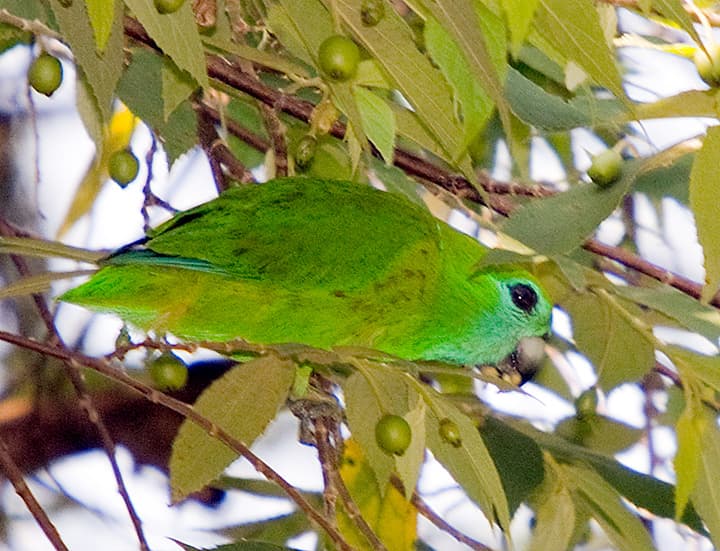
Guaiabero
The Guaiabero is a small, stout parrot endemic to the Philippines, belonging to the monotypic genus Bolbopsittacus and closely related to lovebirds and hanging parrots. Its common name stems from its reputation as a guava-eater, and it is distinctive for its large bill, stubby tail, and sexually dimorphic plumage, with males exhibiting more blue and females having black crescent markings.

Maroon-bellied parakeet
The maroon-bellied parakeet is a small parrot native to southeastern Brazil, Paraguay, Uruguay, and northeastern Argentina. It is notable for its predominantly green plumage, a distinctive maroon patch on its belly, and a scaly breast pattern. This species is also known as the reddish-bellied parakeet or various conure names in aviculture and is generally common in its natural woodland and forest edge habitats.
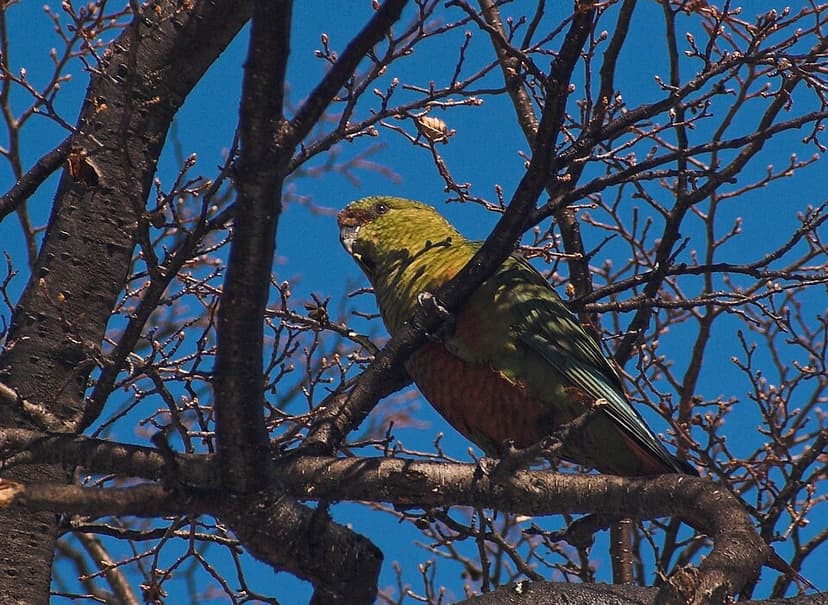
Austral parakeet
The Austral parakeet, also known as the cachaña or emerald parakeet, is a species of parrot native to the southern reaches of South America, primarily Argentina and Chile. It is distinguished by its predominantly green plumage with dull reddish markings on its forehead, belly, and tail, and is notable for being the southernmost parrot species in the world.