
Maroon-bellied parakeet
The maroon-bellied parakeet is a small parrot native to southeastern Brazil, Paraguay, Uruguay, and northeastern Argentina. It is notable for its predominantly green plumage, a distinctive maroon patch on its belly, and a scaly breast pattern. This species is also known as the reddish-bellied parakeet or various conure names in aviculture and is generally common in its natural woodland and forest edge habitats.
Key Facts
- ›Primarily green with a maroon belly patch and a scaly breast.
- ›Ranges from 25 to 28 cm in length.
- ›Found in woodland and forest edges, tolerating urban environments.
- ›Feeds mainly on fruits, flowers, and plant matter.
- ›Typically travels in small flocks of 6–12 individuals.
- ›Considered common and not threatened by the IUCN.

Reddish-Bellied Parakeet, Maroon-Bellied Conure, Reddish-Bellied Conure, Brown-Eared Conure
South America
Woodland, Forest Edges, Urban Parks
- Maroon Patch On the Belly
- Scaly Yellow-Green-Barred Breast and Sides of Neck
- Whitish Ear-Patch Often Tinged Brown
- Dark Maroon Frontlet
Fruits, Flowers, Plant Matter
Can learn to talk, though not clearly, Among the quietest conures, Shrill voices
About Maroon-bellied parakeet
The maroon-bellied parakeet, scientifically known as Pyrrhura frontalis, is a small parrot species native to South America. Its natural range spans from southeastern Brazil, through eastern Paraguay and Uruguay, and into north-eastern Argentina. This species is also recognized by other common names such as the reddish-bellied parakeet, and in aviculture, it is frequently referred to as the maroon-bellied conure, reddish-bellied conure, or brown-eared conure.
Description and Identification
These birds typically measure between 25 and 28 centimeters in length. Their plumage is predominantly green, accented by a distinctive maroon patch on the belly, which gives the species its name. The breast and sides of the neck feature a characteristic 'scaly' pattern of yellow and green bars. A whitish ear-patch, often tinged with brown, and a maroon undertail further contribute to its identification. A key feature that helps distinguish it from similar species is a dark maroon frontlet on its forehead, as indicated by the specific epithet frontalis.
Distribution and Habitat
The maroon-bellied parakeet is commonly found in woodland and at forest edges. While it inhabits lowlands up to 1,000 meters in many areas, in the northern parts of its range, it can be found in highlands up to 1,400 meters. This species demonstrates a notable tolerance for human-altered environments, often living in urban parks in cities like Rio de Janeiro and São Paulo, and can be observed feeding in gardens. They are generally found in small flocks, usually comprising 6 to 12 individuals, though larger gatherings of up to 40 have been reported.
Diet and Behavior
As with other members of the genus Pyrrhura, the maroon-bellied parakeet's diet primarily consists of fruits, flowers, and other plant matter. They are not typically inclined to join mixed-species feeding flocks. Although they can learn to mimic speech, their vocalizations are not always clear. While considered among the quieter conure species, their shrill calls can still be noticeable.
Conservation Status
The maroon-bellied parakeet is generally considered common throughout its distribution. As a result, it is not currently listed as threatened by the IUCN. While there is limited international trade in these parrots, captive-bred individuals are occasionally available in the pet trade.
Source: Wikipedia ↗
Frequently Asked Questions
What are the main physical characteristics of the maroon-bellied parakeet?
The maroon-bellied parakeet is predominantly green, measuring 25 to 28 cm in length. It is distinguished by a maroon patch on its belly, a breast and neck sides with a scaly yellow-green pattern, and a maroon undertail. A dark maroon frontlet is a key feature separating it from similar species.
Where is the maroon-bellied parakeet found in the wild?
This species is found from southeastern Brazil through eastern Paraguay and Uruguay, extending to north-eastern Argentina. It inhabits woodland and forest edges, and can even be found in urban parks like those in Rio de Janeiro and São Paulo.
What does the maroon-bellied parakeet eat?
The diet of the maroon-bellied parakeet primarily consists of fruits, flowers, and other plant matter. They are not typically observed participating in mixed-species feeding flocks.
Are maroon-bellied parakeets social birds?
Yes, maroon-bellied parakeets are social and typically travel in flocks. These flocks are usually small, consisting of 6 to 12 individuals, though larger groups of up to 40 have been observed.
What is the conservation status of the maroon-bellied parakeet?
The maroon-bellied parakeet is generally common throughout its range and is not considered threatened by the IUCN. While there is some trade, captive-bred birds are occasionally available as pets.
Can maroon-bellied parakeets talk?
Maroon-bellied parakeets have the ability to learn to talk, though their vocalizations are not always clear. They are known for being among the quieter conure species, but their shrill voices can still be noticeable.
Related Parrot species

Green-rumped parrotlet
The green-rumped parrotlet is a small parrot species native to northeastern South America and Trinidad. It is distinguished by its predominantly green plumage, with males exhibiting distinctive blue wing markings, and its preference for semi-open lowland habitats. These gregarious birds are known for their light, twittering calls and form strong pair bonds, though they can be opportunistic in seeking nest sites.
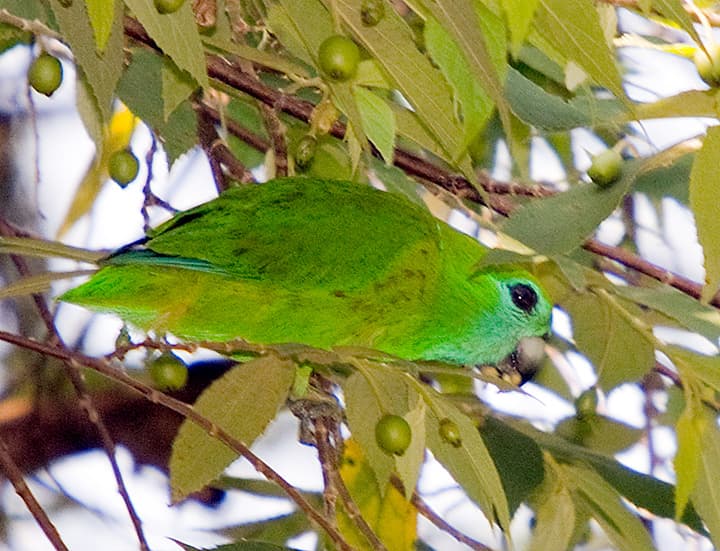
Guaiabero
The Guaiabero is a small, stout parrot endemic to the Philippines, belonging to the monotypic genus Bolbopsittacus and closely related to lovebirds and hanging parrots. Its common name stems from its reputation as a guava-eater, and it is distinctive for its large bill, stubby tail, and sexually dimorphic plumage, with males exhibiting more blue and females having black crescent markings.

Blaze-winged parakeet
The blaze-winged parakeet is a species of parrot found in parts of Brazil, Bolivia, Paraguay, and potentially Argentina. It is characterized by its mostly green plumage with distinctive red and yellow markings on its wings and a maroon belly. This species inhabits the Pantanal and Chaco regions, primarily in deciduous and gallery forests, and is known for its noisy, chattering vocalizations, especially in flight.