
Plain parakeet
The plain parakeet is a species of bird endemic to Brazil, belonging to the Psittacidae family. It is distinctive for its predominantly green plumage with bluish and yellowish tinges on its nape and undersides, respectively, and a bronzy shoulder. This adaptable species inhabits various environments within the Atlantic Forest biome, including urban parks and secondary forests, and is known for its vocal nature.
Key Facts
- ›Endemic to Brazil, inhabiting the Atlantic Forest biome.
- ›Predominantly green plumage with bluish nape and yellowish undersides.
- ›Feeds on seeds, fruits, flowers, nectar, and insects.
- ›Nests in tree cavities.
- ›IUCN conservation status is Least Concern.
- ›Commonly found in urban areas, including large cities like Rio de Janeiro and São Paulo.

Plain Parakeet
Brazil
Atlantic Forest Biome, Secondary Forest, Cultivated Land With Groves of Trees, Plantations, Urban Parks, Edges and Canopy of Montane Rainforest
Green, Blue, Yellowish, Bronzy Green, Brownish Green, Bluish Green
Bluish Tinge On Nape, Yellowish Tinge On Undersides, Bronzy Or Brownish Green Shoulder, Bluish Green Flight Feathers, Bluish Green Underside of Tail
Seeds, Fruit, Flowers, Nectar, Insects
Vocal
High-Pitched Shrill "Cree", Bisyllabic "Cra-Creep", Lower-Pitched, Harsh-Sounding "Cra-Cra-Cra", Calls From Perch and In Flight, Members of A Flock Often Call Simultaneously
Cavities In Trees
About Plain parakeet
The plain parakeet, scientifically known as Brotogeris tirica, is a species of bird endemic to Brazil and a member of the Psittacidae family. Its typical length ranges from 23 to 25 cm with a weight of approximately 63 grams. The plumage is predominantly green, distinguished by a bluish tinge on the nape and a yellowish hue on its undersides, with a bronzy or brownish-green shoulder. The flight feathers and the underside of the tail display a bluish-green coloration.
Distribution and Habitat
This adaptable species is found throughout eastern Brazil, extending from Alagoas southward to Santa Catarina, and also has an isolated population in Rio Grande do Sul. The plain parakeet primarily inhabits the Atlantic Forest biome. It thrives in secondary forests, cultivated areas with tree groves, plantations, and urban parks, demonstrating a notable presence even in large metropolises like Rio de Janeiro and São Paulo. They can also be found in the edges and canopy of montane rainforests at elevations up to 1,200 meters.
Behavior and Diet
Plain parakeets are known to make some local seasonal movements, though these are not fully defined. Their diet is varied, consisting mainly of seeds, fruits, flowers, and nectar gathered from a wide array of plants and trees. They also supplement their diet with adult and larval insects.
Breeding and Vocalization
The breeding season for the plain parakeet is believed to occur between September and December, potentially extending beyond these months. They nest in natural cavities found within trees. In captivity, a clutch typically consists of four eggs, with an incubation period of about 26 days and fledging occurring around seven weeks after hatching. Their vocalizations are characterized by a rather high-pitched shrill "cree" or bisyllabic "cra-creep", as well as a lower-pitched, harsh-sounding "cra-cra-cra". These calls are emitted both when perched and in flight, with members of a flock frequently vocalizing simultaneously.
Conservation Status
The International Union for Conservation of Nature (IUCN) has assessed the plain parakeet as Least Concern. Despite having a somewhat limited range and an unquantified population size, the population is believed to be stable. The species shows a high tolerance for environmental changes, more so than many other parrots endemic to southeastern Brazil, and is present in numerous protected areas, indicating no immediate conservation threats.
Source: Wikipedia ↗
Frequently Asked Questions
What is the scientific name for the plain parakeet?
The scientific name for the plain parakeet is Brotogeris tirica. It was first described by Johann Friedrich Gmelin in 1788, initially placed in the genus Psittacus before being moved to the genus Brotogeris.
Where is the plain parakeet found?
The plain parakeet is endemic to Brazil, found in eastern Brazil from Alagoas south to Santa Catarina, with an isolated population in Rio Grande do Sul. It inhabits the Atlantic Forest biome and is common in urban areas.
What does a plain parakeet eat?
The diet of the plain parakeet primarily consists of seeds, fruits, flowers, and nectar from a wide variety of plants and trees. They also consume some adult and larval insects.
What are the physical characteristics of a plain parakeet?
Adult plain parakeets are about 23 to 25 cm long and weigh around 63 grams. They have an essentially all-green body, with a bluish tinge on the nape and a yellowish tinge on the undersides. Their shoulders are bronzy or brownish-green, and their flight feathers and the underside of their tail are bluish-green.
What is the conservation status of the plain parakeet?
The plain parakeet is assessed by the IUCN as Least Concern. While its exact population size is unknown, it is believed to be stable, and no immediate threats have been identified. It tolerates environmental changes well and is present in many protected areas.
What sounds do plain parakeets make?
Plain parakeets have vocalizations that include a high-pitched shrill "cree" or bisyllabic "cra-creep", and a lower-pitched, harsh-sounding "cra-cra-cra". These calls are made both when perched and in flight, and flock members often vocalize simultaneously.
Related Parrot species
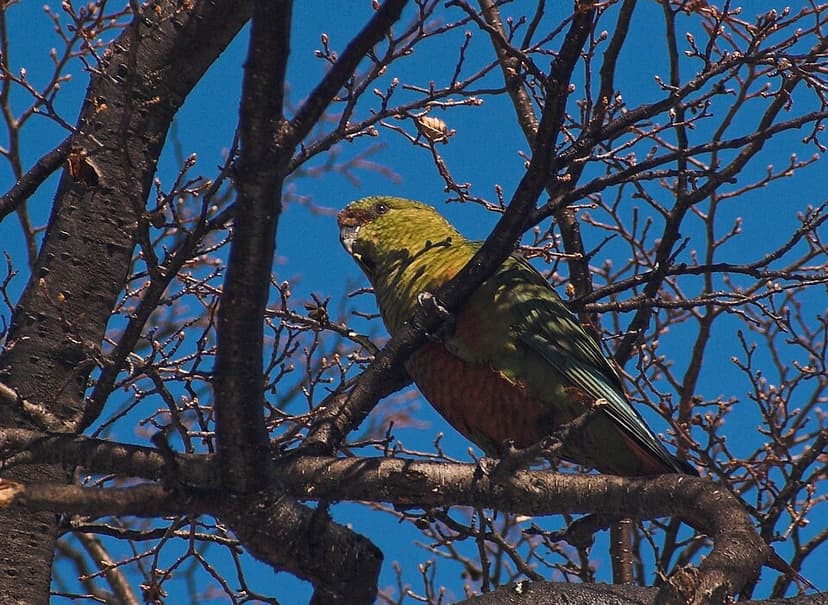
Austral parakeet
The Austral parakeet, also known as the cachaña or emerald parakeet, is a species of parrot native to the southern reaches of South America, primarily Argentina and Chile. It is distinguished by its predominantly green plumage with dull reddish markings on its forehead, belly, and tail, and is notable for being the southernmost parrot species in the world.

Guadeloupe amazon
The Guadeloupe amazon (Amazona violacea) is a hypothetical extinct species of parrot believed to have been native to Guadeloupe in the Lesser Antilles. Described by 17th and 18th-century writers, it was characterized by violet or slate-colored head and underparts, greenish back, and wings with green, yellow, and red. Its extinction is attributed to hunting by French settlers and habitat destruction.

Golden-mantled racket-tail
The golden-mantled racket-tail is a species of parrot endemic to Indonesia, found in lowland and montane moist forests. It is distinguished by its green plumage, an orange collar across the mantle in males, and elongated central tail feathers that form "rackets" with black tips.