
Black-collared lovebird
The black-collared lovebird, also known as Swindern's lovebird, is a small African parrot characterized by a distinctive black band around its neck and a dark greyish-black bill. It is primarily found in the dense tropical rainforests of Africa. This species is rarely kept in captivity due to its specific dietary needs, particularly its reliance on native figs.
Key Facts
- ›Small parrot, approximately 13.5 cm (5 inches) long, belonging to the genus Agapornis.
- ›Native to the tropical closed rainforests of Africa, with a wide distribution.
- ›Distinguished by a black collar on its nape, brownish-red chest, and a dark greyish-black bill.
- ›Both male and female birds share similar coloring; juveniles lack the distinct black collar.
- ›Rarely kept as pets due to a specialized diet requiring native fig seeds or flesh.
- ›Considered to be of Least Concern by the IUCN Red List, despite being rare in some parts of its range.
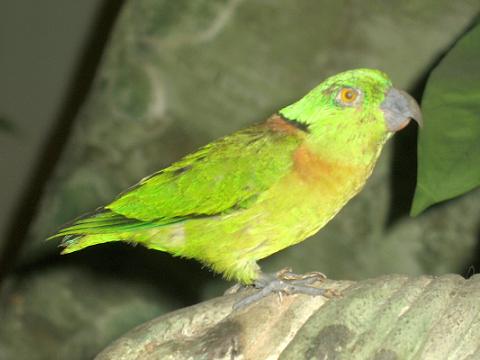
Swindern's Lovebird
Africa
African Tropical Closed Rainforest, Mature and Secondary Subtropic Lowlands, Close-To-Sea-Level Environments, Gallery Forests, Forest Canopy
Green, Black, Brownish-Red, Dark Greyish-Black, Yellow, Royal Dark Blue, Orange-Red
Black Band On the Nape, Dark Greyish-Black Bill, Yellow Iris, Royal Dark Blue Underside
Fig Seeds, African Fruits, Maize, Seeds, Berries, Insects
Shy
High-Pitched, Discordant "Sri-Lee", Variety of Chattering Noises, Constant Tweeting In Large Groups
About Black-collared lovebird
The black-collared lovebird, scientifically known as Agapornis swindernianus and also referred to as Swindern's lovebird, is a small parrot native to the dense tropical rainforests of Africa. Measuring approximately 13.5 cm (5 inches) in length, this species is recognizable by its predominantly green plumage, accented by a distinct black collar around its nape, a brownish-red chest, and a dark greyish-black bill.
Distribution and Habitat
This lovebird is widespread across the African tropical closed rainforest belt, inhabiting forests in countries including Cameroon, the Republic of Congo, Côte d'Ivoire, Ghana, Liberia, and Uganda. They prefer mature and secondary subtropic lowland forests, typically in environments close to sea level and often found in gallery forests along bodies of water. Black-collared lovebirds are characterized as being very shy and tend to hide high in the forest canopy.
Diet and Behavior
The diet of the black-collared lovebird is specialized, relying heavily on fig seeds and native African fruits such as Rauwolfia, Harungana, and Macaranga, along with maize. They have also been observed to forage for seeds, berries, and insects, including caterpillars and beetle larvae. Although they may feed on ground-level food sources, they are most frequently seen in treetops, making them difficult to observe. Vocalizations are not extensively documented but include a high-pitched, discordant "sri-lee," various chattering noises, and constant tweeting when in groups.
Captivity and Conservation
Black-collared lovebirds are rarely kept as pets due to their specific dietary needs, particularly their reliance on native fig seeds or flesh, without which they do not typically thrive or breed well in captivity. Despite being rare or uncommon in some parts of its extensive range, the species is not considered globally threatened and is evaluated as Least Concern by the IUCN Red List. This status reflects its wide distribution, which makes population estimation challenging but suggests the species is not under significant immediate threat.
Source: Wikipedia ↗
Frequently Asked Questions
What is the scientific name for the black-collared lovebird?
The scientific name for the black-collared lovebird is Agapornis swindernianus. It is also known by the common name Swindern's lovebird.
Where are black-collared lovebirds found in the wild?
Black-collared lovebirds are found across a wide range in African tropical closed rainforests. Their habitat includes forests in countries such as Cameroon, the Republic of Congo, Côte d'Ivoire, Ghana, Liberia, and Uganda.
What does a black-collared lovebird look like?
This parrot is mostly green with a distinctive black collar around its neck. It has a brownish-red chest, a dark greyish-black bill, yellow irises, and grey feet. The bottom of the bird is a royal dark blue.
Why are black-collared lovebirds rarely kept in captivity?
They are rarely kept in captivity because of their specific dietary requirements. They need native fig seeds or fig flesh to thrive and breed well, which can be difficult to provide.
What is the conservation status of the black-collared lovebird?
The black-collared lovebird is listed as Least Concern on the IUCN Red List of Threatened Species. While it is considered rare or uncommon in many parts of its range, its vast distribution suggests the overall population is not under significant threat.
What do black-collared lovebirds eat?
Their diet consists primarily of fig seeds, African fruits like Rauwolfia, Harungana, and Macaranga, and maize. They also forage for seeds, berries, and insects, including caterpillars and beetle larvae.
Related Parrot species

Great green macaw
The great green macaw, also known as Buffon's macaw, is a large, critically endangered parrot found in the tropical forests of Central and South America. It is distinguished by its primarily green plumage, reddish forehead, and pale blue markings, and is the largest parrot in its natural range. Due to habitat loss and other threats, its populations have significantly declined, making conservation efforts crucial.

Golden-capped parakeet
The golden-capped parakeet is a species of parrot endemic to Brazil, inhabiting dry and moist lowland forests, savannas, and plantations. It is distinguished by its predominantly green plumage with a black beak, white eyerings, orange-red belly, and a face that transitions from red to yellow on its crown. This parakeet is recognized as a valuable biological indicator due to its sensitivity to habitat fragmentation and vulnerability.

Grey-cheeked parakeet
The grey-cheeked parakeet, also known as the fire-winged parakeet, is a vulnerable bird species native to Ecuador and Peru. It is distinguished by its predominantly green plumage, pale blue crown, ashy gray cheeks, and striking orange to orange-red underwing coverts. This species inhabits a variety of forest types and scrublands and is known for its noisy, chattering vocalizations.