
Great green macaw
The great green macaw, also known as Buffon's macaw, is a large, critically endangered parrot found in the tropical forests of Central and South America. It is distinguished by its primarily green plumage, reddish forehead, and pale blue markings, and is the largest parrot in its natural range. Due to habitat loss and other threats, its populations have significantly declined, making conservation efforts crucial.
Key Facts
- ›The great green macaw is the second heaviest macaw species and the third heaviest parrot species globally.
- ›It is primarily green with a reddish forehead and pale blue markings on its lower back, rump, and upper tail feathers.
- ›This species is found in wet tropical forests and deciduous tropical forests from Honduras to Ecuador.
- ›Their diet consists of seeds, nuts, fruits, flowers, bulbs, roots, and bark, with a particular reliance on the almendro tree (Dipteryx oleifera) in Costa Rica.
- ›Great green macaws are usually observed in pairs or small groups, but can gather in larger flocks after the breeding season.
- ›They are critically endangered, facing significant threats to their survival.

Buffon's Macaw, Great Military Macaw, Guacamayo VerdelimóN, Guacamayo Verde Mayor, Lapa Verde, Papagayo De Guayaquil
Central America, South America
Wet Tropical Forests, Deciduous Tropical Forests, Lowland Rainforests, Canopy
- Reddish forehead
- Pale blue lower back, rump, and upper tail feathers
- Bare facial skin with lines of small dark feathers
- Smaller, narrower bill in subspecies guayaquilensis
Seeds, Nuts, Fruits, Flowers, Bulbs, Roots, Bark
- Unwary of humans
- Prone to biting if not properly adjusted from a young age
Extremely Loud, Raucous 'Aak, Raak', Loud Squawks and Growls, Creaking Or Groaning Sounds
- Nests in cavities high up in large, tall trees
- Cavities often formed by a large branch breaking off
- Can nest in the same tree as other pairs or other species
- Preferred nesting trees include Dipteryx Oleifera, Vochysia Ferruginea, and Ceiba Trichastandra
About Great green macaw
The great green macaw, scientifically known as Ara ambiguus and also referred to as Buffon's macaw or the great military macaw, is a critically endangered species of parrot native to the tropical forests of Central and South America. This magnificent bird is distinguished by its predominantly green plumage, a striking reddish forehead, and markings of pale blue on its lower back, rump, and upper tail feathers. It holds the distinction of being the largest parrot in its natural range and ranks as the second heaviest macaw species globally.
Distribution and Habitat
Great green macaws inhabit the wet tropical forests of the Atlantic lowlands from Honduras to Panama and Colombia, as well as the Pacific coastal lowlands in Panama, Colombia, and western Ecuador. They also occur in deciduous tropical forests. In Costa Rica, their breeding habitat is almost exclusively non-seasonal, evergreen rainforest, often associated with the almendro tree (Dipteryx oleifera), which is a crucial food and nesting source. They are typically found below 600 meters above sea level during breeding season but may disperse to higher elevations afterward.
Diet and Behavior
In the wild, their diet is diverse, encompassing seeds, nuts, fruits, flowers, bulbs, roots, and bark. They possess a powerful beak well-suited for cracking open large nuts, including those larger than what sympatric scarlet macaws can handle. Great green macaws are generally observed in pairs or small groups of up to eight birds. After the breeding season, they may gather in larger flocks to migrate in search of food. In some areas, particularly Nicaragua, they are noted for being remarkably unwary of humans.
Reproduction and Lifespan
The breeding season typically runs from December to June in Costa Rica and August to October in Ecuador. They usually nest in large trees, often utilizing cavities formed by broken branches. Pairs lay clutches of two to three eggs, which are incubated for about 26 days. Both parents are involved in rearing the young, which fledge after approximately 12 to 13 weeks. Juvenile birds stay with their parents for a significant period after fledging. Great green macaws are long-lived, with a typical lifespan of 50 to 70 years.
Conservation Status
Due to extensive habitat loss and other threats, the great green macaw is classified as critically endangered. Conservation efforts are ongoing to protect its remaining populations and habitats. The species has also been recognized culturally, serving as an emblematic symbol for the city of Guayaquil in Ecuador and the village of El Castillo in Nicaragua.
Source: Wikipedia ↗
Frequently Asked Questions
What is the difference between the great green macaw and the military macaw?
The great green macaw can be easily confused with the military macaw where their ranges overlap. A key morphological distinction for the subspecies guayaquilensis is its smaller, narrower bill compared to the military macaw.
Where do great green macaws primarily live?
They inhabit tropical forests in the Atlantic wet lowlands of Central America from Honduras to Panama and Colombia. In South America, they are found in the Pacific coastal lowlands of Panama, Colombia, and western Ecuador, also occurring in deciduous tropical forests.
What do great green macaws eat?
Their diet is varied, including seeds, nuts, fruits, flowers, bulbs, roots, and bark. In Costa Rica, they heavily rely on the seeds of the almendro tree (Dipteryx oleifera) and Sacoglottis trichogyna.
How are great green macaws identified by their plumage?
They are mainly green with a distinctive reddish forehead. Additional markings include pale blue on the lower back, rump, and upper tail feathers, with the tail itself being brownish-red tipped with very pale blue.
What is the conservation status of the great green macaw?
The great green macaw is classified as critically endangered. This status reflects a severe decline in its populations due to various threats, primarily habitat loss.
What are the vocalizations of the great green macaw like?
They produce an extremely loud, raucous 'aak, raak' sound that can be heard over great distances. Captive birds may also emit loud squawks, growls, and creaking or groaning sounds.
Related Parrot species
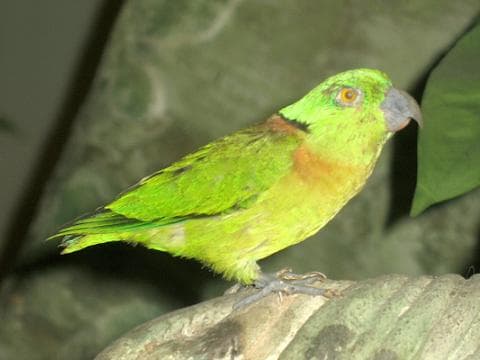
Black-collared lovebird
The black-collared lovebird, also known as Swindern's lovebird, is a small African parrot characterized by a distinctive black band around its neck and a dark greyish-black bill. It is primarily found in the dense tropical rainforests of Africa. This species is rarely kept in captivity due to its specific dietary needs, particularly its reliance on native figs.

Blue-winged racket-tail
The blue-winged racket-tail is a critically endangered parrot species endemic to Tawi-Tawi island in the Philippines. Its plumage is predominantly dark green with blue primary feathers and distinctive racquet-shaped tail feathers. The species faces severe threats from habitat loss and poaching for the illegal pet trade, leading to a drastically reduced population.

Blue-naped parrot
The blue-naped parrot, also known as the blue-crowned green parrot or pikoy, is a medium-sized parrot primarily found throughout the Philippines and the Talaud Islands of Indonesia. Its distinctive plumage includes a light blue crown and nape, contrasting with its predominantly green body. This species faces threats from habitat loss and the pet trade, leading to its classification as near threatened.