
Manu parrotlet
The Manu parrotlet is a small parrot species native to the western Amazon basin, primarily found in lowland forests near bamboo and rivers in Peru, Bolivia, and Brazil. It is distinguished by its bright green plumage with pale blue on its forehead and crown, and its tendency to forage on the ground for seeds, particularly those from bamboo, and to visit clay licks for minerals.
Key Facts
- ›Found in the western Amazon basin, with the majority of its population in Peru.
- ›Inhabits lowland forests, often near bamboo and rivers.
- ›Feeds on seeds, especially from bamboo, and visits clay licks for minerals.
- ›Typically observed in flocks of 5 to 12 individuals.
- ›Plumage is predominantly bright green with pale blue on the forehead and crown.
- ›Classified as 'Least Concern' by the IUCN.

Amazonian Parrotlet
South America
Lowland Forests, Riparian Forests, Forests Near Bamboo, Forests Near Rivers
- Pale Blue Forehead and Anterior Crown
- Paler, Yellowish Green Breast, Belly, and Under-Tail
Seeds, Minerals
Social
Squawking, Peeping
- Possible Nest Observed As A Burrow Among Bromeliads
About Manu parrotlet
The Manu parrotlet, scientifically known as Nannopsittaca dachilleae and sometimes referred to as the Amazonian parrotlet, is a small parrot species native to the western Amazon basin. Its range extends through southern Peru, northwest Bolivia, and into Brazil, where it primarily inhabits lowland and riparian forests, particularly areas rich in bamboo and situated near rivers. The species was first described in 1985 by researchers exploring the Manú River in Peru.
Description and Behavior
Physically, the Manu parrotlet is characterized by its predominantly bright green plumage. Notable features include a pale blue coloration on its forehead and anterior crown, with its breast, belly, and under-tail exhibiting a paler, more yellowish green hue. No sexual dimorphism has been documented for this species. These birds are social, typically observed in flocks ranging from five to twelve individuals, and their vocalizations are described as squawking or peeping sounds.
Diet and Habitat Use
The foraging habits of the Manu parrotlet are quite specific. They are known to feed on seeds, with a particular preference for those dispersed by bamboo of the genus Guadua, often foraging on the ground. A significant aspect of their diet also involves visiting clay licks. These are exposed riverbed banks where the parrots consume sodium and other essential minerals, a behavior observed in groups alongside other parrotlet and parakeet species.
Distribution and Conservation
The Manu parrotlet has a patchy distribution, with Peru hosting the majority of its population. Its preferred habitat consists of riparian forests, often dominated by species such as Calocophyllum spruceanum and Cecropia membranacea. Despite its natural presence, the species faces threats from habitat fragmentation and degradation, largely driven by industrial activities like mining and the development of associated infrastructure such as roads. The International Union for Conservation of Nature (IUCN) currently classifies the Manu parrotlet as 'Least Concern'.
Source: Wikipedia ↗
Frequently Asked Questions
What is the scientific name of the Manu parrotlet?
The scientific name of the Manu parrotlet is Nannopsittaca dachilleae. This name is derived from Greek and Latin, referencing its small size ('dwarf parrot') and the surname of Barbara D'Achille, after whom it was named.
Where does the Manu parrotlet live?
The Manu parrotlet is native to the western Amazon basin, with its distribution spanning southern Peru, northwest Bolivia, and parts of Brazil. It is most commonly found in Peru, occupying lowland forests.
What does the Manu parrotlet eat?
Their diet primarily consists of seeds, especially those left by bamboo of the genus Guadua, which they often forage for on the ground. They also visit clay licks along riverbeds to consume essential sodium and other minerals.
What are the main threats to the Manu parrotlet?
The primary threats to the Manu parrotlet are habitat fragmentation and degradation. These are largely caused by industrial activities, particularly mining, and the associated construction of roads.
What are the physical characteristics of the Manu parrotlet?
The Manu parrotlet is predominantly bright green, with a pale blue coloration on its forehead and anterior crown. Its breast, belly, and under-tail are a paler, more yellowish green. No sexual dimorphism has been described.
Do Manu parrotlets live alone or in groups?
Manu parrotlets are social birds and are consistently observed in flocks. Researchers have noted flocks ranging from 5 to 12 individuals.
Related Parrot species

Great-billed parrot
The great-billed parrot is a medium-sized, primarily green parrot distinguished by its exceptionally large red bill. Native to the forest and mangrove ecosystems of Southeast Asian islands, its diet consists mainly of fruits. It is currently assessed as Least Concern due to its widespread and locally common status.

Blaze-winged parakeet
The blaze-winged parakeet is a species of parrot found in parts of Brazil, Bolivia, Paraguay, and potentially Argentina. It is characterized by its mostly green plumage with distinctive red and yellow markings on its wings and a maroon belly. This species inhabits the Pantanal and Chaco regions, primarily in deciduous and gallery forests, and is known for its noisy, chattering vocalizations, especially in flight.
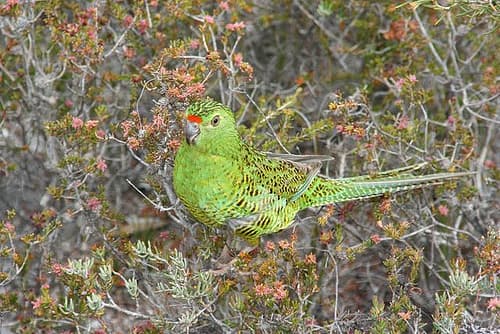
Ground parrot
The ground parrot (Pezoporus wallicus) is a distinctive parrot species endemic to Australia, notable for being one of the few parrots that live primarily on the ground. Its grass-green plumage, marked with black and yellow barring, provides camouflage in its heathland and sedgeland habitats. The species is often identified by its unique whistling call, as it tends to fly low and swiftly when disturbed.