
Great-billed parrot
The great-billed parrot is a medium-sized, primarily green parrot distinguished by its exceptionally large red bill. Native to the forest and mangrove ecosystems of Southeast Asian islands, its diet consists mainly of fruits. It is currently assessed as Least Concern due to its widespread and locally common status.
Key Facts
- ›Approximately 38 cm in length.
- ›Possesses a massive red bill and a cream iris.
- ›Plumage is predominantly green with blackish shoulders, an olive green back, pale blue rump, and yellowish green underparts.
- ›Found in forest, woodland, and mangrove habitats across various Southeast Asian islands.
- ›Diet primarily consists of fruits.
- ›Classified as Least Concern on the IUCN Red List.

Moluccan Parrot, Island Parrot
Southeast Asia
Forest, Woodland, Mangrove
Massive Red Bill, Cream Iris
Fruits
About Great-billed parrot
The Great-billed parrot, scientifically known as Tanygnathus megalorynchos, is a striking medium-sized parrot recognized for its substantial red bill. Also referred to as the Moluccan parrot or island parrot, this species measures approximately 38 centimeters in length. Its plumage is predominantly green, accented by blackish shoulders, an olive green back, a pale blue rump, and yellowish green underparts. A distinctive cream iris complements its prominent bill.
Geographic Distribution and Habitat
This parrot is native to the islands of Southeast Asia, with its range encompassing regions such as Maluku, Raja Ampat, Talaud, Sangir, Sarangani, the Lesser Sundas, and adjacent small islands. Its natural habitat includes forest, woodland, and mangrove environments, where it finds sustenance and shelter. The species remains widespread and locally common within these areas.
Diet and Conservation
The diet of the Great-billed parrot consists primarily of fruits. Due to its widespread distribution and locally fair abundance, the species has been assessed as Least Concern on the IUCN Red List of Threatened Species, indicating it is not currently facing significant threats to its survival.
Taxonomy and Subspecies
The Great-billed parrot was first described by Georges-Louis Leclerc, Comte de Buffon in 1780. The binomial name Psittacus megalorynchos was later coined by Pieter Boddaert in 1783. It is now placed in the genus Tanygnathus, with the genus name derived from Greek words meaning "to stretch out" and "jaw," and the specific epithet referring to its "great bill." Five subspecies are recognized: T. m. megalorhynchus, T. m. affinis, T. m. sumbensis, T. m. hellmayri, and T. m. subaffinis.
Source: Wikipedia ↗
Frequently Asked Questions
What are the distinguishing physical characteristics of the Great-billed parrot?
The Great-billed parrot is a medium-sized parrot, measuring around 38 cm in length. Its most striking feature is its massive red bill. It also has a cream iris, blackish shoulders, an olive green back, a pale blue rump, and yellowish-green underparts.
Where is the Great-billed parrot found naturally?
This parrot species is native to the islands of Southeast Asia. Its range includes Maluku, Raja Ampat, Talaud, Sangir, Sarangani, the Lesser Sundas, and nearby smaller islands.
What is the typical habitat of the Great-billed parrot?
The Great-billed parrot inhabits forest, woodland, and mangrove environments. These ecosystems provide the necessary resources for its survival and foraging.
What does the Great-billed parrot eat?
The primary component of the Great-billed parrot's diet is fruit. They forage in their natural habitats for various fruits to sustain themselves.
What is the conservation status of the Great-billed parrot?
The Great-billed parrot is currently listed as Least Concern on the IUCN Red List of Threatened Species. This designation reflects its widespread distribution and locally common presence.
Are there any notable differences between male and female Great-billed parrots?
The female Great-billed parrot is typically smaller than the male. Beyond this size difference, the sexes are generally similar in appearance.
Related Parrot species

Dusky lory
The dusky lory (Pseudeos fuscata) is a species of parrot native to New Guinea and its offshore islands, known for its striking dark plumage contrasted with bright orange or yellow breast bands. It is a highly social and vocal bird, often observed in large flocks, and exhibits two distinct color morphs: red-orange and yellow. The dusky lory is primarily a nectarivore, adapting to a variety of forest habitats and remaining common across its range, though it faces threats from habitat loss and illegal trade.
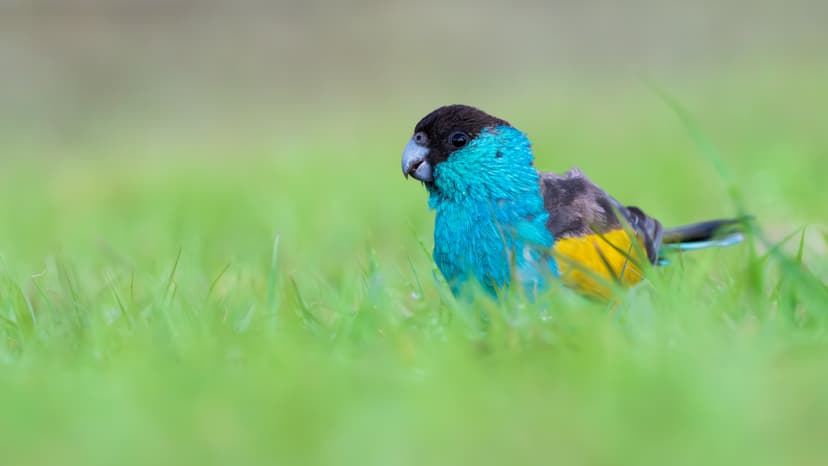
Hooded parrot
The hooded parrot is a species native to the Northern Territory in Australia, inhabiting savannah and open woodland. It is distinctive for being one of the few parrots that breed in termite mounds, and males are recognized by their black head and yellow wing patches. While once more widespread, it remains common in protected areas.

Manu parrotlet
The Manu parrotlet is a small parrot species native to the western Amazon basin, primarily found in lowland forests near bamboo and rivers in Peru, Bolivia, and Brazil. It is distinguished by its bright green plumage with pale blue on its forehead and crown, and its tendency to forage on the ground for seeds, particularly those from bamboo, and to visit clay licks for minerals.