
Blood-eared parakeet
The blood-eared parakeet is a species of parrot endemic to Venezuela, found in cloudforest and wooded savanna habitats. It is distinctive for its bright terracotta ear coverts, slaty gray head, and a mix of green, yellow, and reddish-brown plumage. These parakeets are typically found foraging in small flocks and are known for their noisy, harsh vocalizations.
Key Facts
- ›Endemic to Venezuela, with two subspecies found in different regions.
- ›Measures approximately 25 cm (9.8 inches) in length and weighs between 64-74 g (2.3-2.6 oz).
- ›Distinctive bright terracotta ear coverts stand out against its slaty gray head and green body plumage.
- ›Diet consists of fruits, seeds, flowers, and potentially insect larvae.
- ›Known for its noisy, harsh vocalizations, described as a series of 'krree krree krree' notes.
- ›Classified as near Threatened by the IUCN due to its limited range and habitat degradation.

Red-Eared Parakeet, Red-Eared Conure
Venezuela
Cloudforest, Secondary Forest, Wooded Savanna, Clearings With Scattered Trees
Slaty Gray, Terracotta, Green, Yellow-Green, Reddish Brown, Blue
Bright Terracotta Ear Coverts, Bare White Skin Around the Eye
Fruits, Seeds, Flowers, Insect Larvae
Not Specified
Series of Harsh Notes, Noisy, Harsh Chattering In Flocks
Not Specified
About Blood-eared parakeet
The blood-eared parakeet (Pyrrhura hoematotis), also known as the red-eared parakeet or red-eared conure in aviculture, is a species of parrot native to Venezuela. This species is characterized by its distinct bright terracotta ear coverts, which contrast with its slaty gray head, and its predominantly green body plumage accented with yellow-green on the throat and breast, and some reddish-brown on the belly.
Distribution and Habitat
The blood-eared parakeet is endemic to Venezuela, with its two subspecies inhabiting different regions. The nominate subspecies, P. h. hoematotis, is found in the Venezuelan Coastal Range, while P. h. immarginata resides in the Andes of southeastern Lara state. The species prefers the interior and edges of cloudforests and secondary forests, as well as wooded savannas and clearings with scattered trees, typically found at elevations between 1,000 and 2,000 meters.
Behavior and Diet
These parakeets are social birds, usually observed foraging in small flocks within the forest canopy. Their diet is varied, consisting of fruits, seeds, and flowers, with a possibility of also consuming insect larvae. Some populations exhibit seasonal movement, relocating to lower elevation semi-deciduous forests during the dry season.
Vocalizations
The blood-eared parakeet is known for its distinctive and often noisy vocalizations. Its most common call is a series of harsh notes, frequently described as 'krree krree krree,' emitted both from perches and during flight. When in flocks, they produce a continuous, harsh chattering sound.
Breeding and Conservation
Breeding for the blood-eared parakeet occurs during the wet season, typically centering around August. However, detailed information regarding their breeding biology remains scarce. The International Union for Conservation of Nature (IUCN) has assessed the blood-eared parakeet as Near Threatened. This status is attributed to its limited geographic range and ongoing population declines, largely due to habitat degradation. While the species is present in several protected areas, concerns about its small range and declining numbers necessitate urgent population estimates.
Source: Wikipedia ↗
Frequently Asked Questions
What is the scientific name of the blood-eared parakeet?
The scientific name of the blood-eared parakeet is Pyrrhura hoematotis. It belongs to the family Psittacidae, which includes African and New World parrots.
Where is the blood-eared parakeet found?
The blood-eared parakeet is endemic to Venezuela. The nominate subspecies inhabits the Venezuelan Coastal Range, while another subspecies is found in the Andes of southeastern Lara state.
What does the blood-eared parakeet look like?
Adult blood-eared parakeets are about 25 cm long and have a slaty gray head with bare white skin around the eyes. They are most recognizable by their bright terracotta ear coverts, which give them their name. Their body plumage is predominantly green with yellow-green on the throat and breast, and some reddish-brown on the belly.
What is the diet of the blood-eared parakeet?
The blood-eared parakeet's diet primarily includes fruits, seeds, and flowers. They may also consume insect larvae. They typically forage for food in small flocks within the forest canopy.
What is the conservation status of the blood-eared parakeet?
The blood-eared parakeet is listed as Near Threatened by the International Union for Conservation of Nature (IUCN). This classification is due to its small geographic range and ongoing population decline caused by habitat degradation.
How do blood-eared parakeets communicate?
Blood-eared parakeets are known for their noisy vocalizations. Their most common call is a series of harsh notes, such as 'krree krree krree,' which they use both when perched and in flight. Flocks in flight produce a chattering sound.
Related Parrot species

Blossom-headed parakeet
The Blossom-headed parakeet is a vibrant parrot species native to Southeast Asia, characterized by its lime-green body and a distinctive pink or bluish-grey head. It is known for its social behavior, often seen in small flocks, and its fondness for fruits and blossoms. This species is also referred to as the rosy-headed parakeet and faces threats from habitat loss and the illegal cage-bird trade.
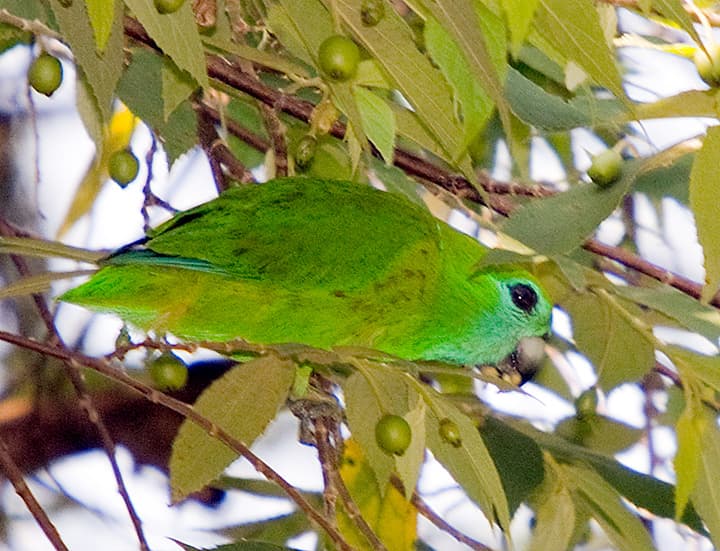
Guaiabero
The Guaiabero is a small, stout parrot endemic to the Philippines, belonging to the monotypic genus Bolbopsittacus and closely related to lovebirds and hanging parrots. Its common name stems from its reputation as a guava-eater, and it is distinctive for its large bill, stubby tail, and sexually dimorphic plumage, with males exhibiting more blue and females having black crescent markings.

Green-rumped parrotlet
The green-rumped parrotlet is a small parrot species native to northeastern South America and Trinidad. It is distinguished by its predominantly green plumage, with males exhibiting distinctive blue wing markings, and its preference for semi-open lowland habitats. These gregarious birds are known for their light, twittering calls and form strong pair bonds, though they can be opportunistic in seeking nest sites.