
Guaiabero
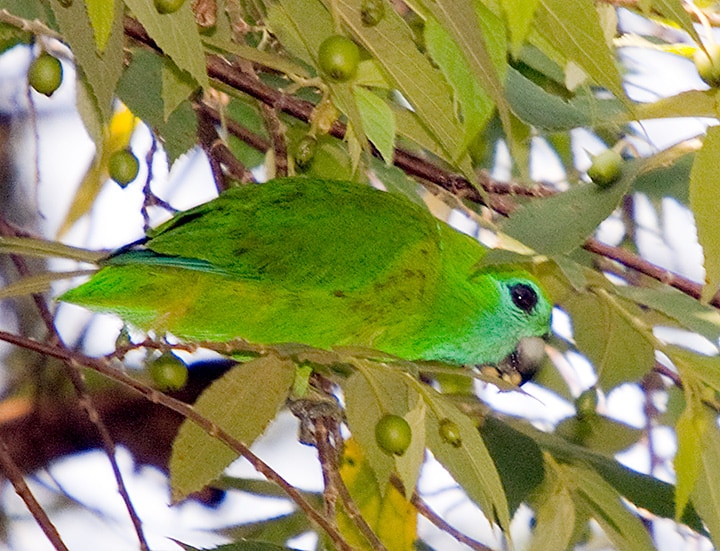
The Guaiabero is a small, stout parrot endemic to the Philippines, belonging to the monotypic genus Bolbopsittacus and closely related to lovebirds and hanging parrots. Its common name stems from its reputation as a guava-eater, and it is distinctive for its large bill, stubby tail, and sexually dimorphic plumage, with males exhibiting more blue and females having black crescent markings.
Key Facts
- ›Endemic to the Philippines, also known locally as bubutok.
- ›Small, stout parrot measuring approximately 15 cm in length with a large bill and stubby tail.
- ›Sexes differ in plumage: males are predominantly green with yellowish underparts and pale blue facial and collar markings, while females are greenish with a yellow collar and black crescent markings on the nape and rump.
- ›Inhabits lowland forests, secondary forests, mangroves, and plantations, often near termite mounds.
- ›Primarily a fruit-eating parrot, with recorded feeding on guavas, mangos, and seeds.
- ›Assessed as Least Concern by the IUCN Red List due to its common status and stable population.
Bubutok
Philippines
Lowland Forests, Secondary Forests, Mangroves, Plantations
Green, Yellow, Blue, Yellow-Green, Black
Large bill, Stubby tail, Black crescent markings on nape and rump
Fruit, Guavas, Mangos, Seeds
Self-Excavated Cavity In Arboreal Ant Nest, Self-Excavated Cavity In Termite Mound
About Guaiabero
The Guaiabero, scientifically known as Bolbopsittacus lunulatus, is a distinctive parrot species endemic to the Philippines. It is the sole member of its genus, Bolbopsittacus, and shares close evolutionary ties with lovebirds and hanging parrots. Its common name is derived from its well-known fondness for guavas, though its diet also includes other fruits like mangos and seeds.
Description and Taxonomy
This parrot is characterized by its small, stout build, measuring approximately 15 centimeters in length. It possesses a noticeably large bill and a short, stubby tail. The Guaiabero exhibits sexual dimorphism, meaning males and females have different physical appearances. Adult males are predominantly green with yellowish undersides, a pale blue face, and a pale blue collar. Their wing primaries are also tinged with blue, and their rump is yellow-green. The bill is grey-blue with a darker tip, and their eyes are dark brown. Adult females share the overall greenish coloration but are distinguished by a yellow collar and less blue on the face. A key identifying feature for females is the presence of black crescent markings on the nape and rump. Their bill is a paler grey.
Habitat and Behavior
The Guaiabero inhabits a variety of environments across the Philippines, including primary and secondary forests, mangroves, and plantations. They are often found in areas with available termite mounds, typically up to 1,000 meters above sea level. While their breeding habits in the wild were not well-documented until recently, current observations indicate they nest in cavities they excavate themselves within arboreal ant nests or termite mounds. Despite being trapped for the pet trade, the species has a relatively low survivability outside its natural habitat compared to other parrots.
Conservation Status
The International Union for Conservation of Nature (IUCN) Red List has assessed the Guaiabero as a species of Least Concern. This classification is due to its common presence throughout its range in the Philippines and a population that is considered stable. The species appears to be tolerant of degraded habitats, which contributes to its continued survival. However, its susceptibility to trapping for the pet trade remains a factor influencing its population dynamics.
Source: Wikipedia ↗
Frequently Asked Questions
What is the Guaiabero and where does it come from?
The Guaiabero is a species of parrot native to the Philippines. It is the sole member of its genus, Bolbopsittacus, and is closely related to lovebirds and hanging parrots.
What does the Guaiabero look like?
This parrot is small and stout, measuring around 15 cm in length, with a large bill and a short tail. Males are mostly green with yellowish undersides and pale blue on the face and collar, while females are also green but have a yellow collar and distinctive black crescent markings.
What is the diet of the Guaiabero?
The Guaiabero is predominantly a fruit-eating parrot. Its common name is derived from its affinity for eating guavas, and it has also been observed feeding on mangos and seeds.
What is the conservation status of the Guaiabero?
The Guaiabero is listed as a Least Concern species by the IUCN Red List. It is common throughout its range in the Philippines, with a stable population that appears tolerant of degraded habitats.
How does the Guaiabero breed?
While breeding habits were historically unknown, recent observations suggest the Guaiabero nests in self-excavated cavities within arboreal ant nests or termite mounds. Sexes are dimorphic, meaning males and females have different appearances.
Related Parrot species

Green-rumped parrotlet
The green-rumped parrotlet is a small parrot species native to northeastern South America and Trinidad. It is distinguished by its predominantly green plumage, with males exhibiting distinctive blue wing markings, and its preference for semi-open lowland habitats. These gregarious birds are known for their light, twittering calls and form strong pair bonds, though they can be opportunistic in seeking nest sites.
Kākāpō
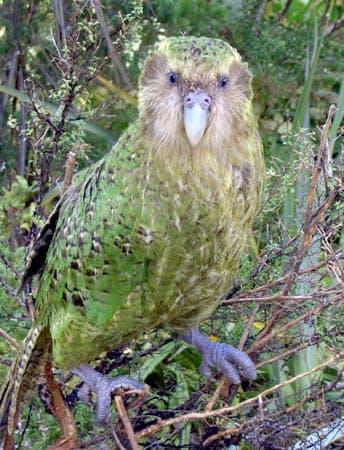
The kākāpō, also known as the owl-parrot, is a unique, large, nocturnal, and flightless parrot endemic to New Zealand. It is distinguished by its finely blotched yellow-green plumage, owl-like facial disc, and exceptionally soft feathers. Historically significant to Māori culture, the kākāpō is now critically endangered due to introduced mammalian predators.

Maroon-bellied parakeet
The maroon-bellied parakeet is a small parrot native to southeastern Brazil, Paraguay, Uruguay, and northeastern Argentina. It is notable for its predominantly green plumage, a distinctive maroon patch on its belly, and a scaly breast pattern. This species is also known as the reddish-bellied parakeet or various conure names in aviculture and is generally common in its natural woodland and forest edge habitats.