
Bronze-winged parrot
Pionus chalcopterus·Psittacidae·28·3-4 eggs
The Bronze-winged parrot (Pionus chalcopterus) is a medium-sized parrot native to northwestern South America, inhabiting forest and woodland environments. It is distinguished by its predominantly dark plumage, a distinctive whitish chin patch, and bronze-green body feathers that shimmer with blue tips, along with short red undertail feathers.
Key Facts
- ›Found in forest and woodland across northwestern South America.
- ›Characterized by dark plumage with a whitish chin and bronze-green body feathers.
- ›Typically seen in pairs or small groups of up to ten individuals.
- ›Nests in tree cavities and lays clutches of three to four white eggs.
- ›Juveniles can be distinguished by whitish eyerings and brownish underparts.

South America
Forest, Woodland, Canopy
Whitish Chin Patch, Short Red Undertail Feathers, Blue Underwings, Pale Yellow Beak, Pink Eyerings In Adults
Tree Cavities
About Bronze-winged parrot
The Bronze-winged parrot, scientifically known as Pionus chalcopterus, is a medium-sized parrot native to the forests and woodlands of northwestern South America. This stocky bird, measuring approximately 28 cm (11 inches) in length, is characterized by its predominantly dark plumage, which includes a distinct whitish chin patch and a body adorned with bronze-green feathers often tipped with blue. Notable features include short red undertail feathers and blue underwings.
Range and Habitat
This species is distributed across far western Venezuela, western and central Colombia, western Ecuador, and far north-western Peru. Its preferred habitat is the canopy of humid and semi-deciduous forests and woodlands, though it also ventures into adjacent areas with mature trees. The exact migratory patterns are not well understood, but it is believed to be somewhat nomadic, possibly in response to food availability.
Behavior and Reproduction
Bronze-winged parrots are typically observed in pairs or small social groups, usually numbering no more than ten individuals. They demonstrate nesting behavior by utilizing tree cavities. The reproductive cycle involves a clutch of three to four white eggs, which are incubated by the female for about 26 days. The young chicks then remain in the nest for approximately 70 days before fledging.
Physical Characteristics
Adult Bronze-winged parrots possess a pale yellow beak and a ring of pink bare skin around their eyes. Juveniles are distinguishable by their whitish eyerings and underparts that are more brownish in tone compared to the adults' plumage. While most authorities consider the species monotypic, some sources recognize two subspecies based on subtle variations in plumage and the size of the chin patch.
Source: Wikipedia ↗
Frequently Asked Questions
What does the Bronze-winged parrot look like?
The Bronze-winged parrot is a medium-sized parrot, primarily dark in coloration. It features a distinct whitish chin patch and its upper chest is speckled with pink feathers. Its body is largely dark bronze-green with blue-tipped feathers, and it has short red undertail feathers.
Where is the Bronze-winged parrot found?
This species is found in far western Venezuela, western and central Colombia, western Ecuador, and far north-western Peru. Its habitat generally includes the canopy of humid and semi-deciduous forests and woodlands, as well as adjacent areas with tall trees.
What is the typical behavior of the Bronze-winged parrot?
Bronze-winged parrots are usually observed in pairs or small social groups, typically numbering up to ten birds. They are known to nest in tree cavities.
What are the nesting and breeding habits of the Bronze-winged parrot?
The Bronze-winged parrot nests in tree cavities. Typically, a clutch consists of three to four white eggs. The female incubates the eggs for approximately 26 days, and the chicks fledge about 70 days after hatching.
Are there any subspecies of the Bronze-winged parrot?
While most authorities consider the species monotypic, some recognize two subspecies: Pionus chalcopterus chalcopterus, found in western Venezuela and northern/central Colombia, and Pionus b. cyanescens, found in southwestern Colombia, western Ecuador, and northwestern Peru. The latter is reputedly distinguished by broader blue margins on feathers and a smaller, less distinct chin patch and surrounding ring.
Related Parrot species

Blue-fronted parrotlet
The blue-fronted parrotlet is a small bird found in the cloud forests and mature secondary forests of Colombia, Ecuador, Panama, and Venezuela. Characterized by its predominantly green plumage, it is distinguished by a vibrant blue forehead, a white eye ring, and red markings on its wings. These birds are known for their gregarious nature and can be quite noisy in flight, though they are often overlooked due to their quiet feeding habits.
Blue-winged parakeet
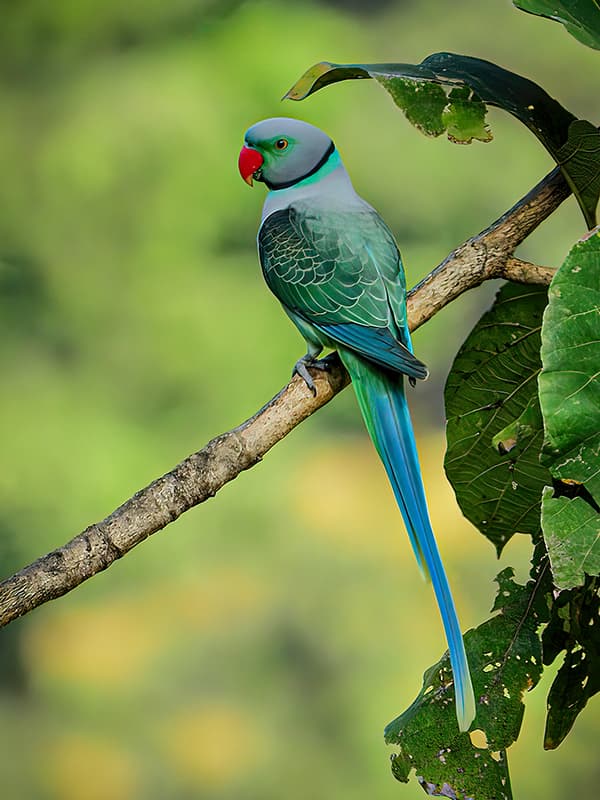
The blue-winged parakeet, also known as the Malabar parakeet, is a species of parakeet native to the Western Ghats of southern India. This species is distinctive for its long blue tails tipped in yellow, contrasting with their dark wings and dull grey head and body. Adult males and females are easily differentiated by the color of their beaks.
Dusky parrot
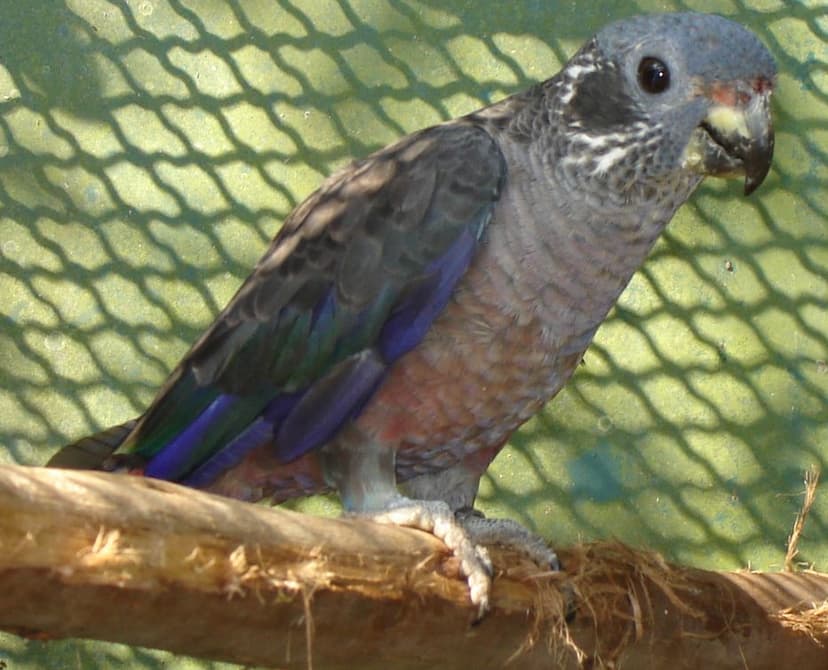
The dusky parrot (Pionus fuscus) is a medium-sized parrot native to northern South America, primarily inhabiting humid lowland forests. It is distinguished by its predominantly dark brownish-gray plumage, a gray eye-ring, and distinct red and blue markings on its underparts and tail.