
Blue-headed racket-tail
The blue-headed racket-tail is a medium-sized parrot native to the western Philippines, particularly the Palawan region. It is distinguished by its vibrant blue head plumage and unique tail feathers, which have extended shafts ending in a racket shape. This species inhabits humid lowland forests and is currently classified as Vulnerable due to significant threats from habitat destruction and limited trapping for the cage-bird trade.
Key Facts
- ›Found exclusively in the western Philippines, primarily around Palawan.
- ›Characterized by a bright blue head and distinctive racket-shaped tail feathers.
- ›Inhabits humid lowland forests and adjacent cultivated areas.
- ›Feeds on a variety of nuts and fruits, sometimes making it a pest in banana plantations.
- ›Classified as Vulnerable by the IUCN due to habitat loss and trapping.
- ›Nests in tree cavities, requiring mature trees for breeding.

Palawan Racket-Tail, Kilit
Philippines
Humid Lowland Forest, Adjacent Cultivated Areas, Scrubland, Mangroves
- Two central tail feathers with extended shafts ending in a racket shape
Nuts, Fruits
Raucous Squawks, Occasional Musical Phrase, Grating Calls, Shrill Squeals
Tree Cavities
About Blue-headed racket-tail
The Blue-headed Racket-tail
The blue-headed racket-tail (Prioniturus platenae), also known as the Palawan racket-tail and locally as 'kinawihan' or 'kilit', is a medium-sized parrot native to the western Philippines. Its plumage is primarily green, distinguished by a striking bright blue head. A unique characteristic of this species is its tail, where the two central tail feathers possess elongated shafts that terminate in a distinctive racket shape. Males also exhibit a bluish breast, and their underwings are blue, contrasting with green coverts.
Ecology and Behavior
This species inhabits humid lowland forests and adjacent cultivated areas, and can occasionally be found in scrubland and mangroves, typically at altitudes up to 650 meters. They are observed in pairs or small flocks and are known to be quite noisy in flight, though they become more subdued while feeding. Their diet consists of a variety of nuts and fruits, and they are known to frequent banana plantations, sometimes leading to them being considered a pest. Like other racket-tails, they nest in tree cavities, making them dependent on mature trees for successful breeding.
Conservation Status
The blue-headed racket-tail is endemic to the islands of Palawan, Balabac, Dumaran, Linapacan, Culion, and Busuanga. It is classified as Vulnerable by the IUCN, a status it has held since 1994. The population is estimated to be between 1,500 and 7,000 mature individuals and is believed to be declining. The primary threats are deforestation due to extensive mining and logging operations, as well as capture for the cage-bird trade, although this latter threat is considered minor and mostly local. Conservation efforts include surveys in remaining forests, controlling the cage-bird trade, protecting existing game reserves, and raising awareness. Efforts are also underway to mitigate farmer persecution by developing alternative measures to protect crops.
Source: Wikipedia ↗
Frequently Asked Questions
What are the key physical characteristics of the blue-headed racket-tail?
The blue-headed racket-tail is approximately 27-28 cm long and is predominantly green. It features a bright, light blue head, blue underwings, and a bluish breast in males. Its most distinctive feature is its tail, where the two central feathers have elongated shafts tipped with a racket-like shape.
Where is the blue-headed racket-tail found?
This species is endemic to the islands of Palawan, Balabac Island, Dumaran Island, Linapacan, Culion, and Busuanga Island in the western Philippines. It inhabits lowland forests and nearby cultivated areas, scrubland, and mangroves.
What is the diet of the blue-headed racket-tail?
The blue-headed racket-tail feeds on a wide variety of nuts and fruits. They are known to feed regularly in banana plantations, which can sometimes lead to them being viewed as a pest.
What are the main threats to the blue-headed racket-tail population?
The most significant threat to the blue-headed racket-tail is habitat destruction, primarily caused by extensive mining and logging operations on Palawan. Capture for the illegal exotic pet trade also poses a minor threat, though most trade is local and captive survival rates are low.
What is the conservation status of the blue-headed racket-tail?
The blue-headed racket-tail is classified as Vulnerable by the International Union for Conservation of Nature (IUCN). This status has been in place since 1994, reflecting concerns about its declining population and the ongoing threats it faces.
How do blue-headed racket-tails reproduce?
Like other racket-tails, they nest in tree cavities. This nesting behavior makes them reliant on the presence of mature trees to breed successfully. Little specific information is available regarding their breeding season or clutch size in the wild.
What sounds does the blue-headed racket-tail make?
The species is described as uttering a variety of raucous squawks, grating calls, and occasional shrill squeals. While generally noisy in flight, they tend to be more silent when feeding.
Related Parrot species
Flame-winged parakeet
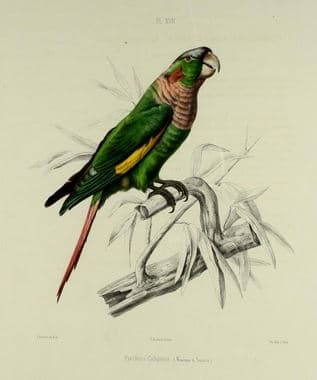
The flame-winged parakeet, also known as the brown-breasted parakeet, is a medium-sized parrot endemic to the eastern Andean slopes of Colombia. This species is distinguished by its bright yellow primary coverts and bluish primaries, with vivid yellow and orange-red wing markings visible in flight, which give it its common name. It is currently facing threats from habitat loss and fragmentation, leading to a declining population.
Ouvea parakeet
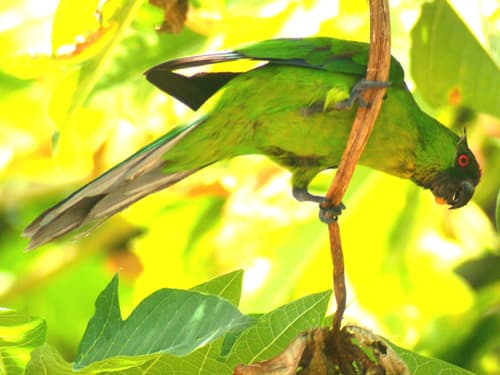
The Ouvea parakeet, also known as the Uvea parakeet, is a medium-sized parrot endemic to Uvea Island in New Caledonia. It is distinguished by its mostly green plumage, a prominent forward-curling green crest, and bright blue accents on its wings and tail. This species inhabits natural forests and is particularly fond of figs, facing threats from habitat loss and the pet trade.

Mindoro racket-tail
The Mindoro racket-tail is a species of parrot endemic to the island of Mindoro in the Philippines, inhabiting tropical moist lowland forests. It is distinguished from its close relative, the blue-crowned racket-tail, by its bluer hindcrown, darker hindcrown, and a more matte green face, along with a slightly longer tail. This species is currently facing threats from habitat loss and the cage-bird trade.