
Blue-rumped parrot
The blue-rumped parrot is a small parrot native to Southeast Asia, found in countries like Malaysia, Borneo, and Sumatra. It is distinguished by its predominantly green plumage, with males featuring a striking blue rump and head, while females have a more subdued grey-brown head. These parrots are often observed in flocks and feed on a diet of seeds, fruits, and blossoms.
Key Facts
- ›Native to the southern tip of Myanmar, peninsular Thailand, Malaysia, Borneo, Sumatra, and nearby islands.
- ›Small parrots, measuring approximately 18 cm in length.
- ›Males are sexually dimorphic with a blue head and rump, red upper mandible, and black mantle.
- ›Females have a grey-brown head, contrasting with the male's vibrant coloration.
- ›Inhabit lowland forests, open woodlands, orchards, plantations, mangroves, and scrublands.
- ›Typically found in flocks of up to 20 individuals.

Southeast Asia
Lowland Forests, Open Woodland, Orchards, Plantations, Mangroves, Dense Scrub, Coconut Groves
Green, Red, Yellow, Blue, Grey-Brown
- Red Underwing Coverts
- Reddish Shoulder Patch
- Yellowish Margins On Wing Coverts
- Male: Blue Head and Rump, Red Upper Mandible, Black Mantle
- Female: Grey-Brown Head
Seeds, Fruit, Blossoms
About Blue-rumped parrot
The blue-rumped parrot (Psittinus cyanurus) is a small parrot species found in the tropical regions of Southeast Asia. Its natural range extends across the southern tip of Myanmar, peninsular Thailand, Malaysia, Borneo, Sumatra, and adjacent islands. This parrot is characterized by its predominantly green plumage, with males displaying more vibrant colors including a striking blue rump and head, a red upper mandible, and a black mantle. Females, in contrast, have a more subdued grey-brown head.
These birds are typically found in lowland forests, generally at elevations below 700 meters. Their preferred habitats are varied and include open woodlands, orchards, plantations, mangroves, dense scrub, and coconut groves. Blue-rumped parrots are social creatures, often observed in flocks that can number up to 20 individuals. Their diet consists of seeds, fruits, and blossoms, which they forage for within their diverse ecological niches.
Historically, the blue-rumped parrot was considered the sole member of the genus Psittinus. However, taxonomic revisions have led to the recognition of certain subspecies, such as the Simeulue parrot (Psittinus abbottii), as separate species by ornithological bodies. Two subspecies of the blue-rumped parrot are recognized: P. c. cyanurus, found on the Malay Peninsula, Sumatra, and Borneo, and P. c. pontius, which inhabits the Mentawai Islands and is noted for being larger than the nominate subspecies.
Source: Wikipedia ↗
Frequently Asked Questions
What is the scientific name of the blue-rumped parrot?
The scientific name of the blue-rumped parrot is *Psittinus cyanurus*. It was formerly considered the sole member of the genus *Psittinus*.
Where does the blue-rumped parrot live?
The blue-rumped parrot is found in the very southern tip of Myanmar, peninsular Thailand, Malaysia, Borneo, Sumatra, and nearby islands.
What are the main physical characteristics of the blue-rumped parrot?
The blue-rumped parrot is primarily green with bright red underwing coverts, a reddish shoulder patch, and yellowish margins on the wing coverts. Males are distinctive with a blue head and rump, a red upper mandible, and a black mantle.
What is the diet of the blue-rumped parrot?
In their natural habitat, blue-rumped parrots feed on seeds, fruit, and blossoms. They forage in various environments including forests, orchards, and plantations.
Are there different subspecies of the blue-rumped parrot?
Yes, there are two recognized subspecies: *P. c. cyanurus*, found in the Malay Peninsula, Sumatra, and Borneo, and *P. c. pontius*, which inhabits the Mentawai Islands and is larger than the nominate subspecies.
What are the habitat preferences of the blue-rumped parrot?
These parrots are generally found in lowland forests, typically below 700 meters. Their habitat includes open woodland, orchards, plantations, mangroves, dense scrub, and coconut groves.
Related Parrot species

Golden-shouldered parrot
The golden-shouldered parrot is a rare bird found in the southern Cape York Peninsula of Queensland, Australia. This species is distinguished by the adult male's yellow shoulder patch, black cap, and pale yellow frontal band. It is critically endangered due to habitat changes, which increase predation, and is the subject of significant conservation efforts.
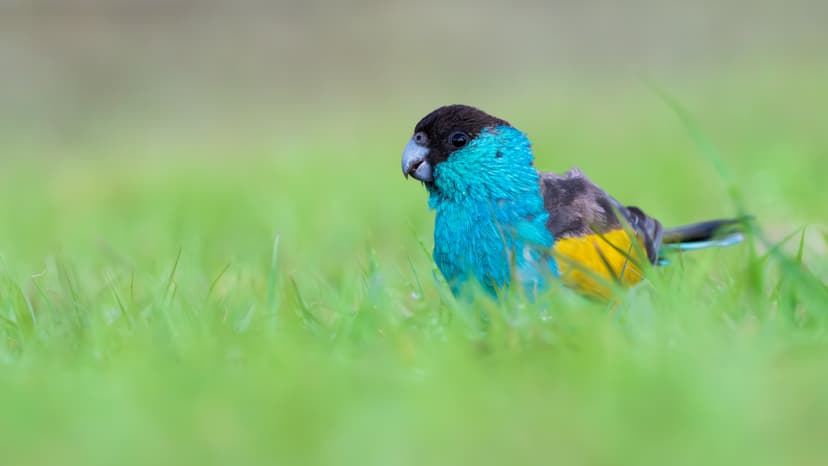
Hooded parrot
The hooded parrot is a species native to the Northern Territory in Australia, inhabiting savannah and open woodland. It is distinctive for being one of the few parrots that breed in termite mounds, and males are recognized by their black head and yellow wing patches. While once more widespread, it remains common in protected areas.

Burrowing parrot
The burrowing parrot, also known as the Patagonian conure, is a species of parrot native to Argentina and Chile. It is distinguished by its white eye ring, white breast marking, olive green body, and brightly colored underparts. These parrots are unique for excavating elaborate burrows in cliff faces for nesting and raising their young.