
Blue-winged parakeet
The blue-winged parakeet, also known as the Malabar parakeet, is a species of parakeet native to the Western Ghats of southern India. This species is distinctive for its long blue tails tipped in yellow, contrasting with their dark wings and dull grey head and body. Adult males and females are easily differentiated by the color of their beaks.
Key Facts
- ›Endemic to the Western Ghats of southern India.
- ›Distinguished by long blue tails with yellow tips and dark wings.
- ›Males have a red and white-tipped upper mandible, while females have an all-black bill.
- ›Found in small, rapidly flying flocks that emit screeching calls.
- ›Nests in tree cavities, often utilizing old woodpecker or barbet nests.
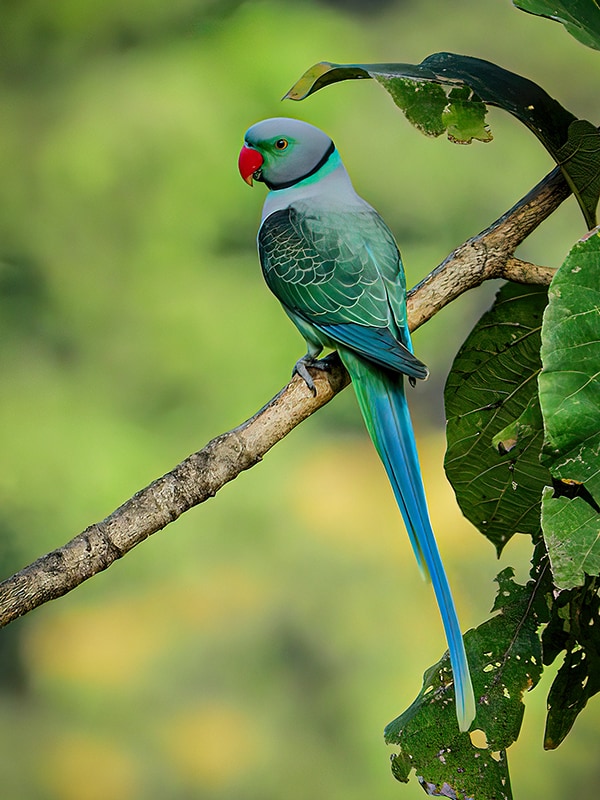
Malabar Parakeet, Bababudan Parrot
India
Forest Clearings, Forests
Bluish Grey, Blue, Yellow, Dark, Black
Long blue tails tipped in yellow, Black neck ring, Bluish-green lower edge to the black collar, Red and white-tipped upper mandible, All black bill
Leaves of Loranthus Longiflorus, Plant Matter
Screeching Calls
- Screeching calls
- Distinctive calls that differ from other parakeet species in their range
- Series of screeching keek-keek-keek calls
Holes In Trees, Old Woodpecker Nests, Old Barbet Nests
About Blue-winged parakeet
The blue-winged parakeet, scientifically known as Psittacula columboides and also referred to as the Malabar parakeet, is a species of parakeet native exclusively to the Western Ghats of southern India. This bird is characterized by its striking plumage, featuring a bluish-grey body, dark wings, and a notably long tail that is tipped in yellow. A complete black neck ring encircles the neck in both sexes, though males possess a bluish-green lower edge to this collar, distinguishing them further.
Physical Description and Sexual Dimorphism
Adult blue-winged parakeets display their sexual dimorphism most clearly through their beak coloration. Males have a red upper mandible with a distinct white tip, while females are identified by their entirely black bill. The overall body is a dull grey, contrasting with the brighter blue of their tails. They are known to fly rapidly through forest clearings in small flocks, emitting characteristic screeching calls that are unique among parakeet species found within their geographical area.
Distribution and Habitat
This parakeet's natural range is confined to the Western Ghats, extending from approximately 19°N latitude southwards to Kerala. Its distribution also encompasses the Palni and Nilgiri hills and potentially reaches into the adjoining Eastern Ghats, including the Biligirirangan range. They inhabit forest environments and are often observed in forest clearings.
Diet and Breeding Habits
Individuals have been documented feeding on the leaves of plants such as Loranthus longiflorus. The breeding cycle of the blue-winged parakeet occurs during the dry season, following the northeast monsoon. They construct nests in tree cavities, frequently repurposing old nests made by woodpeckers and barbets, particularly in tall trees like Mesua ferrea. Egg-laying typically takes place in December and January, with a clutch size of around four eggs. The incubation period lasts approximately 23 days, and the chicks fledge in about a month, departing the nest before the onset of the southwest monsoon in June.
Conservation and Trade
Historically, the blue-winged parakeet has been traded, known in the pet trade as the "Bababudan Parrot." While this trade is now illegal within India, information regarding its current conservation status is not specified. Its closest living relative is Layard's parakeet, a species endemic to Sri Lanka.
Source: Wikipedia ↗
Frequently Asked Questions
What is the scientific name of the blue-winged parakeet?
The scientific name of the blue-winged parakeet is Psittacula columboides. This binomial nomenclature is used to classify this specific species within the broader scientific community.
Where does the blue-winged parakeet live?
The blue-winged parakeet is endemic to the Western Ghats of southern India, with its range extending from Kasa south to Kerala and into the hills of the Palnis and Nilgiris. It may also be found in parts of the adjoining Eastern Ghats.
What are the distinctive physical features of the blue-winged parakeet?
Key distinguishing features include its bluish-grey plumage, a long tail tipped with yellow, and dark wings that contrast with the body. A black neck ring is present in both sexes, but males have a bluish-green lower edge to this collar.
How can male and female blue-winged parakeets be distinguished?
Adult males and females can be easily identified by the color of their beak. Males possess a red upper mandible with a white tip, whereas females have an entirely black bill.
What is the nesting behavior of the blue-winged parakeet?
These parakeets nest in holes found in trees, frequently utilizing abandoned nests of woodpeckers and barbets. They breed in the dry season, with chicks fledging before the onset of the southwest monsoon.
What do blue-winged parakeets eat?
Observations indicate that blue-winged parakeets feed on the leaves of plants such as Loranthus longiflorus. Their diet in the wild consists of various plant matter found within their forest habitat.
Related Parrot species

Blossom-headed parakeet
The Blossom-headed parakeet is a vibrant parrot species native to Southeast Asia, characterized by its lime-green body and a distinctive pink or bluish-grey head. It is known for its social behavior, often seen in small flocks, and its fondness for fruits and blossoms. This species is also referred to as the rosy-headed parakeet and faces threats from habitat loss and the illegal cage-bird trade.

Bronze-winged parrot
The Bronze-winged parrot (Pionus chalcopterus) is a medium-sized parrot native to northwestern South America, inhabiting forest and woodland environments. It is distinguished by its predominantly dark plumage, a distinctive whitish chin patch, and bronze-green body feathers that shimmer with blue tips, along with short red undertail feathers.
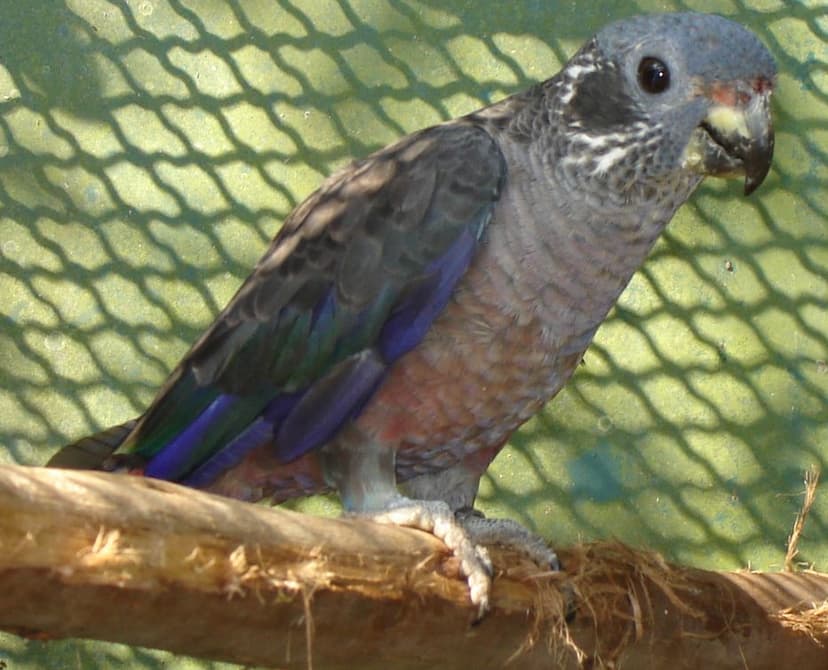
Dusky parrot
The dusky parrot (Pionus fuscus) is a medium-sized parrot native to northern South America, primarily inhabiting humid lowland forests. It is distinguished by its predominantly dark brownish-gray plumage, a gray eye-ring, and distinct red and blue markings on its underparts and tail.