
Brown lory
The Brown lory, also known as Duyvenbode's lory, is a species of parrot native to the lowland forests of northern New Guinea. It is distinguished by its mostly dark brown plumage, a black beak, a yellow-streaked face, and a white tail.
Key Facts
- ›Native to northern New Guinea.
- ›Inhabits subtropical or tropical moist lowland forests.
- ›Has mostly dark brown plumage with a yellow-streaked face and white tail.
- ›Breeding season occurs in April.
- ›Clutches typically consist of two eggs.
- ›Listed as Least Concern by the IUCN, though its population is believed to be declining.
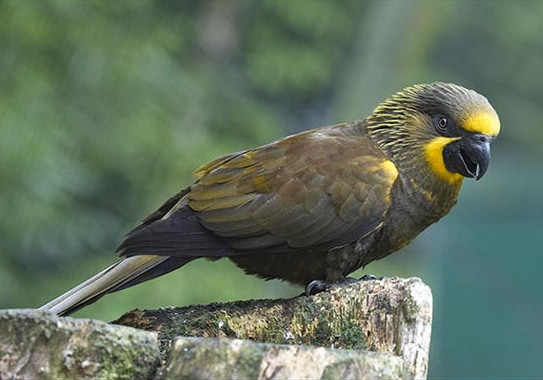
Duyvenbode's Lory
New Guinea
Subtropical Lowland Forests, Tropical Lowland Forests
Yellow-Streaked Face, White Tail
About Brown lory
What is the Brown Lory?
The Brown lory, scientifically known as Chalcopsitta duivenbodei and also referred to as Duyvenbode's lory, is a species of parrot found exclusively in the northern regions of New Guinea. This species belongs to the genus Chalcopsitta and is noted for its distinctive appearance, characterized by predominantly dark brown plumage, a black beak, a face marked with yellow streaks, and a contrasting white tail.
Habitat and Distribution
This parrot inhabits subtropical and tropical moist lowland forests, generally at elevations not exceeding 150 meters (492 feet). While considered generally uncommon throughout its range, the Brown lory can be locally abundant in specific areas, such as the Puwani River region south of Vanimo.
Behavior and Reproduction
The Brown lory's breeding season is documented to occur in April. Observations in captivity have indicated that females lay clutches of two eggs. The incubation period for these eggs is approximately 24 days, and the young birds typically fledge, or take their first flight, nearly 11 weeks after hatching.
Conservation Status
The International Union for Conservation of Nature (IUCN) lists the Brown lory as a species of Least Concern. Despite this classification, there is an indication that the species' population is experiencing a decline. The estimated total population of Brown lories is around 50,000 individuals.
Source: Wikipedia ↗
Frequently Asked Questions
What is the scientific name of the Brown lory?
The scientific name of the Brown lory is Chalcopsitta duivenbodei. The genus name Chalcopsitta is derived from Greek and Latin, meaning 'bronze parrot', and the species epithet commemorates Maarten Dirk van Renesse van Duivenbode.
Where is the Brown lory found?
The Brown lory is found in northern New Guinea. Its natural habitat is subtropical or tropical moist lowland forests, typically at elevations up to 150 meters.
What does a Brown lory look like?
Brown lories are characterized by their mostly dark brown plumage. They have a black beak, a face streaked with yellow, and a white tail.
What is the conservation status of the Brown lory?
The Brown lory is listed as Least Concern by the IUCN. However, its population is thought to be declining, with an estimated total population of 50,000 individuals.
When does the Brown lory breed?
The breeding season for the Brown lory occurs in April. In captivity, they typically lay clutches of two eggs.
What is the incubation and nestling period for Brown lory eggs?
In captivity, the incubation period for Brown lory eggs is approximately 24 days. The nestling period, from hatching to fledging, is nearly 11 weeks.
Related Parrot species
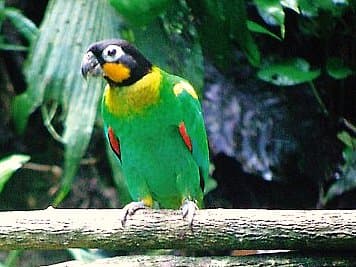
Orange-cheeked parrot
The orange-cheeked parrot, also known as Barraband's parrot, is a species of parrot native to the Amazonian Andes and humid lowland forests of the Amazon Basin in South America. Its distinctive features include an olive throat and breast, yellow thighs, and varying shades of orange on its wings and cheeks, with a notable white eye-ring. This species faces threats from habitat loss due to deforestation in its native range.
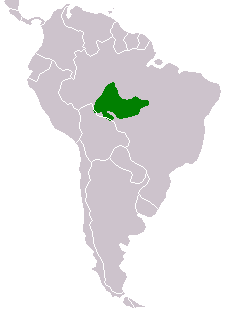
Madeira parakeet
The Madeira parakeet, also known as the Madeira conure, is a species of parrot native to the eastern and central Amazon basin in Brazil and Bolivia. It is distinctive for its white ear coverts, cream upper breast with brown feather shafts, and a yellow eye ring. This species is currently classified as Least Concern, though its population is slowly decreasing due to habitat loss.

Orange-chinned parakeet
The orange-chinned parakeet (Brotogeris jugularis), also known as the Tovi parakeet, is a species of parrot found from southern Mexico through Central America into Colombia and Venezuela. This small, predominantly green parrot is distinctive for its bright orange chin patch, though this can be difficult to see. They inhabit semi-open to open landscapes and are often observed in pairs or small flocks.