
Brown-necked parrot
Poicephalus fuscicollis·Psittacidae
The brown-necked parrot is a large parrot species endemic to Africa, known for its stocky build, large head and bill, and light grey head. It is divided into two subspecies, the savanna-dwelling brown-necked parrot and the grey-headed parrot, and is adaptable to captivity, where it is known for its intelligence and ability to mimic sounds and speech.
Key Facts
- ›Endemic to Africa with two subspecies: P. fuscicollis fuscicollis and P. f. suahelicus.
- ›Characterized by a relatively large head and bill, stocky build, and light grey head.
- ›The nominate subspecies, P. fuscicollis fuscicollis, has a bluer sheen to its plumage.
- ›Found in West Africa (Gambia to Togo) and Southern Africa (Congo to South Africa).
- ›Adapts readily to captivity and is intelligent, known for mimicking speech and sounds.
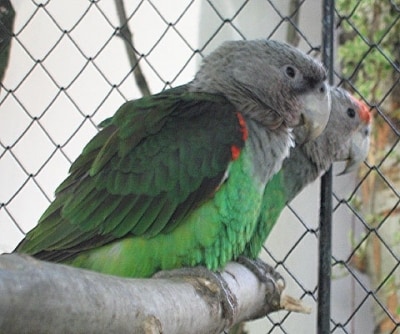
Uncape Parrot
Africa
Savanna
Grey, Yellow-Green, Greenish, Blue Sheen
Large Head and Bill, Stocky Build, Light Grey Head
Intelligent
Mimics Sounds, Mimics Human Speech
About Brown-necked parrot
The brown-necked parrot, scientifically known as Poicephalus fuscicollis, is a substantial parrot species native to the African continent. It is sometimes referred to in aviculture as the uncape parrot. This species is characterized by its large size within its genus, featuring a notably large head and bill, coupled with a stocky build. Its plumage is predominantly yellow-green on the upperparts and greenish on the underparts, with a distinctive light grey head.
Taxonomy and Classification
First described by German naturalist Heinrich Kuhl in 1819, the brown-necked parrot's scientific name reflects its appearance, derived from the Latin words 'fuscus' (dark) and 'collum' (neck). Historically, it was considered to include the Cape parrot as a subspecies, but current classification recognizes them as distinct species based on bill morphology, head coloration, and habitat preference. Genetic studies indicate that the ancestors of the brown-necked and Cape parrots diverged millions of years ago during the late Pliocene to early Pleistocene epochs, a period marked by significant climatic shifts that influenced speciation.
Distribution and Habitat
The brown-necked parrot is comprised of two subspecies, each with its own geographical range. Subspecies P. fuscicollis fuscicollis, the nominate subspecies, inhabits West Africa, extending from Gambia and southern Senegal eastward to Ghana and Togo. The second subspecies, P. f. suahelicus (the grey-headed parrot), is found in Southern Africa, with its range stretching from southern Congo and Tanzania southwards to northern Namibia and northern South Africa. The savanna-dwelling subspecies is locally common in some areas, though declines have been noted in parts of its West African range.
Aviculture and Behavior
In captivity, the brown-necked parrot is known for its adaptability and intelligence. It readily adjusts to domestic environments and is a common sight in the pet trade. These parrots are particularly noted for their ability to mimic sounds and learn human speech, making them engaging companions. While details about their social behavior in the wild are not extensively documented, their presence in aviculture highlights their capacity for interaction and learning.
Source: Wikipedia ↗
Frequently Asked Questions
What are the different subspecies of the brown-necked parrot?
The brown-necked parrot consists of two subspecies. These are the savanna-dwelling brown-necked parrot (P. fuscicollis fuscicollis) and the grey-headed parrot (P. f. suahelicus).
What is the geographic distribution of the brown-necked parrot?
Subspecies P. fuscicollis fuscicollis is found in West Africa, from Gambia and southern Senegal to Ghana and Togo. Subspecies P. f. suahelicus inhabits Southern Africa, ranging from southern Congo and Tanzania down to northern Namibia and South Africa.
What are the physical characteristics of the brown-necked parrot?
The brown-necked parrot is the largest member of its genus, featuring a relatively large head and bill, and a stocky build. It is distinguished by a light grey head, with upperparts being yellow-green and underparts greenish. The nominate subspecies has a bluer sheen to its plumage.
Is the brown-necked parrot kept as a pet?
Yes, the brown-necked parrot adapts readily to captivity and is found in the pet trade. They are known for being highly intelligent and can mimic sounds and human speech.
What is the scientific classification of the brown-necked parrot?
The brown-necked parrot was described by German naturalist Heinrich Kuhl in 1819. Its scientific name, Poicephalus fuscicollis, comes from the Latin words 'fuscus' meaning 'dark' and 'collum' meaning 'neck'.
Related Parrot species
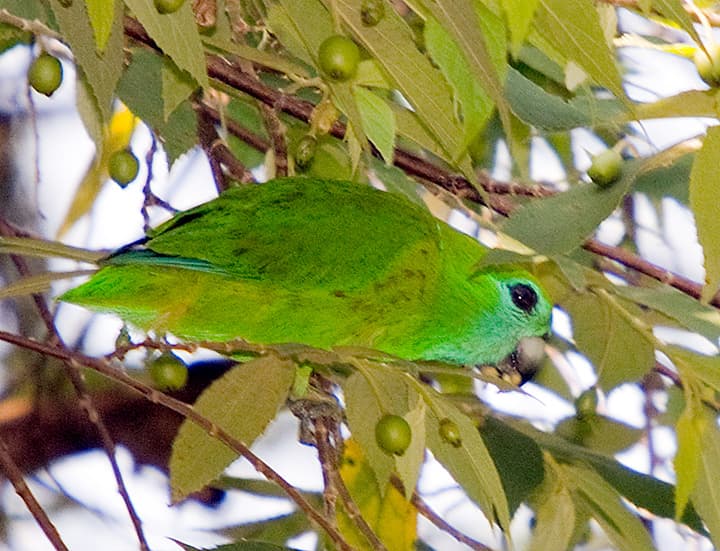
Guaiabero
The Guaiabero is a small, stout parrot endemic to the Philippines, belonging to the monotypic genus Bolbopsittacus and closely related to lovebirds and hanging parrots. Its common name stems from its reputation as a guava-eater, and it is distinctive for its large bill, stubby tail, and sexually dimorphic plumage, with males exhibiting more blue and females having black crescent markings.

Green-rumped parrotlet
The green-rumped parrotlet is a small parrot species native to northeastern South America and Trinidad. It is distinguished by its predominantly green plumage, with males exhibiting distinctive blue wing markings, and its preference for semi-open lowland habitats. These gregarious birds are known for their light, twittering calls and form strong pair bonds, though they can be opportunistic in seeking nest sites.

Maroon-bellied parakeet
The maroon-bellied parakeet is a small parrot native to southeastern Brazil, Paraguay, Uruguay, and northeastern Argentina. It is notable for its predominantly green plumage, a distinctive maroon patch on its belly, and a scaly breast pattern. This species is also known as the reddish-bellied parakeet or various conure names in aviculture and is generally common in its natural woodland and forest edge habitats.