
Buff-faced pygmy parrot
The buff-faced pygmy parrot is the world's smallest parrot, measuring approximately 8.6 cm in length and weighing around 11.5 grams. Primarily green with a buff-colored face and a distinctive blue crown, this species inhabits tropical lowland forests in New Guinea and the Bismarck Archipelago. They are known to live in small social groups and are highly active in their arboreal environment.
Key Facts
- ›The world's smallest parrot species.
- ›Plumage is predominantly green with buff-colored cheeks and face.
- ›Features a dark blue patch on the crown, which is less distinct in females.
- ›Found in subtropical and tropical moist lowland forests.
- ›Occurs in New Guinea and the Bismarck Archipelago.
- ›Listed as 'Least Concern' by the IUCN due to its wide range.

Buff-Faced Pygmy Parrot, Little Pygmy Parrot
New Guinea, Bismarck Archipelago
Subtropical Moist Lowland Forest, Tropical Moist Lowland Forest
World's Smallest Parrot, Buff-Colored Face and Cheeks, Dark Blue Crown Patch
About Buff-faced pygmy parrot
The buff-faced pygmy parrot (Micropsitta pusio) holds the distinction of being the world's smallest parrot. This tiny avian is found in the subtropical and tropical moist lowland forests of New Guinea and the Bismarck Archipelago. Its diminutive size, typically measuring around 8.6 cm in length and weighing approximately 11.5 grams, makes it a remarkable species within the parrot family.
Physical Description
The plumage of the buff-faced pygmy parrot is predominantly green, often with a yellowish hue on its underparts. Its most distinguishing features are the buff-colored feathers on its cheeks, face, and crown, which give the species its common name. A notable characteristic is a dark blue patch located on the top of its head, extending towards the occiput. While males and females share general similarities, females typically exhibit smaller head markings and a paler facial coloration. Immature birds lack the distinctive blue crown, which is replaced by green, and their buff coloration is less pronounced.
Distribution and Habitat
These parrots inhabit the northern lowlands of New Guinea, ranging from the western parts to the southeastern tip, and are also present in the Bismarck Archipelago. They prefer subtropical and tropical moist lowland forest environments. They are often observed in small social groups, numbering up to six individuals, and are known for their active nature as they hop along tree trunks.
Conservation Status
The buff-faced pygmy parrot is categorized as 'Least Concern' by the International Union for Conservation of Nature (IUCN). This status is attributed to its extensive geographic range, although specific population numbers are not precisely documented.
Source: Wikipedia ↗
Frequently Asked Questions
What is the size of the buff-faced pygmy parrot?
The buff-faced pygmy parrot is recognized as the world's smallest parrot. It measures approximately 8.6 cm (3.4 inches) in total length and typically weighs around 11.5 grams (0.41 oz).
What are the distinctive physical characteristics of the buff-faced pygmy parrot?
Its plumage is mainly green with a yellowish tone on the underparts. The cheeks, face, and crown are a buff color, and there is a dark blue patch on the top of the head extending to the occiput. Females tend to have smaller head markings and paler facial colors.
Where is the buff-faced pygmy parrot found?
This species is distributed across the northern lowlands of New Guinea, from the west to the southeastern tip, and also inhabits the Bismarck Archipelago. They are found in subtropical or tropical moist lowland forest environments.
What is the conservation status of the buff-faced pygmy parrot?
The buff-faced pygmy parrot is listed as 'Least Concern' by the IUCN. While its exact population size is not known, it occurs over a very wide geographic range.
Are male and female buff-faced pygmy parrots different in appearance?
The male and female buff-faced pygmy parrots are similar in appearance, but there are subtle differences. Head markings are generally smaller in females, and their facial color is paler. The blue crown patch is also less distinct in females.
Related Parrot species
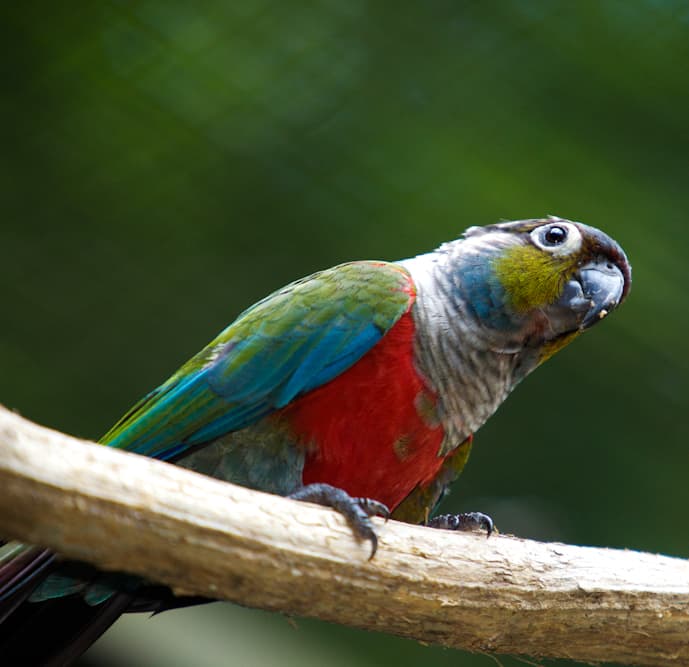
Crimson-bellied parakeet
The crimson-bellied parakeet, also known as the crimson-bellied conure in aviculture, is a species of parrot native to Bolivia and Brazil. This bird is distinctive for its striking red belly contrasting with its predominantly green plumage, and it inhabits the canopy of humid forests. Despite its large range, its population is believed to be decreasing due to deforestation.

Painted parakeet
The painted parakeet, also known as the painted conure in aviculture, is a species of parrot native to northeastern South America. This medium-sized parrot is distinguished by its vibrant plumage, featuring a mix of green, blue, and maroon, with distinctive scalloped markings on its breast. It inhabits various forest types and is known to forage in flocks.

Golden-mantled racket-tail
The golden-mantled racket-tail is a species of parrot endemic to Indonesia, found in lowland and montane moist forests. It is distinguished by its green plumage, an orange collar across the mantle in males, and elongated central tail feathers that form "rackets" with black tips.