
Crimson-bellied parakeet
The crimson-bellied parakeet, also known as the crimson-bellied conure in aviculture, is a species of parrot native to Bolivia and Brazil. This bird is distinctive for its striking red belly contrasting with its predominantly green plumage, and it inhabits the canopy of humid forests. Despite its large range, its population is believed to be decreasing due to deforestation.
Key Facts
- ›Found in the Amazon Basin of Bolivia and Brazil.
- ›Measures approximately 24-25 cm in length and weighs 76-91 g.
- ›Distinguished by a bright red belly, green upperparts, and a grayish-brown head.
- ›Feeds primarily on fruits and flowers.
- ›Breeds between August and November, laying clutches of four to six eggs.
- ›Its conservation status is currently listed as Least Concern by the IUCN.
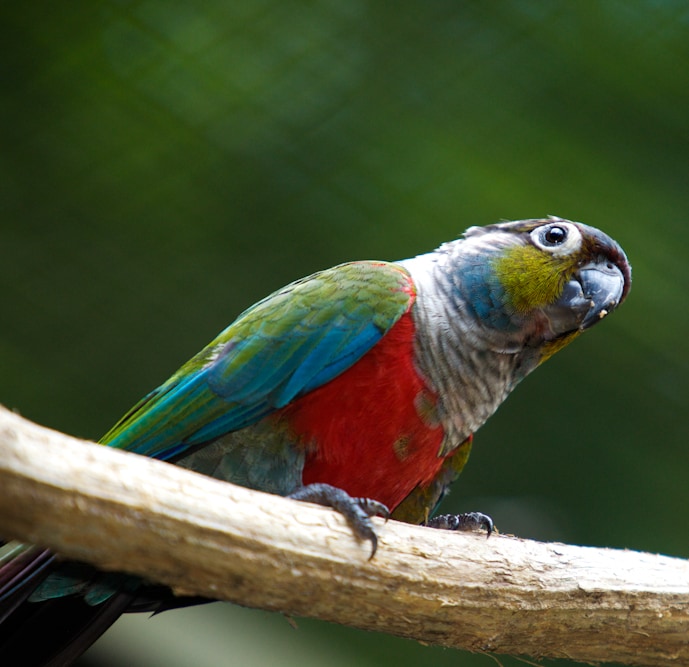
Crimson-Bellied Conure
Bolivia, Brazil
Humid Terra Firme Forest Canopy, Humid Terra Firme Forest Edges, Secondary Forest, Drier Lowland Forest
- Bright red belly
- Dark grayish brown head flecked with pale grayish buff
- Goldish green upper cheeks
- Turquoise-blue lower cheeks
- Narrow blue band on the nape
- Scaly appearance on throat and upper breast
Fruit, Flowers
High, Rapid "Wrr'Wur-Wir-Wir-Wir", Strange, Slightly Toy-Trumpet-Like "PeeéH"
Assumed To Nest In Tree Cavities
About Crimson-bellied parakeet
The crimson-bellied parakeet, scientifically known as Pyrrhura perlata and often called the crimson-bellied conure in aviculture, is a species of parrot native to the Amazon Basin. It is found in parts of Bolivia and Brazil, inhabiting the canopy and edges of humid terra firme forests, secondary forests, and drier lowland forests.
Description and Identification
Adult crimson-bellied parakeets typically measure between 24 to 25 cm (9.4 to 9.8 inches) in length and weigh between 76 to 91 grams (2.7 to 3.2 ounces). A distinctive feature is their bright red belly, which contrasts sharply with their predominantly green upperparts and bluish tinge. Their heads are dark grayish brown, flecked with pale grayish buff, with goldish green on the upper cheeks and turquoise-blue on the lower cheeks. A narrow blue band adorns the nape. The throat, upper breast, and sides of the neck appear gray to blue with a scaly pattern, sometimes showing pinkish feather tips. The lower flanks and vent area are greenish blue. Wings are mostly green, featuring black and cobalt blue primaries and red underwing coverts. The tail is reddish brown on its upper surface and blackish brown underneath. Their irises are dark brown, bills are blackish, and legs are blackish gray. Immature birds are similar to adults but have a predominantly green belly.
Distribution and Habitat
This species is distributed across the Amazon Basin, extending from the Mamoré River in northeastern Bolivia eastward into Brazil, south of the Amazon River. Its range includes the Brazilian states of Mato Grosso, Rondônia, Amazonas, and Pará. The crimson-bellied parakeet primarily occupies the canopy and forest edges of humid terra firme and secondary forests, and can also be found in drier lowland forest environments, generally up to an elevation of 600 meters (2,000 ft).
Behavior and Ecology
The crimson-bellied parakeet is a non-migratory species. Its diet consists mainly of fruits, supplemented by flowers. Breeding typically occurs between August and November, with a possibility of a second season from April to June. Like other parakeets in the Pyrrhura genus, they are believed to nest in tree cavities. A clutch usually contains four to six eggs, with an incubation period of approximately 25 days. The young fledge about seven to eight weeks after hatching.
Vocalizations
Their vocalizations include a characteristic high, rapid call described as "wrr'wur-wir-wir-wir." They are also known to make a peculiar sound resembling a "strange, slightly toy-trumpet-like 'peeéh'."
Conservation Status
The conservation status of the crimson-bellied parakeet has been reassessed multiple times by the IUCN. While it was once considered Vulnerable, it is currently listed as Least Concern. Despite possessing a large geographic range, its population size is not precisely known and is thought to be declining. The main threats to the species are deforestation, driven by agricultural expansion for cattle ranching and soy production, and hunting. Fortunately, the species is present within a considerable area of protected lands within its overall range.
Source: Wikipedia ↗
Frequently Asked Questions
What is the scientific name for the crimson-bellied parakeet?
The scientific name for the crimson-bellied parakeet is Pyrrhura perlata. Historically, it was sometimes referred to as Pyrrhura rhodogaster, but this name is now considered a junior synonym.
Where are crimson-bellied parakeets found in the wild?
Crimson-bellied parakeets are found in the Amazon Basin, specifically in northeastern Bolivia and extending east into Brazil south of the Amazon River. They inhabit states like Mato Grosso, Rondônia, Amazonas, and Pará.
What is the typical diet of a crimson-bellied parakeet?
In their natural habitat, crimson-bellied parakeets feed mainly on fruits. They also incorporate flowers into their diet.
What are the main threats to the crimson-bellied parakeet population?
The primary threat to the crimson-bellied parakeet is accelerating deforestation in the Amazon basin, largely driven by land clearing for cattle ranching and soy production. Hunting also negatively affects the species.
What are the nesting and breeding habits of this species?
It is assumed that crimson-bellied parakeets nest in tree cavities, similar to other Pyrrhura parakeets. They typically breed between August and November, and potentially also from April to June, laying a clutch of four to six eggs.
What is the conservation status of the crimson-bellied parakeet?
The crimson-bellied parakeet's conservation status has fluctuated, but as of 2021, it is assessed as Least Concern by the IUCN. Despite this, its population is believed to be decreasing.
Related Parrot species

Buff-faced pygmy parrot
The buff-faced pygmy parrot is the world's smallest parrot, measuring approximately 8.6 cm in length and weighing around 11.5 grams. Primarily green with a buff-colored face and a distinctive blue crown, this species inhabits tropical lowland forests in New Guinea and the Bismarck Archipelago. They are known to live in small social groups and are highly active in their arboreal environment.

Painted parakeet
The painted parakeet, also known as the painted conure in aviculture, is a species of parrot native to northeastern South America. This medium-sized parrot is distinguished by its vibrant plumage, featuring a mix of green, blue, and maroon, with distinctive scalloped markings on its breast. It inhabits various forest types and is known to forage in flocks.

Mindanao lorikeet
The Mindanao lorikeet is a parrot species endemic to the island of Mindanao in the Philippines. It is distinguished by its vibrant green plumage, red face, and a distinctive dark purple band across its head. This species inhabits tropical moist montane forests and faces significant threats from habitat loss and the illegal pet trade.