
Painted parakeet
Pyrrhura picta·Psittacidae·20-23·46-85
The painted parakeet, also known as the painted conure in aviculture, is a species of parrot native to northeastern South America. This medium-sized parrot is distinguished by its vibrant plumage, featuring a mix of green, blue, and maroon, with distinctive scalloped markings on its breast. It inhabits various forest types and is known to forage in flocks.
Key Facts
- ›Found in northeastern South America, including Venezuela, the Guianas, and northern Amazonian Brazil.
- ›Measures 20 to 23 cm in length and weighs between 46 to 85 grams for the nominate subspecies.
- ›Plumage is predominantly green with blue on the head, maroon on the back and tail, and buff with reddish-brown scalloping on the breast.
- ›Feeds on fruits, seeds, and flowers from a diverse range of plants.
- ›Breeding biology is largely unknown, with limited information on nesting and clutch size in the wild.
- ›Vocalizations vary by subspecies, typically consisting of high-pitched yelping notes or rolling calls.

Painted Conure
South America
Terra Firme Forests, VáRzea Forests, Forested Savanna, Coastal Sand-Ridge Forest
Green, Blue, Maroon, Buff, Reddish-Brown, Grayish
Scalloped Breast Pattern, Bare Grayish Skin Around the Eye
Fruits, Seeds, Flowers
- High-pitched, yelping notes
- Rolling notes
- Subdued 'kek' calls
- Noisy, harsh, and piercing chattering in flight
Tree Cavities
About Painted parakeet
The Painted Parakeet
The painted parakeet, scientifically known as Pyrrhura picta and referred to as the painted conure in aviculture, is a bird species belonging to the subfamily Arinae within the Psittacidae family. It is native to the northeastern regions of South America.
Description and Identification
Measuring between 20 and 23 cm in length, the painted parakeet is characterized by its striking plumage. Adults typically display blue on the forehead and crown, transitioning to deep maroon on the hindcrown and nape, often with a narrow blue collar. The face is maroon, accented by a ring of bare grayish skin around the eye, and the ear coverts are whitish. The upperparts are predominantly green, complemented by a dull red lower back and rump. A distinctive feature is the breast, which is buff with a reddish-brown scalloped appearance. The center of the belly is dull red, while the rest of the underparts are green. The wings are mostly green, featuring a red carpal area and blue primaries, and the tail is largely maroon with a green base. Immature birds are similar to adults but lack the red carpal area and have a whitish eye ring.
Distribution and Habitat
The natural range of the painted parakeet extends from southeastern Venezuela through the Guianas and into northern Amazonian Brazil. It inhabits a variety of forest ecosystems, including terra firme forests, várzea forests, forested savannas, and coastal sand-ridge forests. While it primarily occurs in lowland areas, it can be found at elevations up to 1,800 meters.
Behavior and Diet
Painted parakeets are social birds, commonly observed foraging in flocks of up to approximately 30 individuals. Their diet consists of fruits, seeds, and flowers from a wide array of plant species.
Vocalizations
The vocalizations of the painted parakeet can vary between subspecies. The nominate subspecies typically emits a series of rather high-pitched, somewhat yelping notes, often described as "kyeek kyeek kyeek," which can be heard both from perches and in flight. Perched birds may also produce a more rolling "kurrek" or a subdued "kek." When in flight, flocks are known to call frequently and simultaneously, creating a noisy, harsh, and piercing chattering sound.
Breeding Biology
Information regarding the breeding biology of the painted parakeet in the wild is scarce. The nominate subspecies is known to breed between December and February in the Guianas, though its breeding season elsewhere is not clearly defined. In captivity, they have been observed nesting in tree cavities and laying clutches of four or five eggs. Some subspecies have defined breeding periods, such as P. p. caeruleiceps breeding between March and September, P. p. eisenmanni between January and March, and P. p. subandina between March and June.
Conservation Status
The conservation status of the painted parakeet is assessed differently for its various subspecies. The nominate subspecies is classified as Least Concern, despite a believed decreasing population size and an unknown total population. However, several subspecies face significant threats. The Perija parakeet (P. p. caeruleiceps) is Endangered due to habitat loss and capture for the pet trade. The Sinu parakeet (P. p. subandina) is Critically Endangered, possibly extinct, with no sightings since 1949 and severe habitat clearance. The Azuero parakeet (P. p. eisenmanni), listed as Vulnerable, is threatened by habitat loss for agriculture, although it does inhabit Cerro Hoya National Park.
Source: Wikipedia ↗
Frequently Asked Questions
What is the scientific name of the painted parakeet?
The scientific name of the painted parakeet is Pyrrhura picta. This binomial name was given by Philipp Statius Müller in 1776.
Where are painted parakeets found naturally?
Painted parakeets are found in northeastern South America, specifically from southeastern Venezuela to the Guianas and northern Amazonian Brazil. They inhabit a range of forest types, including terra firme and várzea forests.
What do painted parakeets eat?
In their natural habitat, painted parakeets feed on fruits, seeds, and flowers from a wide variety of plants and trees. They typically forage in social groups.
What are the distinctive physical features of the painted parakeet?
Adult painted parakeets are characterized by blue on their forehead and crown, deep maroon on the hindcrown and nape, and a blue collar. Their face is maroon with a bare grayish skin ring around the eye, and their breast is buff with a reddish-brown scalloped pattern. The upperparts are green, with a red lower back and rump, and the tail is primarily maroon.
What is the conservation status of the painted parakeet?
The conservation status varies significantly among its subspecies. The nominate subspecies is of Least Concern, while the Perija parakeet is Endangered. The Sinu parakeet is Critically Endangered (Possibly Extinct), and the Azuero parakeet is listed as Vulnerable. Habitat loss is a primary threat for several subspecies.
Are painted parakeets social birds?
Yes, painted parakeets are social birds and typically forage in flocks of up to about 30 individuals. Their vocalizations are often heard when they are in flight as a group.
Related Parrot species

Buff-faced pygmy parrot
The buff-faced pygmy parrot is the world's smallest parrot, measuring approximately 8.6 cm in length and weighing around 11.5 grams. Primarily green with a buff-colored face and a distinctive blue crown, this species inhabits tropical lowland forests in New Guinea and the Bismarck Archipelago. They are known to live in small social groups and are highly active in their arboreal environment.
Crimson-bellied parakeet
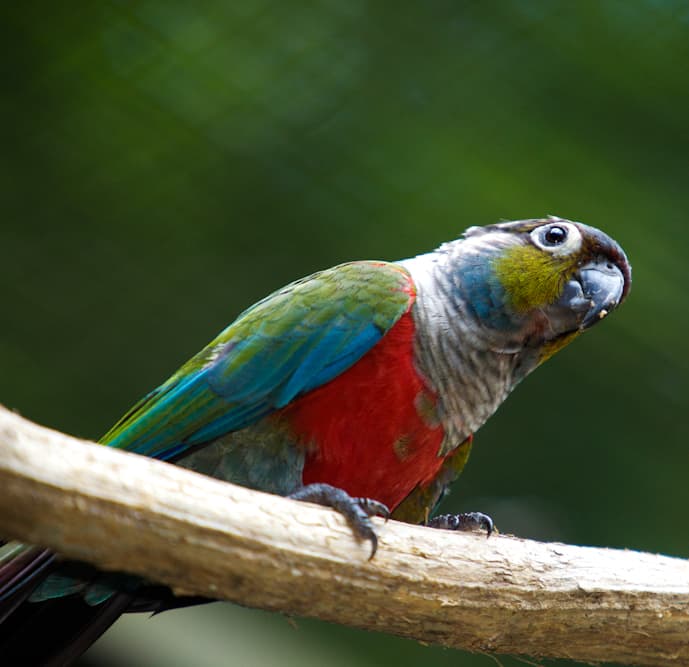
The crimson-bellied parakeet, also known as the crimson-bellied conure in aviculture, is a species of parrot native to Bolivia and Brazil. This bird is distinctive for its striking red belly contrasting with its predominantly green plumage, and it inhabits the canopy of humid forests. Despite its large range, its population is believed to be decreasing due to deforestation.
Brown-hooded parrot
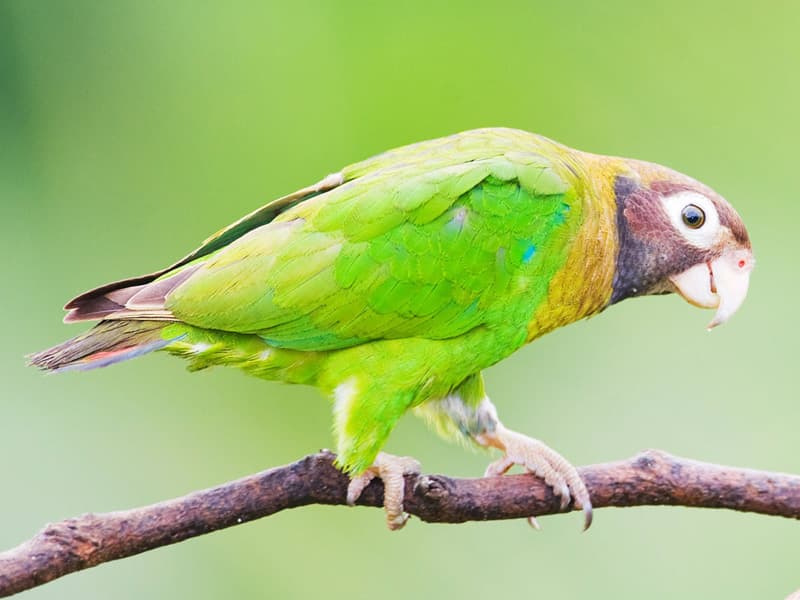
The brown-hooded parrot is a species of parrot found from Mexico to Colombia, belonging to the family Psittacidae. It is distinguished by its vibrant plumage, featuring a reddish-brown crown and throat, olive-yellow breast, and green body with blue accents on the wings and tail.