
Buru racket-tail
Prioniturus mada·Psittaculidae·32·December-February
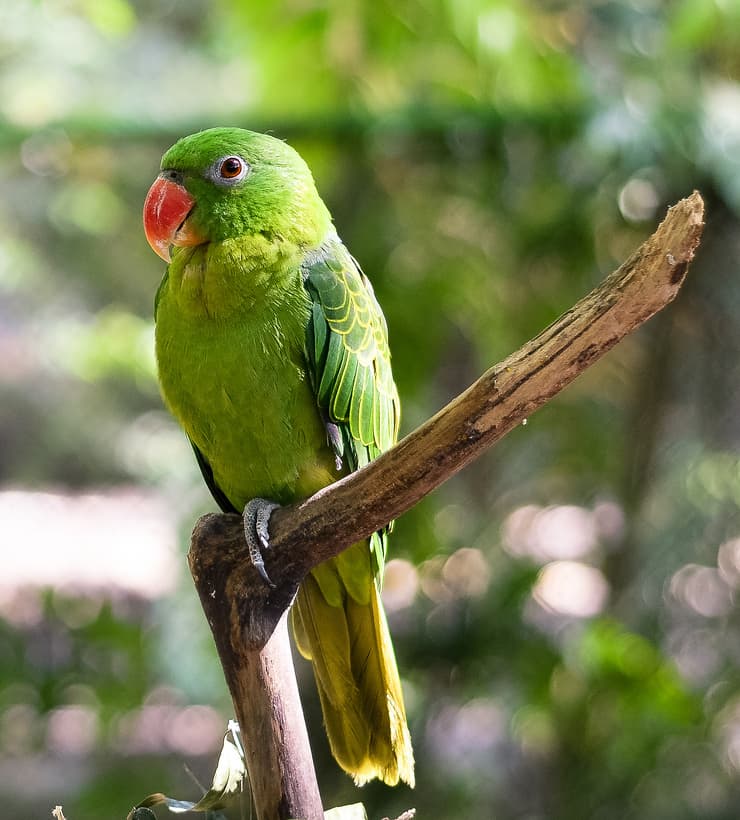
The Buru racket-tail is a species of parrot endemic to the forests of Buru Island in Indonesia. This primarily green parrot is distinguished by its racket-shaped tail feathers, which are absent in juveniles. It inhabits various forest types and is often seen in cultivated areas, feeding on fruits, seeds, and flowers.
Key Facts
- ›Endemic to the island of Buru in Indonesia.
- ›Primarily green plumage with blue markings on the male's back and wings.
- ›Adult males have distinctive racket-shaped tail feathers.
- ›Found in old-growth and secondary forests, as well as cultivated areas.
- ›Diet consists of wild fruits, seeds, berries, and flowers.
- ›Breeding season typically occurs from December to February.

Buru Racquet-Tail
Indonesia
Old-Growth Forest, Secondary Forest, Cultivated Areas, Farms, Villages
Racket-Shaped Tail Feathers, Blue Upper-Parts, Blue Nape
Wild Fruits, Seeds, Berries, Flowers
About Buru racket-tail
The Buru racket-tail (Prioniturus mada) is a distinct parrot species found exclusively on the Indonesian island of Buru, within the Maluku Islands. It belongs to the Psittaculidae family and is characterized by its primarily green plumage, measuring approximately 32 cm in length. A notable feature, particularly in adult males, is the presence of racket-shaped tail feathers, which are absent in juveniles. Adult males also exhibit striking blue coloration on their upper parts, extending from the head to the mid-back and into the upper surfaces of their forewings, while females possess a smaller area of blue on the nape.
Habitat and Ecology
This species is typically found in various forest environments up to elevations of about 1600 meters. It thrives in both mature, old-growth forests and taller secondary forests. The Buru racket-tail is also commonly observed in the remaining trees within cultivated landscapes, such as farms and small villages, indicating a degree of adaptability. Ecologically, they are often seen in flocks of up to ten birds and exhibit seasonal nomadic behavior, migrating to areas with abundant fruiting trees. Their diet is largely composed of natural resources, including wild fruits, seeds, berries, and flowers.
Conservation Concerns
Like many avian species in Indonesia, the Buru racket-tail faces significant threats. Habitat destruction, driven by the expansion of plantations, logging, and mining operations, is a primary concern. Furthermore, the species is vulnerable to trapping for the exotic pet trade, which further endangers its wild populations. The known breeding season for the Buru racket-tail occurs from December to February, during which females typically lay clutches of up to five eggs.
Source: Wikipedia ↗
Frequently Asked Questions
Where does the Buru racket-tail live?
The Buru racket-tail is exclusively found on the Indonesian island of Buru, within the Maluku Islands archipelago. It inhabits various types of forest, including old-growth and secondary forests, and can also be seen in cultivated areas near farms and villages.
What makes the Buru racket-tail distinctive?
The most distinctive feature of the adult Buru racket-tail is its racket-shaped tail feathers. Adult males also display notable blue plumage on their upper parts, extending to their wings, while females have a smaller blue patch on the nape.
What is the diet of the Buru racket-tail?
The diet of the Buru racket-tail primarily consists of natural food sources found in its environment. This includes a variety of wild fruits, seeds, berries, and flowers.
When do Buru racket-tails breed?
The known breeding season for the Buru racket-tail typically falls between December and February. During this period, females are known to lay clutches of up to five eggs.
What are the threats facing the Buru racket-tail?
The Buru racket-tail faces significant threats from habitat destruction due to deforestation for plantations, logging, and mining. Additionally, trapping for the exotic pet trade poses a danger to its population.
Related Parrot species

Australian king parrot
The Australian king parrot is a striking parrot species native to the humid, forested eastern regions of Australia. It is distinguished by the vibrant red plumage of the adult male, contrasting with the predominantly green female. These parrots are known for their relatively quiet nature and devotion to their human companions when kept as pets.
Blue-backed parrot
The blue-backed parrot is a large, endangered parrot species endemic to the Philippines. Primarily green with distinctive blue rump and wing bends, it is often confused with the blue-naped parrot but can be differentiated by its red iris, more pronounced sexual dimorphism, and vocalizations. Its main threats are habitat loss and trapping for the pet trade, leading to a critically low population.

Blue-crowned hanging parrot
The blue-crowned hanging parrot is a small parrot species found in Southeast Asia, known for its vibrant green plumage and a distinctive blue crown on the male's head. These parrots are notable for their unique habit of sleeping upside down, a behavior believed to be an adaptation for predator avoidance. They play a cultural role in some regions, symbolizing love and courage.