
Cape parrot
Threatened (implied by conservation efforts and threats)
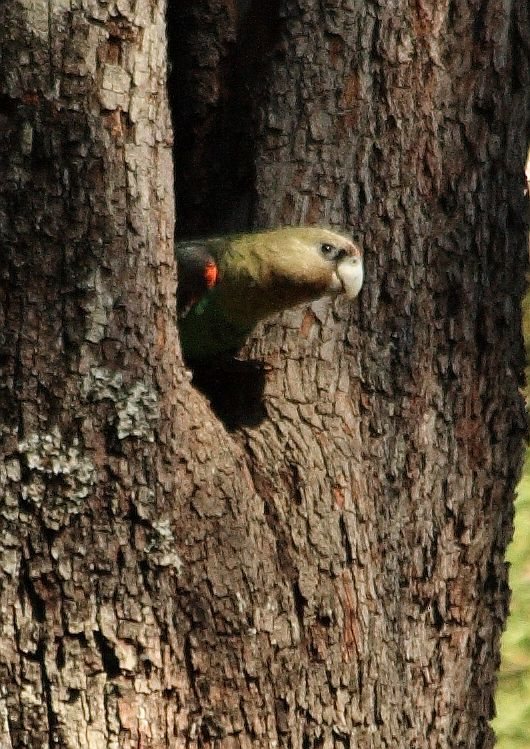
The Cape parrot (Poicephalus robustus), also known as Levaillant's parrot, is a large parrot endemic to the temperate Afromontane forests of South Africa. It is distinguished by its very large beak, used for cracking hard nuts and fruit kernels, and a distinctive olive-yellow head, differentiating it from closely related savanna species. The species faces threats from habitat loss and a specific viral disease, leading to conservation efforts.
Key Facts
- ›Endemic to the Afromontane forests of South Africa.
- ›Possesses a very large beak adapted for cracking hard nuts and fruit kernels.
- ›Females typically have an orange frontal patch on their forehead.
- ›Juveniles have a larger orange-pink forehead patch but lack red on shoulders and legs.
- ›Threatened by habitat reduction due to logging and modification of African yellowwood trees.
- ›Subject to an annual population count known as the "Cape Parrot Big Birding Day".
Levaillant's Parrot
South Africa
Afromontane Forests, Temperate Forests
Very Large Beak, Short Tail, Olive-Yellow Head
Hard Nuts, Fruit Kernels, African Yellowwood Tree Seeds
Intelligent
Raucous Calls
Tree Cavities
About Cape parrot
The Cape Parrot: An Endemic Jewel of South African Forests
The Cape parrot (Poicephalus robustus), also known by the common name Levaillant's parrot, is a striking parrot species found exclusively in the temperate Afromontane forests of South Africa. This moderately large bird is characterized by its robust build and a distinctively large beak, perfectly adapted for cracking the hard nuts and fruit kernels found in its habitat, particularly those of African yellowwood trees. Unlike its savanna-dwelling relatives, the Cape parrot thrives in forest environments at mid-altitudes.
Taxonomy and Distinctiveness
Historically grouped with the brown-necked parrot and grey-headed parrot, genetic analysis has confirmed the Cape parrot as a distinct species. It is distinguished by its olive-yellow head, differing from the silvery-grey head of the brown-necked parrot. The species is monotypic, meaning no subspecies are recognized. This divergence is thought to have occurred millions of years ago during periods of significant climate change that altered forest and grassland ecosystems.
Distribution and Habitat
The Cape parrot's range is confined to South Africa, specifically within Afromontane forests. These forests are often fragmented, with the largest populations centered around the Amathole mountains in the Eastern Cape Province and extending into KwaZulu-Natal. A small, isolated population also exists in the Magoebaskloof area of Limpopo Province. The species prefers habitats dominated by yellowwood trees (Podocarpus spp.), which provide essential food and nesting sites.
Physical Characteristics and Diet
Cape parrots are notable for their very large beaks, a key adaptation for their diet. They primarily consume hard nuts and fruit kernels, with a particular fondness for African yellowwood fruits. The species exhibits sexual dimorphism; females typically possess an orange frontal patch on their forehead, a feature also present in juveniles but usually more prominent. Adults may also display red coloration on their shoulders and legs.
Conservation Concerns and Efforts
The survival of the Cape parrot is precarious due to several threats. Habitat reduction, driven by logging and the modification of their preferred yellowwood trees, diminishes both food sources and essential nesting cavities. Furthermore, the species is highly susceptible to the Psittacine beak and feather disease virus (BFDV), which can be fatal. Conservation initiatives include an annual population count, the "Cape Parrot Big Birding Day," to monitor numbers and distribution. Efforts to mitigate habitat loss and provide nesting boxes are also underway, offering a glimmer of hope for the species' future.
Source: Wikipedia ↗
Frequently Asked Questions
What is the scientific name for the Cape parrot?
The scientific name for the Cape parrot is Poicephalus robustus. This binomial name was coined by Johann Friedrich Gmelin in 1788, citing the earlier work of John Latham.
Where does the Cape parrot naturally live?
The Cape parrot is endemic to South Africa, specifically inhabiting Afromontane forests at moderate altitudes. Its distribution is disjunct, with populations found in areas like the Amathole mountains and the southern midlands of KwaZulu-Natal.
What makes the Cape parrot's beak distinctive?
The Cape parrot has a very large beak, which is a distinctive feature adapted for cracking all sorts of hard nuts and fruit kernels. This specialized beak is particularly useful for consuming the seeds of African yellowwood trees.
How can male and female Cape parrots be distinguished?
The species exhibits sexual dimorphism, with females typically displaying an orange frontal patch on their forehead. Juveniles also have a similar patch, but it is larger and more pronounced.
What are the main threats to the Cape parrot population?
The Cape parrot is threatened by habitat reduction, primarily due to logging and the modification of African yellowwood trees, which are crucial for their diet and nesting. Additionally, the species is vulnerable to the fatal Psittacine beak and feather disease virus (BFDV).
How is the population of Cape parrots monitored?
An annual population count called the "Cape Parrot Big Birding Day" takes place on the first weekend of May. Volunteers count the parrots throughout their distribution, observing their distinctive silhouettes and flight patterns at roosting sites.
Related Parrot species

Pohnpei lorikeet
The Pohnpei lorikeet (Trichoglossus rubiginosus), also known as serehd in Pohnpeian, is a parrot species endemic to Pohnpei and the Ant Atoll in Micronesia. It is distinguished by its predominantly reddish-maroon plumage with darker striations, and slight differences in beak and iris color between males and females.

Fuertes's parrot
Fuertes's parrot, also known as the indigo-winged parrot, is an endangered species endemic to the west slope of Colombia's Central Andes. This parrot is distinguished by its striking blue and green plumage, accented with red and violet-blue markings on its wings and tail. It inhabits wet temperate cloudforests and is known to feed in flocks, with conservation efforts focusing on nest box programs to aid its population recovery.

Cordilleran parakeet
The Cordilleran parakeet is a species of bird found in Ecuador and Peru, belonging to the Psittacidae family. This parakeet is characterized by its predominantly green plumage with red markings on its forehead and wing bends, and it is known for its vocal nature, often traveling in small flocks within a variety of Andean forest habitats.