
Cuban parakeet
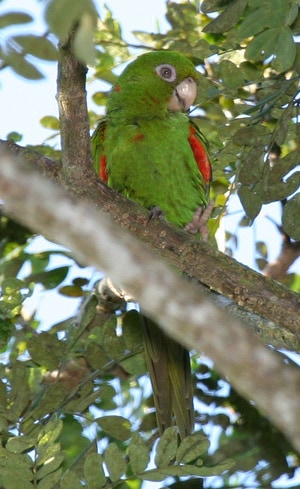
The Cuban parakeet (Psittacara euops) is a Vulnerable species of bird endemic to Cuba, characterized by its predominantly yellow-green plumage with distinctive red markings on the head, neck, and breast. It inhabits savannas with palms and montane forests, where it nests in cavities. This highly social bird is known for its varied vocalizations and faces threats from habitat loss and illegal trapping.
Key Facts
- ›Endemic to the island of Cuba.
- ›Adults are primarily yellow-green with red spots on the head, neck, and breast.
- ›Inhabits savannas with palms and montane forests.
- ›Nests are typically found in holes excavated by woodpeckers.
- ›Diet consists of seeds, fruits, flower buds, pollen, and nectar.
- ›Listed as Vulnerable by the IUCN due to a small, fragmented range and decreasing population.
Cuba
Savannas With Palms and Isolated Trees, Evergreen and Semi-Deciduous Montane Forest
- Red spots on head, neck, and breast
- Bright red on the edge of the wing and underwing coverts
- Pale yellow eye surrounded by bare pink to reddish-white skin
Seeds, Fruits, Flower Buds, Pollen, Nectar
- Variety of vocalizations
- Warning calls: metallic, described as 'Erh, erh, erh, erh'
- Contact call: described as 'Kkkkeeeeerrrrrrrrrrrrrr'
- Flight contact call: similar to warning call, used during takeoff and landing
- Courtship calls: smooth and short, sounding like 'Keirp-keirp-keirp'
Nests in holes excavated by woodpeckers, Cavities in limestone cliffs are also used
About Cuban parakeet
The Cuban parakeet (Psittacara euops) is a species of bird native exclusively to the island of Cuba. It belongs to the family Psittacidae, which encompasses African and New World parrots. For a period, it was classified under the genus Aratinga, but has since been placed in the genus Psittacara.
Description and Appearance
Adult Cuban parakeets typically measure between 22 to 29 cm (8.7 to 11 inches) in length and weigh between 78 to 96 grams (2.8 to 3.4 ounces). Their plumage is predominantly yellow-green, with paler underparts. A distinctive feature is the scattering of red spots on their head, neck, and breast; these markings are generally more pronounced in males than in females. The edges of their wings and their underwing coverts are a bright red. The undersides of their flight feathers and tail exhibit a pale green to olive hue. Their eyes are light yellow, encircled by bare skin that ranges from light pink to reddish-white. The bill is light pink, and their feet are pink to ivory. Juveniles share a resemblance to adults but exhibit minimal to no red coloration on the head and breast.
Distribution and Habitat
Historically, the Cuban parakeet was found across the main island of Cuba and on Isla de la Juventud (Isle of Pines). However, it was extirpated from Isla de la Juventud by around 1900. In the 21st century, its distribution is fragmented, with populations found in the Zapata Swamp, various provinces including Villa Clara, Ciego de Ávila, Sancti Spíritus, Camagüey, and Guantanamo, as well as in the western Escambray Mountains and the Cauto River watershed.
The species inhabits two distinct ecological landscapes: savannas characterized by numerous palms and scattered trees, and evergreen and semi-deciduous montane forests. Royal palms are a common element in both these environments and are the preferred substrate for nesting.
Behavior and Diet
The Cuban parakeet is a highly social bird, typically observed in flocks that can comprise up to approximately 50 individuals. They are not migratory. Their diet is varied, consisting of seeds, fruits (both mature and immature), flower buds, pollen, and nectar. More than 50 different plant species have been documented as food sources for this parakeet.
Breeding Habits
Breeding for the Cuban parakeet occurs between February and September. Nests are predominantly located in cavities excavated by woodpeckers, although holes in limestone cliffs are also utilized. While no nesting material is added, adults may loosen chips from the inner walls of tree or palm cavities to line the bottom. A clutch typically consists of two to five eggs, with an average of four. The incubation period lasts approximately 24 days, and fledging occurs 55 to 60 days after hatching. The male plays a role in feeding by bringing food to the nest for the female, who then feeds the young.
Vocalizations
The Cuban parakeet possesses a range of vocalizations. Its warning calls, issued in response to predators, are described as metallic and are rendered as 'erh, erh, erh, erh.' The contact call, used while feeding, is characterized as 'kkkkeeeeerrrrrrrrrrrrrr.' A flight contact call, similar to the warning call, is employed during takeoff and landing. Courtship calls are noted as being smooth, short, and sounding like 'keirp-keirp-keirp.'
Conservation Status
The International Union for Conservation of Nature (IUCN) initially assessed the Cuban parakeet as Threatened. Since 1994, it has been rated as Vulnerable. The species faces challenges due to its small and fragmented range, with an estimated population of 1,500 to 7,000 mature individuals that is believed to be declining. Habitat loss and illegal trapping for the pet trade are identified as the principal threats. Furthermore, the increasing severity and frequency of hurricanes, attributed to climate change, pose a potential additional risk. Cuban authorities have suggested that the IUCN rating be elevated to Endangered. A majority of the remaining populations are situated in areas offering some level of protection.
Source: Wikipedia ↗
Frequently Asked Questions
What is the scientific name of the Cuban parakeet?
The scientific name of the Cuban parakeet is Psittacara euops. It was formerly placed in the genus Aratinga but has been in its present genus Psittacara since approximately 2013.
What is the typical size and weight of a Cuban parakeet?
The Cuban parakeet measures between 22 to 29 cm (8.7 to 11 inches) in length and typically weighs between 78 to 96 grams (2.8 to 3.4 ounces).
What are the main threats facing the Cuban parakeet?
The primary threats to the Cuban parakeet are continuing habitat loss and illegal trapping for the cage bird trade. The increasing frequency and intensity of hurricanes due to climate change are also considered a potential threat.
What do Cuban parakeets eat?
The diet of the Cuban parakeet is varied and includes seeds, fruits (both green and ripe), flower buds, pollen, and nectar. Over 50 species of plants have been identified as food sources.
Where do Cuban parakeets build their nests?
Cuban parakeets primarily nest in holes excavated by woodpeckers, though cavities in limestone cliffs are also utilized. Royal palm is a preferred nest substrate.
Related Parrot species
Little lorikeet
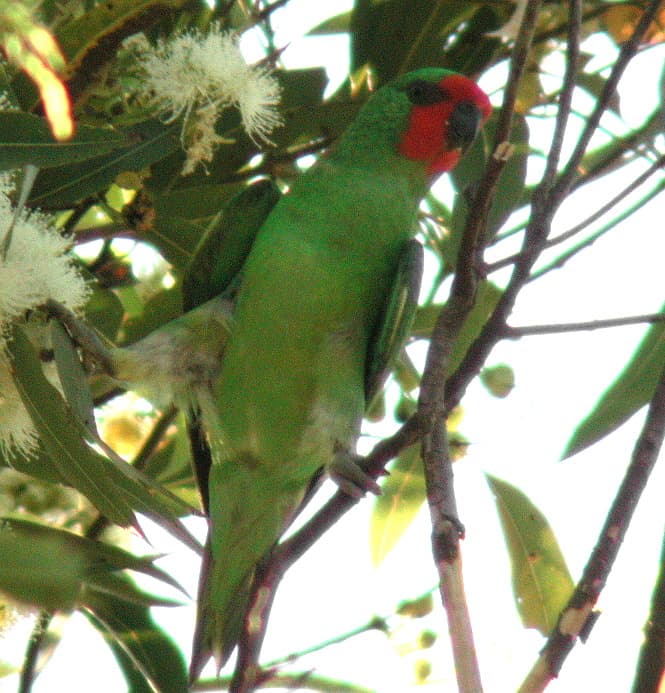
The Little lorikeet (Psitteuteles pusillus) is a small parrot endemic to Australia, characterized by its predominantly green plumage and a distinctive red face. It inhabits temperate and subtropical forests, feeding primarily on nectar and pollen from flowering trees. This species is known for its gregarious nature, often flocking with other lorikeet species.

Blood-eared parakeet
The blood-eared parakeet is a species of parrot endemic to Venezuela, found in cloudforest and wooded savanna habitats. It is distinctive for its bright terracotta ear coverts, slaty gray head, and a mix of green, yellow, and reddish-brown plumage. These parakeets are typically found foraging in small flocks and are known for their noisy, harsh vocalizations.
Brown-necked parrot
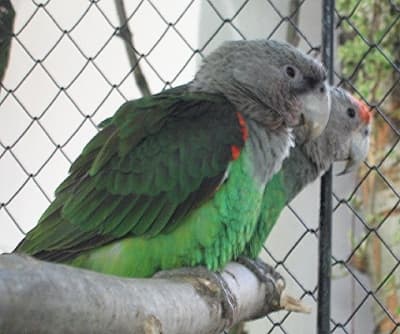
The brown-necked parrot is a large parrot species endemic to Africa, known for its stocky build, large head and bill, and light grey head. It is divided into two subspecies, the savanna-dwelling brown-necked parrot and the grey-headed parrot, and is adaptable to captivity, where it is known for its intelligence and ability to mimic sounds and speech.