
Echo parakeet
The echo parakeet, also known as the Mauritius parakeet, is the sole surviving native parrot of the Mascarene Islands, endemic to Mauritius. This species is distinguished by its vibrant green plumage, featuring two distinct neck collars in males (black and pink) and a less defined set in females (green and indistinct black). Once critically endangered, intensive captive breeding efforts have helped it recover, making it a symbol of successful conservation.
Key Facts
- ›The echo parakeet is the only native parrot species remaining in the Mascarene Islands.
- ›Males have a black and pink neck collar, while females have a green and indistinct black collar.
- ›Its diet primarily consists of fruits and leaves from native and introduced plants.
- ›The species nests in natural cavities of old trees.
- ›Intensive captive breeding programs in the 1990s were crucial in saving the echo parakeet from extinction.
- ›Its conservation status has improved from critically endangered to vulnerable due to population recovery.

Mauritius Parakeet, Cateau Vert, Kato, Katover
Mauritius
Forests With Native Vegetation, Canopy
- Two Neck Collars
- Orange Skin Around the Eyes
- Male Has A Red Upper Bill, Female Has A Dark/Black Upper Bill
Fruits, Leaves
Arboreal, Keeps To the Canopy
- Wide Range of Vocalisations
- Common Call Sounds Like "Chaa-Chaa, Chaa-Chaa"
Natural Cavities In Old Trees
About Echo parakeet
The echo parakeet (Psittacula eques), also commonly known as the Mauritius parakeet, holds the distinction of being the sole surviving native parrot species of the Mascarene Islands. Its natural range is limited to the island of Mauritius, where it inhabits forests rich in native vegetation, primarily residing in the canopy.
Physical Characteristics and Identification
This parrot is typically green, with males generally being lighter and females darker. A defining feature for both sexes is the presence of two neck collars, though they differ significantly. Adult males display a striking combination of a black and a pink collar, with the male also possessing a bright red upper bill. Females, on the other hand, have a less distinct black collar and a green collar, with their upper bill being dark, almost black. The skin around their eyes is orange, and their feet are grey.
Diet and Reproduction
The echo parakeet's diet in the wild consists mainly of fruits and leaves from both native and introduced plant species. They are arboreal, spending most of their time feeding and resting in the trees. Reproduction involves nesting in natural cavities found in old trees. Clutches typically contain two to four white eggs. The female incubates the eggs while the male provides her with food, and the female also broods the young.
Conservation Status and History
Historically, the echo parakeet faced severe threats from hunting and habitat destruction, leading to a drastic decline in its population, which at one point numbered as few as eight to twelve individuals. This dire situation led to it being referred to as "the world's rarest parrot." Fortunately, an intensive captive breeding program initiated in the 1990s proved instrumental in saving the species from extinction. As a result of these conservation efforts, its status has improved significantly, moving from critically endangered to endangered, and more recently to vulnerable, with the population recovering to several hundred birds.
Taxonomy and Evolution
Genetic studies have placed the echo parakeet within the Psittacula genus, suggesting a relatively recent divergence from its ancestors. Its closest relatives include Newton's parakeet of Rodrigues and the rose-ringed parakeet found in Asia and Africa. The binomial name Psittacula eques is derived from the Latin word for "horseman," referencing military colors, and was first applied to the extinct Réunion parakeet population.
Source: Wikipedia ↗
Frequently Asked Questions
What is the scientific name for the echo parakeet?
The scientific name for the echo parakeet is *Psittacula eques*. This name is used for the species as a whole, with the subspecies previously recognized on Réunion and Mauritius being designated as *P. eques eques* and *P. eques echo*, respectively.
Where are echo parakeets found naturally?
Echo parakeets are endemic to the Mascarene Islands, specifically Mauritius. They are largely restricted to forest areas with native vegetation, primarily within Black River Gorges National Park in southwestern Mauritius.
What are the key physical differences between male and female echo parakeets?
Adult males are generally lighter green and possess a distinct black and pink collar around their neck, with the male's upper bill being bright red. Females are darker green overall, have an indistinct black collar and a green collar, and their upper bill is dark, almost black.
What is the conservation status of the echo parakeet?
The echo parakeet was once considered one of the world's rarest parrots, reaching critically endangered status. Due to significant conservation efforts, including intensive captive breeding, its status has improved, and it is now classified as vulnerable.
What do echo parakeets eat in the wild?
In their natural habitat, echo parakeets primarily feed on the fruits and leaves of native plants. They have also been observed consuming introduced plant species.
How long do echo parakeets live?
Detailed information regarding the lifespan of echo parakeets in the wild is not extensively documented. However, like many parrot species, they are expected to have a relatively long lifespan, particularly in protected environments or captivity.
What makes the echo parakeet unique among Mascarene parrots?
The echo parakeet is unique as it is the only living native parrot species of the Mascarene Islands. All other native parrot species from this region have unfortunately become extinct due to human activities.
Related Parrot species

Black-lored parrot
The black-lored parrot, also known as the Buru green parrot, is a parrot species endemic to the Indonesian island of Buru. It is distinguished by its 40 cm length, green plumage, black lores, and turquoise crown, with males featuring red beaks and females being gray-brown. Its singing is notable for being high-pitched and more protracted compared to similar species.

Pesquet's parrot
Pesquet's parrot is a large, distinctive parrot native to the hill and montane rainforests of New Guinea. It is characterized by its black plumage with striking red markings on its belly and wings, and a unique bare, black facial skin giving it a vulture-like appearance. Primarily feeding on figs and other fruits, this species is known for its specialized diet and is currently listed as Vulnerable due to overhunting and habitat loss.
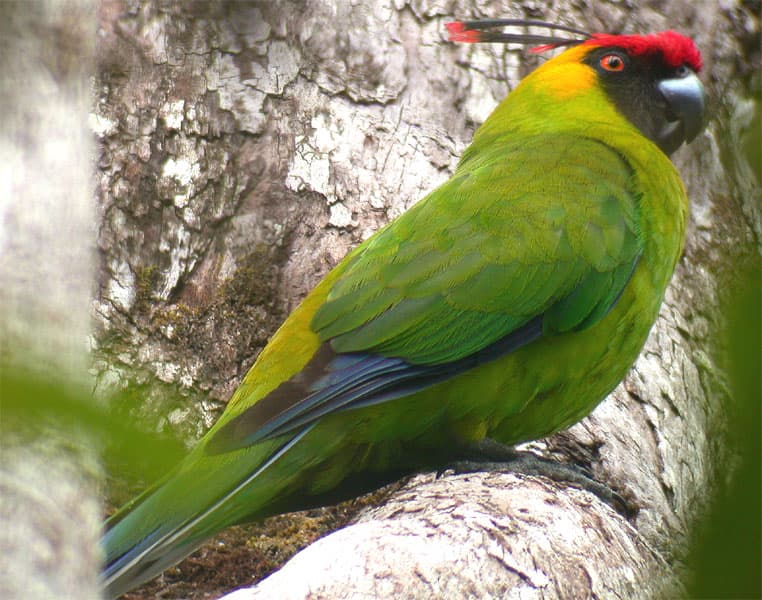
Horned parakeet
The horned parakeet (Eunymphicus cornutus) is a medium-sized parrot native to New Caledonia. It is distinguished by two prominent black crest feathers tipped with red that protrude from its head. Primarily green with a yellowish nape, black and red face, and bluish wings and tail, this species inhabits rainforests and scrublands.