
Festive amazon
The Festive Amazon is a vibrant parrot species known for its colorful plumage, primarily found in the Amazon and Orinoco river basins of South America. It is distinguished by patches of red on its forehead and blue on its face, with deep blue outer wings and a red rump visible in flight. While historically considered common, its population has declined due to deforestation and hunting, leading to its current classification as vulnerable.
Key Facts
- ›Native to Brazil, Colombia, Ecuador, Bolivia, Guyana, Peru, and Venezuela.
- ›Inhabits forests, particularly Várzea, and woodlands near major rivers, also found in coastal mangroves.
- ›Possesses red forecrown and blue facial coloration, with deep blue outer wings and a red rump.
- ›Has two recognized subspecies: a. f. festiva and a. f. bodini.
- ›Classified as vulnerable by Birdlife International and IUCN due to deforestation and hunting pressures.
- ›Can be observed near larger cities within its range.

Festive Parrot
South America
Forest, VáRzea Forest, Woodland Near Rivers, Coastal Mangroves
Red Forecrown, Blue Face, Deep Blue Outer Wings, Red Rump
Not Specified
Not Specified
Not Specified
Not Specified
About Festive amazon
The Festive Amazon (Amazona festiva), also known as the festive parrot, is a species of parrot native to South America. Its range encompasses countries such as Brazil, Colombia, Ecuador, Bolivia, Guyana, Peru, and Venezuela. This species is closely tied to forested environments, particularly Várzea forests and woodlands situated near major rivers. It has also been observed in coastal mangrove areas.
Taxonomy and Description
First formally described by Carl Linnaeus in 1758, the Festive Amazon was initially placed in the genus Psittacus before being reclassified into the genus Amazona. The species name, "festiva," is derived from the Latin word for "festive" or "cheerful." Two subspecies are recognized: A. f. festiva and A. f. bodini. The subspecies A. f. bodini is distinguished by more extensive red coloration on its forecrown and a greater extent of blue on its face compared to the nominate subspecies. Both subspecies share prominent markings in flight, including deep blue on the outer wings and a red rump, although these are less pronounced in juvenile birds.
Distribution and Habitat
The nominate subspecies, A. f. festiva, primarily inhabits areas along the Amazon River, while the subspecies A. f. bodini is found near the Orinoco River. Their preferred habitats are forests and woodlands adjacent to significant river systems, with a notable presence in coastal mangroves.
Conservation Status
Historically, the Festive Amazon was considered fairly common across much of its extensive range, even appearing near urban centers like Manaus and Iquitos. However, its population has experienced local declines. Consequently, it was uplisted to Vulnerable status by BirdLife International and the IUCN in 2012. This reclassification is attributed to projections of rapid population decline over the next three generations, driven by the ongoing deforestation of the Amazon Rainforest and the species' susceptibility to hunting.
Source: Wikipedia ↗
Frequently Asked Questions
What is the Festive Amazon's scientific name and common names?
The scientific name for the Festive Amazon is Amazona festiva. It is also commonly referred to as the festive parrot.
Where is the Festive Amazon found geographically?
The Festive Amazon is found across several South American countries, including Brazil, Colombia, Ecuador, Bolivia, Guyana, Peru, and Venezuela. It primarily inhabits regions along the Amazon and Orinoco rivers.
What type of habitat does the Festive Amazon prefer?
This species is closely associated with forests, especially Várzea forests, and woodlands that grow near major rivers. It can also be found in coastal mangroves.
What are the distinctive physical features of the Festive Amazon?
The Festive Amazon is characterized by red coloration on its forecrown and blue on its face. In flight, its outer wings are a deep blue, and it displays a red rump, though this is less pronounced in juveniles.
What is the conservation status of the Festive Amazon?
The Festive Amazon is currently classified as Vulnerable by the IUCN and BirdLife International. This status reflects concerns about population decline due to deforestation and hunting.
Are there different subspecies of the Festive Amazon?
Yes, there are two recognized subspecies: Amazona festiva festiva, which is found in west Amazonia, and Amazona festiva bodini, found in east Colombia, east Venezuela, and Guyana. Subspecies bodini tends to have more red on the forecrown and more blue on the face.
Related Parrot species
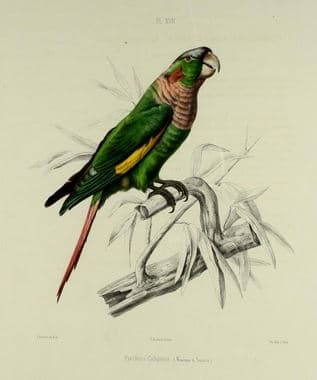
Flame-winged parakeet
The flame-winged parakeet, also known as the brown-breasted parakeet, is a medium-sized parrot endemic to the eastern Andean slopes of Colombia. This species is distinguished by its bright yellow primary coverts and bluish primaries, with vivid yellow and orange-red wing markings visible in flight, which give it its common name. It is currently facing threats from habitat loss and fragmentation, leading to a declining population.
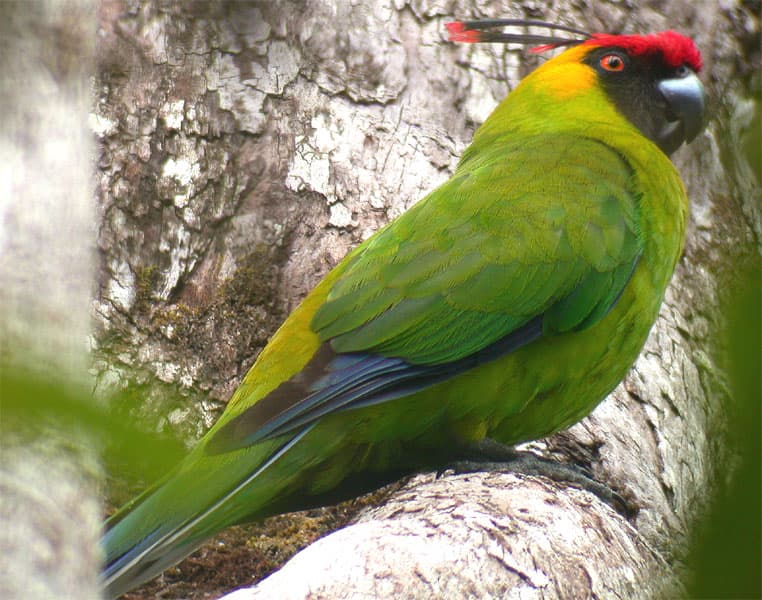
Horned parakeet
The horned parakeet (Eunymphicus cornutus) is a medium-sized parrot native to New Caledonia. It is distinguished by two prominent black crest feathers tipped with red that protrude from its head. Primarily green with a yellowish nape, black and red face, and bluish wings and tail, this species inhabits rainforests and scrublands.
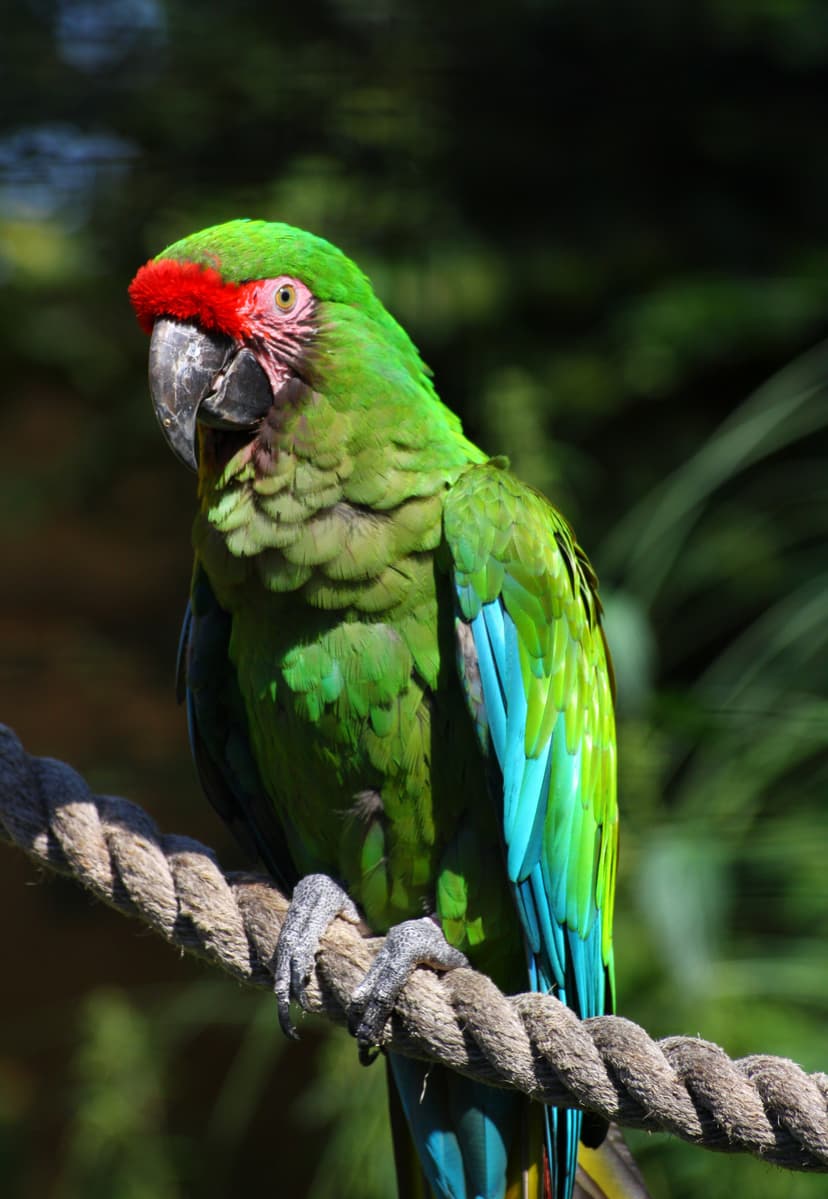
Military macaw
The military macaw (Ara militaris) is a medium to large parrot recognized by its predominantly green plumage accented with blue and yellow, and a distinctive red forehead patch, reminiscent of a military uniform. Native to a range stretching from west-central Mexico down to northern Argentina and Bolivia, these macaws are known for their loud vocalizations and social behavior. While facing conservation challenges, they are also commonly found in captivity due to their relative ease of breeding and long lifespan.