
Military macaw
The military macaw (Ara militaris) is a medium to large parrot recognized by its predominantly green plumage accented with blue and yellow, and a distinctive red forehead patch, reminiscent of a military uniform. Native to a range stretching from west-central Mexico down to northern Argentina and Bolivia, these macaws are known for their loud vocalizations and social behavior. While facing conservation challenges, they are also commonly found in captivity due to their relative ease of breeding and long lifespan.
Key Facts
- ›Predominantly green plumage with blue and yellow flight feathers and a red forehead patch.
- ›Native to tropical deciduous and semi-deciduous forests from Mexico to Argentina and Bolivia.
- ›Known for loud, raucous vocalizations and social behavior, often seen in large flocks.
- ›Diet primarily consists of seeds, fruits, and leaves, with a notable habit of visiting clay licks.
- ›Can live for 50-60 years in the wild and are among the longest-lived pet birds.
- ›Subspecies include Ara M. mexicanus, Ara M. militaris, and Ara M. bolivianus.
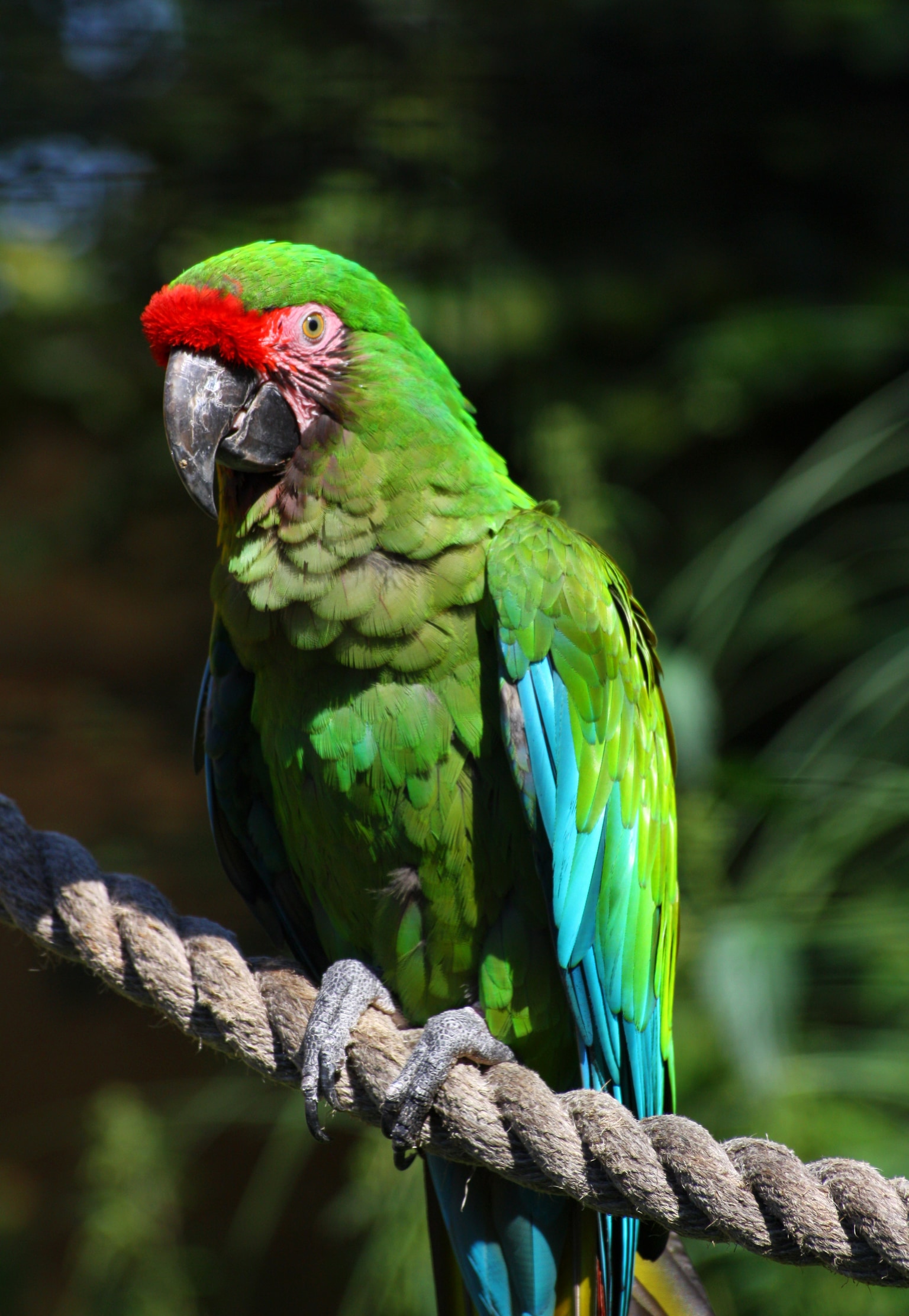
Military Macaw
Mexico, Central America, South America
Tropical Deciduous Forests, Semi-Deciduous Forests, Canopy Species, Humid Forests, Thorny Woodlands
Red Forehead Patch, Bare Facial Skin With Black Striations, Slate-Grey Bill
Seeds, Fruits, Leaves, Clay
- Social
- Noisy
- Requires advanced knowledge and experience to keep healthy and stimulated
Loud Cracking and Shrieking Sounds, Loud Kraa-Aak, Can Be Heard Long Before Seen
Cavity Nesters, Natural Cavities In Trees, Cavities In Cliffs
About Military macaw
The military macaw (Ara militaris) is a striking medium to large parrot, distinguished by its predominantly green plumage, accented by vibrant blue and yellow flight and tail feathers, and a characteristic bright red patch on its forehead. This coloration vaguely resembles a military uniform, lending the species its name. They are native to a broad geographical range that extends from west-central Mexico southward through northern Argentina and Bolivia.
Habitat and Distribution
These macaws primarily inhabit tropical deciduous and semi-deciduous forests, acting as canopy species that rely on large trees for feeding, breeding, and nesting. They are typically found at elevations between 600 to 1500 meters, often higher in mountainous regions than many other macaw species. While they favor these specific forest types, they may seasonally descend to lowlands, where they can be found in humid forests and thorny woodlands. The three recognized subspecies—A. m. mexicanus, A. m. militaris, and A. m. bolivianus—are distinguished by their specific geographic locations across Mexico, Colombia, Ecuador, Peru, Bolivia, and Argentina.
Diet and Behavior
Military macaws are social creatures, often living in large flocks, and their presence is frequently announced by their loud, raucous vocalizations long before they are seen. They are most active in the morning and evening. Their diet consists mainly of seeds, supplemented by fruits and leaves. A notable behavior is their flocking to clay deposits, known as 'macaw licks,' located along riverbanks. It is believed that consuming this clay helps them to neutralize toxins found in their food and to obtain essential dietary salts.
Breeding and Conservation
Breeding behaviors, including mutual grooming and regurgitation, are observed throughout the year. The courtship period can begin as early as March, with copulation occurring from May to July. The nesting season typically spans from March to October, with incubation and hatching occurring in August and September. They are cavity nesters, utilizing natural holes in trees or cliff faces. In captivity, military macaws can be bred with relative ease and are available in the pet trade. However, wild populations face significant threats, including habitat loss due to agriculture, deforestation, mining, and road construction, leading to their classification as vulnerable by the IUCN. Their somewhat narrow diet also poses a conservation concern, as a significant impact on their food sources could severely affect the species.
Source: Wikipedia ↗
Frequently Asked Questions
What does the military macaw look like?
Military macaws are largely green with blue and yellow flight and tail feathers. They have a bright red patch on their forehead and a bare, whitish face with black striations. Their bill is large, strong, and slate-grey.
Where do military macaws live in the wild?
These macaws are found from west-central Mexico south through northern Argentina and Bolivia. They typically inhabit tropical deciduous and semi-deciduous forests, often at higher elevations than other macaws.
What do military macaws eat?
Their diet is primarily composed of seeds, supplemented with fruits and leaves. They are also known to visit clay licks along riverbanks, which may help detoxify seeds and provide essential salts.
What is the conservation status of the military macaw?
The military macaw is listed as vulnerable by the IUCN due to threats like habitat loss from deforestation and mining. Their populations are fragmented, and commercial international trade in wild specimens is prohibited.
Are military macaws noisy birds?
Yes, military macaws are very noisy birds, making a variety of loud cracking and shrieking sounds. They can often be heard long before they are seen.
How long do military macaws live?
In the wild, military macaws can live for approximately 50 to 60 years. They are also known to be among the longest-lived pet birds.
Related Parrot species
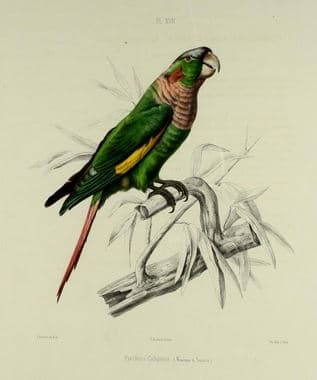
Flame-winged parakeet
The flame-winged parakeet, also known as the brown-breasted parakeet, is a medium-sized parrot endemic to the eastern Andean slopes of Colombia. This species is distinguished by its bright yellow primary coverts and bluish primaries, with vivid yellow and orange-red wing markings visible in flight, which give it its common name. It is currently facing threats from habitat loss and fragmentation, leading to a declining population.

Grey-cheeked parakeet
The grey-cheeked parakeet, also known as the fire-winged parakeet, is a vulnerable bird species native to Ecuador and Peru. It is distinguished by its predominantly green plumage, pale blue crown, ashy gray cheeks, and striking orange to orange-red underwing coverts. This species inhabits a variety of forest types and scrublands and is known for its noisy, chattering vocalizations.
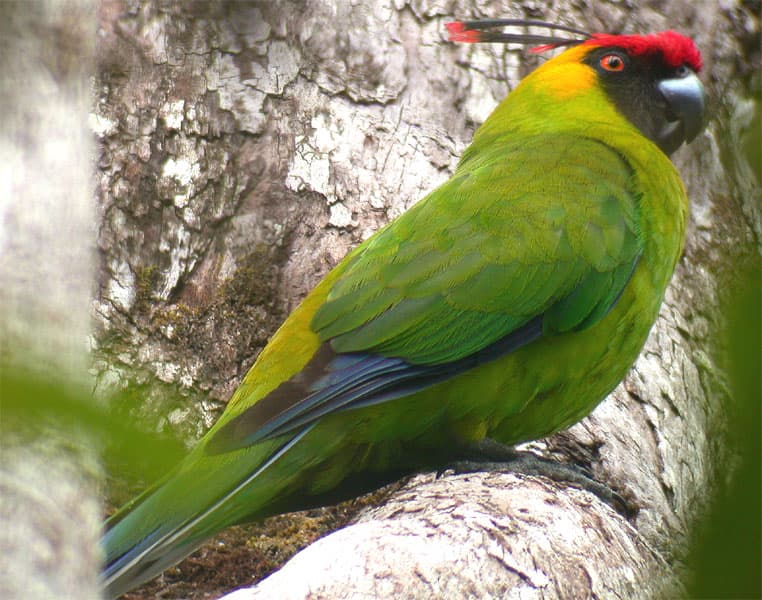
Horned parakeet
The horned parakeet (Eunymphicus cornutus) is a medium-sized parrot native to New Caledonia. It is distinguished by two prominent black crest feathers tipped with red that protrude from its head. Primarily green with a yellowish nape, black and red face, and bluish wings and tail, this species inhabits rainforests and scrublands.