
Niam-Niam parrot
The Niam-Niam parrot is a poorly-known parrot species found in Central Africa, characterized by its predominantly green plumage, grey-brown head, and orange irises. It is notable for being one of the last unphotographed birds in Africa until 2017. The species inhabits plateau savannah and diverse forests within its broad distribution.
Key Facts
- ›The Niam-Niam parrot (Poicephalus crassus) is a member of the Poicephalus genus.
- ›It is primarily green with a grey-brown head and distinctive orange eyes.
- ›The species is found across northern-central western Africa, including the Central African Republic, Cameroon, Chad, DRC, and Sudan.
- ›Its habitat includes plateau savannah and diverse forests.
- ›The Niam-Niam parrot is not known to be sexually dimorphic.
- ›It was one of the last unphotographed birds in Africa, with documentation only emerging in 2017.
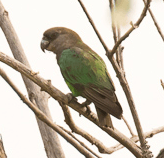
Niam Niam Parrot
Africa
Plateau Savannah, Diverse Forests, Arboreal
Grey-Brown Head and Breast, Orange Irises, Lack of Yellow Under Wings
Seeds, Fruit, Leaves, Nectar, Insects, Maize, Millet
Nesting In Trees
About Niam-Niam parrot
The Niam-Niam parrot, scientifically known as Poicephalus crassus, is a species of parrot belonging to the genus Poicephalus. It is one of the least understood parrots globally, with its existence only being confirmed through photographs relatively recently in 2017. This species is characterized by its predominantly green plumage, a grey-brown head and breast, and striking orange irises.
Distribution and Habitat
The Niam-Niam parrot possesses a broad geographical distribution across northern-central western Africa. Its range encompasses areas from eastern Cameroon and southwestern Chad, extending through the Central African Republic and into the extreme northern Democratic Republic of Congo, and reaching the southwestern edge of Sudan. The species thrives in varied environments, inhabiting both plateau savannah and highly diverse forest ecosystems. As with other Poicephalus parrots, they are arboreal, meaning they rest and build their nests in trees.
Description and Behavior
Visually, the Niam-Niam parrot is not sexually dimorphic, making it difficult to distinguish between males and females based on appearance alone. Key identifying features include its grey-brown head and breast, contrasting with a green belly and upper parts, and green underwings. A notable characteristic is its pale lower beak and distinctive orange eyes. Unlike some of its relatives in the Poicephalus genus, the Niam-Niam parrot lacks yellow coloration on the underside of its wings.
Diet and Conservation
The diet of the Niam-Niam parrot is varied, consisting of seeds, fruits, leaves from a range of trees and shrubs, nectar, and insects. They are also known to consume maize and millet, which can lead to them being perceived as pests by farmers due to potential crop destruction. Regarding its conservation status, the Niam-Niam parrot is classified as 'Least Concern.' While precise data on its distribution and population size remains elusive, it is not currently considered globally threatened, nor does its range meet the criteria for a higher conservation concern classification.
Source: Wikipedia ↗
Frequently Asked Questions
What are the key physical characteristics of the Niam-Niam parrot?
The Niam-Niam parrot is identified by its grey-brown head and breast, a green belly and upper parts, and green underwings. It also features a pale lower beak and striking orange eyes, distinguishing it from other Poicephalus parrots by the absence of yellow under its wings.
Where is the Niam-Niam parrot found?
This parrot has a wide distribution across northern-central western Africa. Its range extends from eastern Cameroon and southwestern Chad, through the Central African Republic and the extreme northern Democratic Republic of Congo, to the southwestern edge of Sudan.
What type of environment does the Niam-Niam parrot inhabit?
The Niam-Niam parrot thrives in both plateau savannah and highly diverse forest ecosystems. Being arboreal, these parrots typically rest and nest in trees within their territories.
What is the diet of the Niam-Niam parrot?
Their diet is varied and includes seeds, fruits, leaves from various trees and shrubs, nectar, insects, maize, and millet. Due to their consumption of crops like maize and millet, farmers may consider them pests.
Is the Niam-Niam parrot endangered?
The conservation status of the Niam-Niam parrot is listed as 'least concern.' While its exact distribution and population numbers are unknown, it is not considered globally threatened, nor does its range approach a size that would warrant a higher threat classification.
What is the lifespan of a Niam-Niam parrot?
The average lifespan of a wild Niam-Niam parrot is not precisely known. However, related species within the Poicephalus genus, such as the Senegal parrot and Meyer's parrot, commonly live for 20–30 years in the wild and can exceed 50 years in captivity.
Are male and female Niam-Niam parrots visually different?
No, Niam-Niam parrots are not known to be sexually dimorphic. This means there are no readily apparent physical differences in appearance between males and females of the species.
Related Parrot species

Burrowing parrot
The burrowing parrot, also known as the Patagonian conure, is a species of parrot native to Argentina and Chile. It is distinguished by its white eye ring, white breast marking, olive green body, and brightly colored underparts. These parrots are unique for excavating elaborate burrows in cliff faces for nesting and raising their young.
Hooded parrot
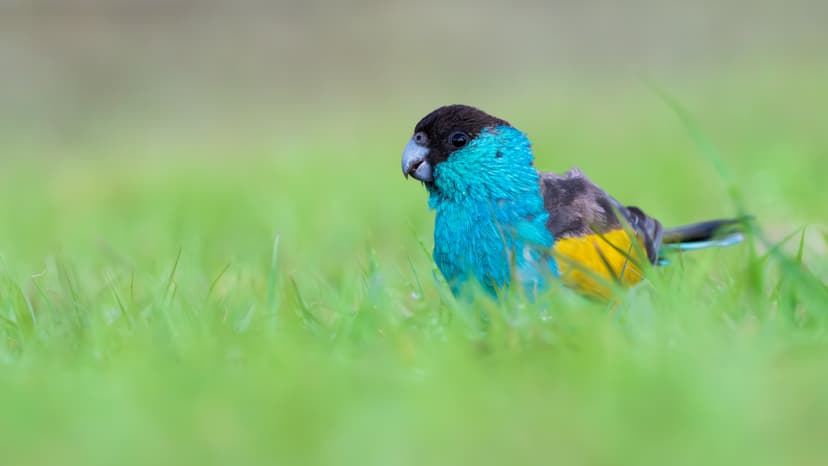
The hooded parrot is a species native to the Northern Territory in Australia, inhabiting savannah and open woodland. It is distinctive for being one of the few parrots that breed in termite mounds, and males are recognized by their black head and yellow wing patches. While once more widespread, it remains common in protected areas.

Blue-rumped parrot
The blue-rumped parrot is a small parrot native to Southeast Asia, found in countries like Malaysia, Borneo, and Sumatra. It is distinguished by its predominantly green plumage, with males featuring a striking blue rump and head, while females have a more subdued grey-brown head. These parrots are often observed in flocks and feed on a diet of seeds, fruits, and blossoms.