
Plum-faced lorikeet
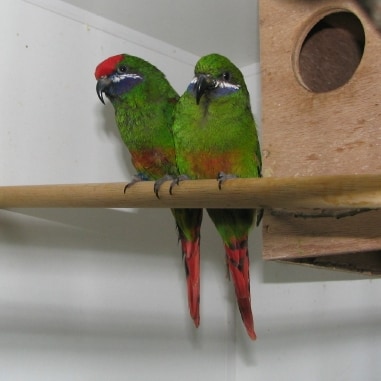
The plum-faced lorikeet is a small, predominantly green parrot native to the New Guinea Highlands. It is distinguished by two white stripes under each eye and a distinctive plum-colored or red forehead in adult males. This species is the sole member of its genus, Oreopsittacus.
Key Facts
- ›Found exclusively in the New Guinea Highlands, at altitudes between 2000m and 3750m.
- ›Adult males possess a red forehead, while adult females have a green forehead.
- ›Features two prominent white stripes beneath each eye.
- ›Characterized by a long, pointed tail and a narrow, pointed black bill.
- ›The species is monotypic within its genus, Oreopsittacus.
Whiskered Lorikeet
New Guinea
Montane Regions
Two White Stripes Under Each Eye, Long Pointed Tail, Red Forehead, Green Forehead
About Plum-faced lorikeet
The plum-faced lorikeet, scientifically known as Oreopsittacus arfaki and also referred to as the whiskered lorikeet, is a species of parrot found in the mountainous regions of New Guinea. It holds the distinction of being the sole member of its genus, Oreopsittacus.
Description and Distinguishing Features
This small parrot typically measures around 15 cm in length and is characterized by its predominantly green plumage and a long, pointed tail. A striking feature of the plum-faced lorikeet is the presence of two white stripes situated beneath each eye. The species possesses a narrow, pointed black bill and dark-brown irises. A key sexual dimorphism is evident in the forehead coloration: adult males display a red forehead, while adult females have a green forehead.
Range and Habitat
The natural habitat of the plum-faced lorikeet is confined to the highlands of mainland New Guinea. Its range extends across both the Indonesian and Papua New Guinean portions of the island, at elevations varying between approximately 2000 meters and 3750 meters. These high-altitude montane environments form the core of its ecological niche.
Taxonomy and Subspecies
The plum-faced lorikeet is classified within the family Psittaculidae. As the only species in the genus Oreopsittacus, it has been further divided into three recognized subspecies, primarily differentiated by subtle variations in plumage and size:
- Oreopsittacus arfaki arfaki: Noted for its red-orange abdomen.
- Oreopsittacus arfaki grandis: Distinguished by a green abdomen.
- Oreopsittacus arfaki major: Characterized by a red-orange abdomen and a larger overall size compared to other subspecies.
Source: Wikipedia ↗
Frequently Asked Questions
What is the plum-faced lorikeet's scientific name?
The scientific name for the plum-faced lorikeet is Oreopsittacus arfaki. It is the only species within its genus, Oreopsittacus.
Where does the plum-faced lorikeet live?
The plum-faced lorikeet is found in the mountainous regions of mainland New Guinea. Its native range spans altitudes from approximately 2000 meters to 3750 meters, across both Indonesian and Papua New Guinean territories.
What are the distinctive physical features of the plum-faced lorikeet?
The plum-faced lorikeet is a small parrot, about 15 cm in length, with a long, pointed tail. It is primarily green with two white stripes located under each eye. Adult males are identifiable by their red forehead.
How can you tell the difference between a male and female plum-faced lorikeet?
The primary distinction between adult males and females is the color of their forehead. Adult males have a red forehead, whereas adult females display a green forehead.
What are the different subspecies of the plum-faced lorikeet?
The plum-faced lorikeet has three recognized subspecies: Oreopsittacus arfaki arfaki, which has a red-orange abdomen; Oreopsittacus arfaki grandis, characterized by a green abdomen; and Oreopsittacus arfaki major, which also has a red-orange abdomen and is larger in size.
Related Parrot species

Eastern rosella
The eastern rosella (Platycercus eximius) is a vibrantly colored parrot native to southeastern Australia. Known for its distinctive red head, yellow and green body, and blue wings, this species is also established in New Zealand. They are cavity nesters and primarily feed on seeds, fruits, and insects.

Plum-headed parakeet
The plum-headed parakeet is a species of parakeet native to the Indian subcontinent, known for its distinctive head coloration, which differs between males and females. These gregarious birds are found in forests and woodlands, and are recognized for their swift, twisting flight and raucous calls. They are also known for their ability to mimic sounds in captivity.

Pink cockatoo
The pink cockatoo, also known as Major Mitchell's cockatoo, is a medium-sized Australian bird distinguished by its salmon-pink and white plumage and a prominent red and yellow crest. It inhabits arid and semiarid inland regions across Australia, preferring extensive woodlands. Unlike many other cockatoos, pink cockatoos do not nest near each other, which makes them sensitive to habitat fragmentation.