
Red-cheeked parrot
The red-cheeked parrot is a stocky, short-tailed parrot species recognized for its predominantly green plumage and distinctive red cheeks in adult males. Native to Indonesia, Papua New Guinea, and the northern tip of Queensland, Australia, this species exhibits sexual dimorphism, with females having duller coloration and brown heads. They inhabit various tropical forests and are known for their swift flight and metallic calls.
Key Facts
- ›The red-cheeked parrot has predominantly bright green plumage and a stocky body with a short tail.
- ›Adult males display pink-tinged red cheeks and a blue-mauve nape and crown.
- ›Females have a brown head and more olive-brown cheeks and throat.
- ›They are found in subtropical or tropical dry forests, moist lowland forests, and mangrove forests.
- ›Their diet consists of seeds, fruits (especially figs), blossoms, and nectar.
- ›The species is classified as Least Concern by the IUCN due to its large range and stable numbers.

Indonesia, Papua New Guinea, Australia
Subtropical Or Tropical Dry Forests, Subtropical Or Tropical Moist Lowland Forests, Subtropical Or Tropical Mangrove Forests
Red Cheeks, Mauve Nape and Crown, Brown Head, Yellow Eyes, Coral-Pink Upper Mandible, All Brown-Grey Bill, Swift and Direct Flight Pattern
Seeds, Fruits, Blossoms, Nectar
Shy, Noisy When Feeding In Groups
Metallic Call
Excavates nest in a rotting tree limb
About Red-cheeked parrot
The red-cheeked parrot (Geoffroyus geoffroyi) is a species of parrot found across parts of Indonesia, Papua New Guinea, and the northernmost tip of Queensland, Australia. It is characterized by its stocky build, short tail, and predominantly bright green plumage. The species is notable for its sexual dimorphism; adult males possess striking pink-tinged red cheeks and a blue-mauve nape and crown, while females are duller with a brown head and more olive-brown cheeks and throat.
Distribution and Habitat
This parrot inhabits a range of subtropical and tropical environments. Its natural habitats include dry forests, moist lowland forests, and mangrove forests, often found along streams. The species is distributed across the Cape York Peninsula in Australia, Indonesia, East Timor, and various islands within the region.
Behavior and Diet
Red-cheeked parrots typically live in pairs or small family groups outside of the breeding season. While generally shy, they become quite vocal and conspicuous when congregating in large groups to feed. Their diet is varied, consisting of seeds, fruits (with a preference for figs), blossoms, and nectar. Their beaks are adapted for consuming seeds and fruits.
Physical Characteristics
Both sexes share predominantly green plumage and a stocky, short-tailed build. Adult males are distinguished by their red cheeks and blue-mauve crown. Females have brown heads and more subdued facial coloration. All individuals have yellow eyes. Their flight is swift and direct, often compared to that of a starling. The typical length of the red-cheeked parrot ranges from 203 to 250 mm, with a wingspan of 135 to 155 mm.
Reproduction
During the breeding season, females excavate their nests within rotting tree limbs. A clutch typically consists of three eggs. Information regarding their courtship behavior in the wild is limited.
Conservation
With a large geographic range and a population believed to be stable, the red-cheeked parrot is classified as Least Concern by the International Union for Conservation of Nature (IUCN). There are seventeen recognized subspecies of this parrot.
Source: Wikipedia ↗
Frequently Asked Questions
What is the scientific name of the red-cheeked parrot?
The scientific name of the red-cheeked parrot is Geoffroyus geoffroyi. It is one of three species classified in the genus Geoffroyus.
Where does the red-cheeked parrot live?
The red-cheeked parrot is found in Indonesia, Papua New Guinea, and the northern tip of Queensland, Australia. Its natural habitats include subtropical or tropical dry forests, moist lowland forests, and mangrove forests.
What are the main physical characteristics of the red-cheeked parrot?
Red-cheeked parrots have predominantly bright green plumage, a stocky body, and a short tail. Adult males are distinguished by their red cheeks and a blue-mauve nape and crown, while females have a brown head and more subdued coloration.
What does the red-cheeked parrot eat?
Their diet primarily consists of seeds, fruits, particularly figs, as well as blossoms and nectar. Specific recorded food items include the fruit and seeds of Corymbia papuana, Casuarina papuana, and scaly ash.
What is the conservation status of the red-cheeked parrot?
The red-cheeked parrot is classified as Least Concern by the IUCN. This designation is due to its large geographic range and believed stable population numbers.
How do red-cheeked parrots behave?
Outside of the breeding season, they typically live in pairs or small family groups. While generally shy, they can become very noisy and conspicuous when gathering in large groups to feed.
Related Parrot species

Goldie's lorikeet
Goldie's lorikeet is a distinctive parrot species native to the highlands of New Guinea. It is recognized for its vibrant, multi-colored head plumage, which includes red, blue, and purple, contrasting with its predominantly green body and yellowish-streaked chest. This species is known for its quiet and non-aggressive temperament, making it a well-regarded pet.

Blaze-winged parakeet
The blaze-winged parakeet is a species of parrot found in parts of Brazil, Bolivia, Paraguay, and potentially Argentina. It is characterized by its mostly green plumage with distinctive red and yellow markings on its wings and a maroon belly. This species inhabits the Pantanal and Chaco regions, primarily in deciduous and gallery forests, and is known for its noisy, chattering vocalizations, especially in flight.
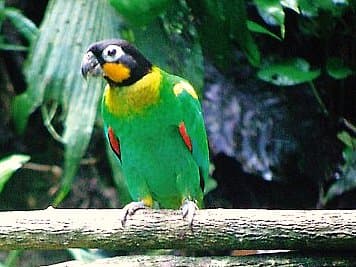
Orange-cheeked parrot
The orange-cheeked parrot, also known as Barraband's parrot, is a species of parrot native to the Amazonian Andes and humid lowland forests of the Amazon Basin in South America. Its distinctive features include an olive throat and breast, yellow thighs, and varying shades of orange on its wings and cheeks, with a notable white eye-ring. This species faces threats from habitat loss due to deforestation in its native range.