
Red-fronted lorikeet
The red-fronted lorikeet is a species of parrot found in northern New Guinea and the island of Biak. Distinctive for its sexual dimorphism, males and females exhibit significant differences in plumage, particularly on their forecrown and ear coverts. They inhabit moist montane forests and are observed feeding on pollen, nectar, flowers, and seeds.
Key Facts
- ›Found in northern New Guinea and the island of Biak.
- ›Inhabits subtropical or tropical moist montane forests.
- ›Males have red forecrowns, while females have green forecrowns.
- ›Feeds on pollen, nectar, flowers, and seeds.
- ›Breeding season occurs in July-August.
- ›Listed as Least Concern by the IUCN with a stable population.

Red-Spotted Lorikeet, Red-Rumped Lorikeet
New Guinea, Biak Island
Subtropical Or Tropical Moist Montane Forests, Humid Forest, Forest Edges, Coconut Plantations, Trees and Shrubs In Open Country
Red Forecrowns, Green Forecrowns, Red Underwing Coverts, Green Underwing Coverts, Red Markings On Upper Tail Coverts, Yellow-Tipped Green Tail
Pollen, Nectar, Flowers, Seeds
Uncommon Pets
Soft, Harsh Sounds While In Flight, Sharp Kss Notes
About Red-fronted lorikeet
The red-fronted lorikeet, scientifically known as Hypocharmosyna rubronotata, is a species of parrot belonging to the family Psittaculidae. This vibrantly colored bird is native to the northern regions of New Guinea and the island of Biak. Its natural environment consists of subtropical and tropical moist montane forests, as well as humid forests, forest edges, and occasionally coconut plantations.
Description and Identification
Measuring approximately 17 cm (6.7 inches) in length and weighing between 30–35 grams, the red-fronted lorikeet is characterized by its distinct sexual dimorphism. Males typically sport red forecrowns, red bills, and orange eyes, complemented by purple or blue ear coverts streaked with paler blue, and red underwing coverts. Their tails are green with yellow tips, and the base of the side tail feathers is red. In contrast, females exhibit green forecrowns and green ear coverts, which may be streaked with green or yellow. They possess green underwing coverts and red markings on their upper tail coverts. Males of the kordoana subspecies tend to have larger, paler forecrowns and more bluish ear coverts than those of the rubronotata subspecies, while the females of both subspecies appear similar. Juveniles resemble adult females, with juvenile males additionally showing red underwing coverts and dark, unstreaked ear coverts, along with a yellow underwing band. Their beaks are brown, and their eyes are pale brown.
Behavior and Ecology
Red-fronted lorikeets are social birds, often observed in small flocks of up to ten individuals, flying above the forest canopy. They are known to forage alongside other lorikeet species when feeding on flowers. Their diet primarily consists of pollen, nectar, flowers, and seeds.
Breeding Habits
The breeding season for the red-fronted lorikeet typically occurs in July and August. Females lay clutches of two eggs, each measuring approximately 17.0 mm by 13.5 mm. The incubation period for these eggs lasts about 23 days, and the chicks fledge, or are ready to fly, around seven weeks after hatching.
Distribution and Conservation
This species is found in northern New Guinea and on the island of Biak. It inhabits various forest types and can be seen up to an elevation of 900 meters (2,950 feet) above sea level. The red-fronted lorikeet is currently listed as Least Concern by the International Union for Conservation of Nature (IUCN), indicating a stable population. It is also recognized as a Cites II species.
Relationship with Humans
While not commonly kept as pets, red-fronted lorikeets are sometimes found in aviculture.
Source: Wikipedia ↗
Frequently Asked Questions
What are the different subspecies of the red-fronted lorikeet?
Two subspecies are recognized: H. r. rubronotata, found on Salawati, the West Papuan Islands, Irian Jaya, and New Guinea, and H. r. kordoana, found on Biak, Geelvink Bay, and Irian Jaya.
How can I tell the difference between a male and female red-fronted lorikeet?
The species is sexually dimorphic. Males typically have red forecrowns and red bills, while females have green forecrowns and green ear coverts. Males also often have red underwing coverts, which are green in females.
What do red-fronted lorikeets eat?
Their diet consists of pollen, nectar, flowers, and seeds. They are often observed feeding in the canopy with other lorikeet species.
When do red-fronted lorikeets breed?
The breeding season for the red-fronted lorikeet is in July and August. They lay clutches of two eggs.
What is the conservation status of the red-fronted lorikeet?
The red-fronted lorikeet is listed as Least Concern by the IUCN. Its population is considered stable, and it is also listed as a Cites II species.
Related Parrot species

Duchess lorikeet
The Duchess lorikeet (Vini margarethae) is a species of parrot native to the Solomon Islands archipelago. This vibrantly colored bird, primarily bright red with distinctive yellow and purple markings, inhabits lowland and montane forests, as well as plantations. It is currently listed as Least Concern but faces threats from habitat loss and potential large-scale pet trade.

Goldie's lorikeet
Goldie's lorikeet is a distinctive parrot species native to the highlands of New Guinea. It is recognized for its vibrant, multi-colored head plumage, which includes red, blue, and purple, contrasting with its predominantly green body and yellowish-streaked chest. This species is known for its quiet and non-aggressive temperament, making it a well-regarded pet.
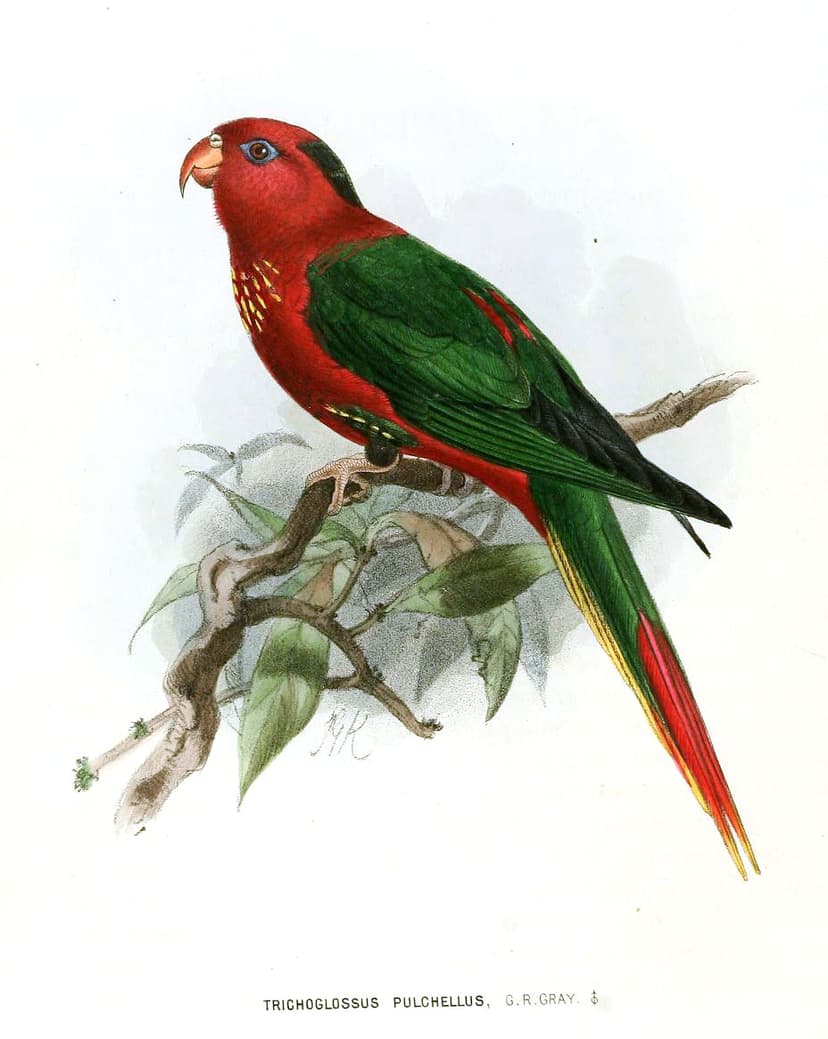
Fairy lorikeet
The fairy lorikeet (Charmosynopsis pulchella) is a small, vibrantly colored parrot native to New Guinea. Primarily red with green wings and yellow accents, it inhabits moist lowland and montane forests. Distinctive subspecies exist, differing in the extent of yellow and green markings, particularly on the breast and rump.