
Fairy lorikeet
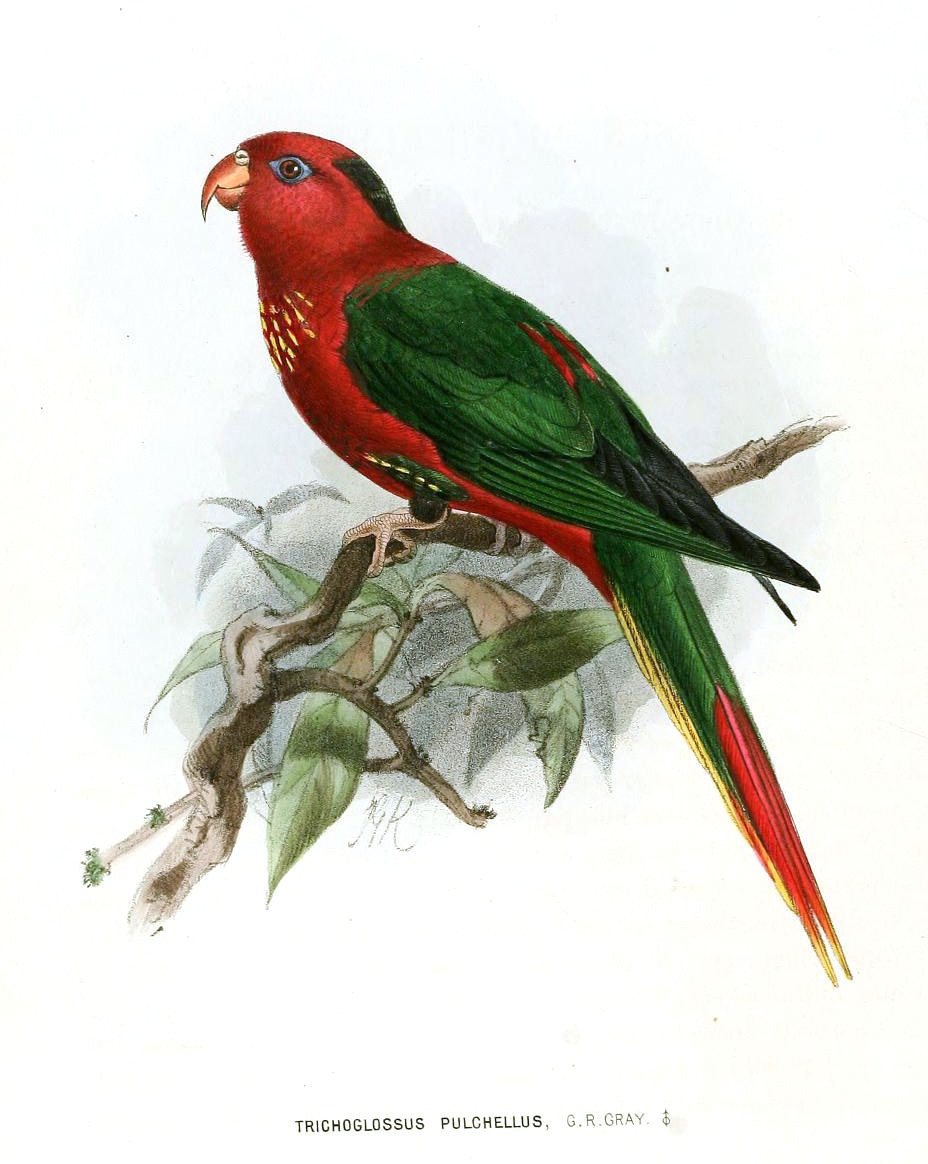
The fairy lorikeet (Charmosynopsis pulchella) is a small, vibrantly colored parrot native to New Guinea. Primarily red with green wings and yellow accents, it inhabits moist lowland and montane forests. Distinctive subspecies exist, differing in the extent of yellow and green markings, particularly on the breast and rump.
Key Facts
- ›Found in New Guinea's subtropical and tropical moist forests.
- ›Primarily red plumage with yellow throat and green wings.
- ›Measures approximately 18 cm in length and weighs 24-34 g.
- ›Two subspecies are recognized: C. p. pulchella and C. p. rothschildi.
- ›Feeds on pollen and nectar from flowers, often associated with Melicope trees.
- ›Conservation status is 'least concern' due to a stable population and wide range.
Little Red Lorikeet, Little Red Lory
New Guinea
Subtropical Or Tropical Moist Lowland Forests, Subtropical Or Tropical Moist Montane Forests
Purplish spot on the back of the crown, Yellowish-green patch on the side of the rump
Pollen, Nectar
Hole at the base of an epiphytic plant
About Fairy lorikeet
The fairy lorikeet, scientifically known as Charmosynopsis pulchella, is a small and vividly colored parrot species native to the island of New Guinea. It belongs to the family Psittaculidae and is also recognized by common names such as the little red lorikeet and little red lory. This species inhabits the subtropical and tropical moist forests, including both lowland and montane environments, where it is often found foraging high in the canopy.
Description and Taxonomy
Adult fairy lorikeets measure approximately 18 cm (7 inches) in length and typically weigh between 24 and 34 grams. Their plumage is predominantly red, accented with yellow on the throat and green on the wings. Variations exist between sexes and subspecies. The nominate subspecies, C. p. pulchella, features a male with red head, nape, breast, and underparts, sometimes streaked with yellow, and a purplish spot on the crown. The back and wings are dark green, with a green tail tipped in yellow. Females of this subspecies differ with a yellowish-green lower back and yellow sides of the rump and flanks.
The subspecies C. p. rothschildi presents further distinctions. Males have a green breast streaked with yellow, a larger dark crown spot extending forward to the eye, and yellow-washed upper tail coverts. The belly is dark purple. Females of C. p. rothschildi possess a broad green breast band streaked with yellow and a greenish-yellow patch on the side of the rump. The species was initially described by George Robert Gray in 1859 as Charmosyna pulchella but was later moved to the genus Charmosynopsis based on molecular phylogenetic studies.
Distribution and Behavior
The fairy lorikeet is a resident species found across New Guinea. C. p. pulchella is distributed in mountainous areas from the Vogelkop Peninsula eastward to the Huon Peninsula and the southeastern regions, as well as the Fakfak Mountains. C. p. rothschildi inhabits the northern and central mountainous areas, including the Cyclops Mountains.
Their diet is believed to consist mainly of pollen and nectar foraged from flowers, and they are often associated with Melicope trees. Breeding activity has been recorded in December, January, and April. Nests are typically located in holes at the base of epiphytic plants, where females lay one to two eggs, which hatch after approximately twenty-five days of incubation.
Conservation
The fairy lorikeet has a wide range and is considered common in many parts of its habitat. Despite being collected for the pet trade in some areas, its population appears stable. Consequently, the International Union for Conservation of Nature (IUCN) has assessed its conservation status as 'least concern.'
Source: Wikipedia ↗
Frequently Asked Questions
What are the main physical characteristics of the fairy lorikeet?
The fairy lorikeet is a small parrot, growing to about 18 cm (7 inches) in length and weighing between 24 and 34 grams. Its plumage is predominantly red, often with yellow on the throat and green on the wings. Males and females, as well as subspecies, can exhibit variations in these colors, particularly on the breast and lower back.
Where does the fairy lorikeet live?
This species is found exclusively on the island of New Guinea. Its natural habitats include both subtropical or tropical moist lowland forests and subtropical or tropical moist montane forests.
What does the fairy lorikeet eat?
It is believed that the fairy lorikeet primarily feeds on pollen and nectar foraged from flowers. They are often observed feeding high in the forest canopy and are frequently associated with Melicope trees.
When does the fairy lorikeet breed and what are its nesting habits?
Breeding activity has been observed in December, January, and April. Fairy lorikeets typically nest in a hole at the base of an epiphytic plant, laying a clutch of one or two eggs which are incubated for approximately twenty-five days.
What is the conservation status of the fairy lorikeet?
The fairy lorikeet is listed as 'least concern' by the IUCN. This assessment is based on its wide distribution and a population that appears to be stable, although it is occasionally collected for the pet trade.
Related Parrot species

Duchess lorikeet
The Duchess lorikeet (Vini margarethae) is a species of parrot native to the Solomon Islands archipelago. This vibrantly colored bird, primarily bright red with distinctive yellow and purple markings, inhabits lowland and montane forests, as well as plantations. It is currently listed as Least Concern but faces threats from habitat loss and potential large-scale pet trade.

Goldie's lorikeet
Goldie's lorikeet is a distinctive parrot species native to the highlands of New Guinea. It is recognized for its vibrant, multi-colored head plumage, which includes red, blue, and purple, contrasting with its predominantly green body and yellowish-streaked chest. This species is known for its quiet and non-aggressive temperament, making it a well-regarded pet.

Iris lorikeet
The iris lorikeet is a small, predominantly green lorikeet found in the forests and woodlands of Timor and Wetar in the Lesser Sunda Islands. Its distinctive plumage includes a red forehead and a purple band over the eyes, with variations between males and females. Due to habitat loss and trapping, it is currently listed as Near Threatened.