
Red-headed lovebird
Agapornis pullarius·Psittaculidae·15
The red-headed lovebird, also known as the red-faced lovebird, is a small, predominantly green parrot native to Africa. It is distinguished by a striking red or orange coloration on its head, which varies between sexes, and a unique nesting habit within termite mounds. This species is part of the Agapornis genus, commonly referred to as lovebirds.
Key Facts
- ›The red-headed lovebird is a 15 cm long parrot, primarily green in plumage.
- ›Males have a distinct red head, while females exhibit a less defined orange head.
- ›They construct nests by digging tunnels into termite mounds, often located in trees.
- ›Breeding in captivity is challenging due to their specific nesting and heating requirements.
- ›The species is found across the African tropical rainforest with a patchy distribution.
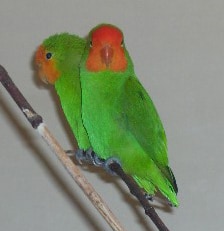
Red-Faced Lovebird
Africa
African Tropical Rainforest
Well-Demarcated Red Head, Less Well-Demarcated Orange Head, Red Beak, Paler Red Beak, Grey Feet
Very Nervous
- Nests in termite mounds
- Female digs a tunnel up to 30 cm into the termite mound
About Red-headed lovebird
The red-headed lovebird, scientifically known as Agapornis pullarius and sometimes called the red-faced lovebird, is a species of parrot native to Africa. Belonging to the genus Agapornis, which encompasses all lovebirds, this species is recognizable by its predominantly green plumage and a distinctive red coloration on its head, which varies in intensity and demarcation between males and females.
Description and Distinctions
Adult red-headed lovebirds measure approximately 15 cm (6 inches) in length. The male typically displays a vibrant, well-defined red patch on its head, extending from the beak over the forehead to the mid-crown and up to the eyelid margins. In contrast, females exhibit orange head coloration that is less sharply defined. Both sexes have grey feet. The adult male possesses a red beak, while the female's beak is a paler shade of red. The underside of their wings is a lighter shade of green.
Distribution and Habitat
This species has a patchy distribution across the African tropical rainforest. Its range spans from Guinea and Sierra Leone eastward to Sudan, the Democratic Republic of Congo, and Angola. A recognized subspecies, A. p. ugandae, inhabits areas from west Ethiopia to east DR Congo and northwest Tanzania.
Breeding and Nesting Habits
Red-headed lovebirds exhibit unique nesting behavior, constructing their nests within termite mounds. These mounds are usually located in trees, though occasionally they can be found on the ground. The female is responsible for digging a tunnel, which can be up to 30 cm (12 inches) in length, into the termite nest to prepare a nesting chamber. They may nest in colonies with other lovebirds.
Aviculture and Captivity
In captivity, the red-headed lovebird is considered difficult to breed. This is attributed to their innate need to burrow for nest construction and the requirement for their nest chambers to be artificially heated to approximately 27 °C (81 °F). While they can be encouraged to burrow into cork material to build a nest, their nervous disposition can also present challenges for keepers. Historically, the species was formally described by Carl Linnaeus in 1758, who initially placed it in the genus Psittacus.
Source: Wikipedia ↗
Frequently Asked Questions
What is the scientific name for the red-headed lovebird?
The scientific name for the red-headed lovebird is Agapornis pullarius. It was first described by Carl Linnaeus in 1758 as Psittacus pullarius before being placed in the genus Agapornis.
Where do red-headed lovebirds live in the wild?
Red-headed lovebirds have a patchy distribution across the African tropical rainforest. Their range includes areas from Guinea and Sierra Leone to Sudan, the Democratic Republic of Congo, and Angola, with a subspecies found in Ethiopia and Tanzania.
What makes the red-headed lovebird's head color distinctive?
The red-headed lovebird is identified by a well-demarcated red area on its head, extending from the beak to the mid-crown. Females display a less defined orange head coloration, and adult males have a red beak while females' beaks are a paler red.
How do red-headed lovebirds build their nests?
These lovebirds make their nests within termite mounds, typically situated in trees or occasionally on the ground. The female digs a tunnel, up to 30 cm long, into the termite nest to create her nesting chamber.
Are red-headed lovebirds easy to breed in captivity?
Breeding red-headed lovebirds in captivity is considered difficult. This is primarily because they require the ability to burrow for nesting and their nest chambers need to be maintained at a specific temperature of around 27 °C (81 °F).
Related Parrot species
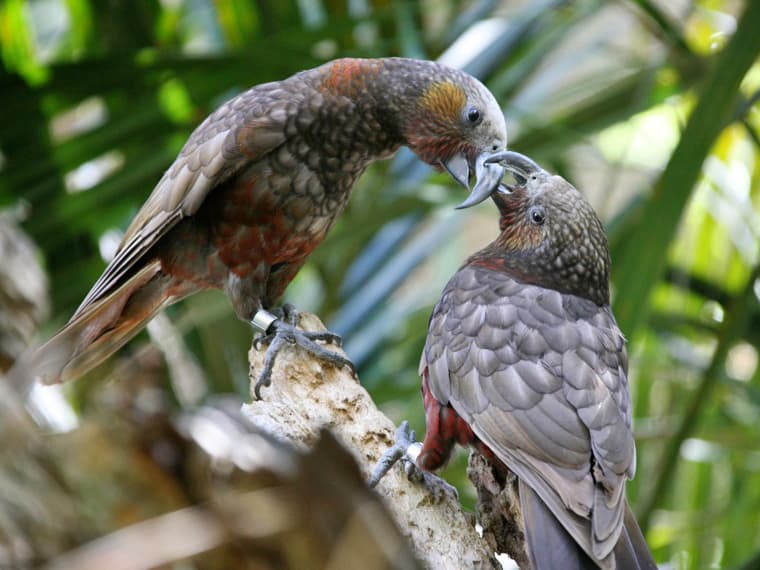
New Zealand kākā
The New Zealand kākā (Nestor meridionalis) is a large, endangered parrot native to the forests of New Zealand. Known for its distinctive brown and green plumage with scarlet flashes, it is an arboreal species that plays a vital role in its ecosystem through its varied diet, which includes fruits, seeds, nectar, and sap. Its conservation is a priority due to significant population declines caused by habitat loss and introduced predators.

Red-bellied parrot
The Red-bellied parrot (Poicephalus rufiventris) is a small, primarily green and grey African parrot, distinguished by the striking orange belly of the males, a trait visible even in chicks. It inhabits various parts of Africa and feeds on seeds, fruits, flowers, and nectar.

Golden-mantled racket-tail
The golden-mantled racket-tail is a species of parrot endemic to Indonesia, found in lowland and montane moist forests. It is distinguished by its green plumage, an orange collar across the mantle in males, and elongated central tail feathers that form "rackets" with black tips.