
Nesolagus
Nesolagus is a genus of rabbits distinguished by their unique striped coats, making them the only rabbit species with such markings. The genus contains three species, two of which are extant: the Sumatran striped rabbit and the Annamite striped rabbit. Very little is known about the genus overall, with most available information pertaining to the Sumatran variety.
Key Facts
- ›Nesolagus rabbits are the only species within the rabbit family to possess stripes.
- ›The genus contains three species: the Sumatran striped rabbit, the Annamite striped rabbit, and the extinct N. sinensis.
- ›The Sumatran striped rabbit is known to be nocturnal and to utilize existing burrows.
- ›These rabbits are relatively small, with short ears compared to other rabbit species.
- ›Their fur is soft and dense, with an overlay of longer, harsher hairs.
- ›Striped rabbits are found in limited geographic locations across Southeast Asia and historically in China.

- Seven Brown Or Black Stripes
- Red Rump
- White Underside
- Short Ears
- Soft and Dense Fur, Overlaid By Longer, Harsher Hairs
Nocturnal, Hides In Burrows, Prefers To Forage Near Its Home
About Nesolagus
The genus Nesolagus represents a fascinating group of rabbits, uniquely distinguished by their striped coats, a characteristic not found in any other rabbit species. This genus contains three known species, though very little is scientifically documented about them overall. The most information available pertains to the Sumatran striped rabbit.
Taxonomy and Distribution
Historically, only the Sumatran striped rabbit (Nesolagus netscheri) was recognized within this genus. It was first described in 1880 and is native to the Bukit Barisan mountain range of Sumatra, Indonesia. The genus Nesolagus was formally established in 1899. The genus now includes three species: Nesolagus netscheri (Sumatran striped rabbit), Nesolagus timminsi (Annamite striped rabbit), and the extinct Nesolagus sinensis. The Annamite striped rabbit inhabits the Annamite mountain range, bordering Vietnam and Laos. Fossils of Nesolagus sinensis have been discovered in southwest China, indicating a broader historical distribution.
Physical Description
Both living species of Nesolagus are characterized by seven distinct brown or black stripes running along their bodies, complemented by a red rump and a white underside. They are relatively small lagomorphs, with adult body lengths typically ranging from 368 to 417 millimeters. A notable physical trait is their short ears, measuring approximately 43–45 millimeters, which are about half the length of those found in most other rabbit species. Their fur is described as soft and dense, with longer, harsher guard hairs on the surface.
Behavior and Ecology
Due to the rarity of sightings and the small number of individuals observed, detailed knowledge of Nesolagus behavior is scarce. However, the Sumatran striped rabbit is known to be nocturnal, meaning it is primarily active during the night. It also exhibits a tendency to remain close to its burrow, which it uses for shelter but does not excavate itself. Information regarding their diet and lifespan is not extensively documented.
Source: Wikipedia ↗
Frequently Asked Questions
What makes Nesolagus rabbits distinctive?
Nesolagus rabbits are uniquely characterized by their striped fur, being the only species of rabbit to exhibit this pattern. They also have notably short ears, which are about half the length of those found in typical rabbits.
How many species are in the genus Nesolagus?
The genus Nesolagus includes three species. Two of these are currently living: the Sumatran striped rabbit (Nesolagus netscheri) and the Annamite striped rabbit (Nesolagus timminsi). The third species, Nesolagus sinensis, is now extinct.
Where are Nesolagus rabbits found?
The Sumatran striped rabbit inhabits the Barisan Mountains in western Sumatra, Indonesia. The Annamite striped rabbit is found in the Annamite mountains, straddling the border of Vietnam and Laos. Fossils of the extinct N. sinensis were discovered in southwest China.
What is known about the behavior of Nesolagus rabbits?
Information on the behavior of Nesolagus rabbits is limited due to their rarity and infrequent sightings. However, the Sumatran striped rabbit is known to be nocturnal and tends to stay close to its burrow, which it does not dig itself.
What do Nesolagus rabbits look like?
Both living species of striped rabbits have seven brown or black stripes, a red rump, and a white underside. They are described as relatively small, with bodies measuring approximately 368–417 mm in length and short ears.
Related Rabbits, Hares & Pikas

Pentalagus
The Amami rabbit (Pentalagus furnessi), also known as the Ryukyu rabbit, is a unique, dark-furred species endemic to the Japanese islands of Amami Ōshima and Tokunoshima. Considered a "living fossil," it represents an ancient lineage of rabbits that once inhabited the Asian mainland. Its distinctiveness lies in its smaller ears, unique molar count, and specialized habitat requirements.
Poelagus
The Bunyoro rabbit (Poelagus marjorita), also known as the Uganda grass hare, is a medium-sized, greyish-brown, nocturnal, plant-eating mammal found in central Africa. It is the sole member of the genus Poelagus and is distinctive for its shorter ears and hind legs compared to other African leporids, as well as its coarser fur. While historically considered abundant, recent sightings have been infrequent, leading to concerns about its distribution.
Bunolagus
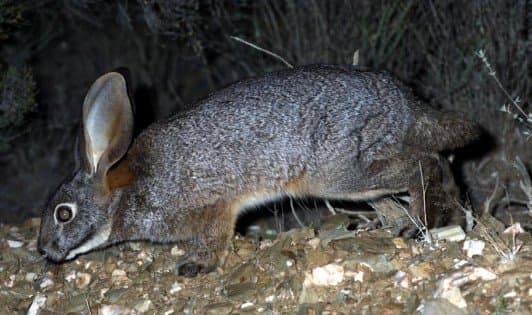
The riverine rabbit (Bunolagus monticularis), also known as the bushman rabbit, is a critically endangered species found in the Karoo region of South Africa. It is distinguished by its unique dark brown facial stripe, a white ring around its eyes, and its habit of digging its own burrows, a trait unusual for rabbits in Africa.