
Harpia harpyja
The harpy eagle (Harpia harpyja) is a formidable, large neotropical eagle, renowned as the largest bird of prey in its range and one of the largest eagles globally. Primarily inhabiting the emergent canopy of tropical lowland rainforests, it is distinguished by its immense talons, powerful build, and a distinctive double crest on its head. Due to extensive habitat destruction, its populations have significantly declined across much of its historical territory.
Key Facts
- ›It is the largest bird of prey in its range and among the largest extant eagle species.
- ›Harpy eagles inhabit the upper canopy of tropical lowland rainforests.
- ›They possess the largest talons of any living eagle, capable of carrying prey up to half their body weight.
- ›Their primary diet consists of tree-dwelling mammals, particularly sloths and monkeys.
- ›Habitat loss due to logging, agriculture, and ranching is the main threat to their survival.
- ›The species is considered vulnerable globally by the IUCN.
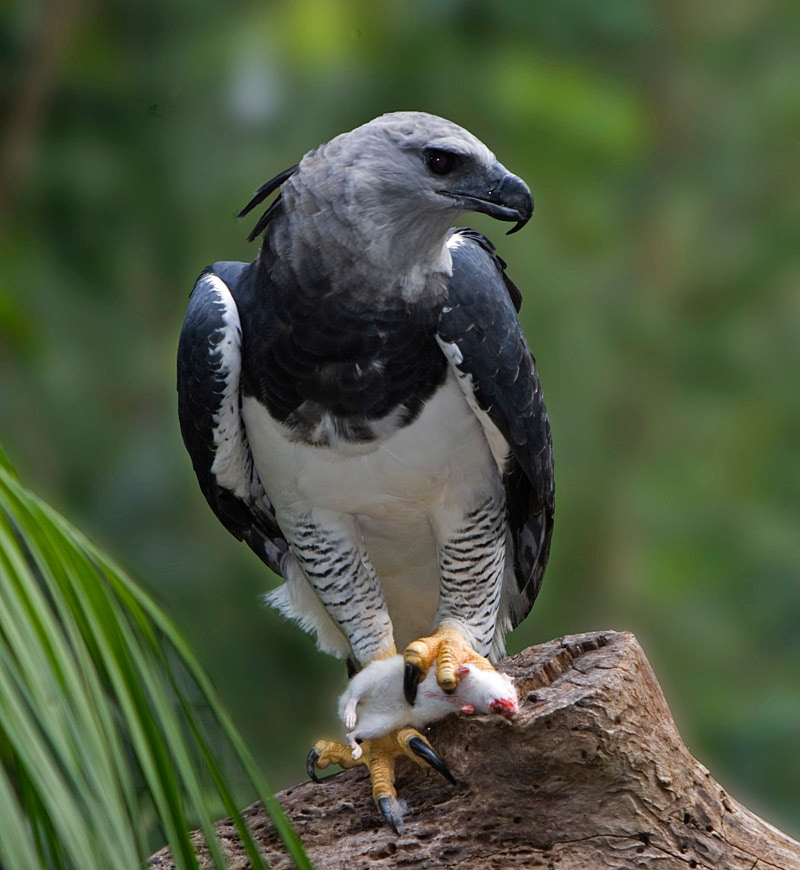
American Harpy Eagle
Tropical Lowland Rainforests, Upper Canopy Layer
Southern Mexico, Central America, South America
- Large size, among the largest eagles in the world
- Slate-black feathers on the upper side, mostly white on the underside
- Feathered tarsi striped black
- Broad black band across the upper breast
- Pale grey head crowned with a double crest
- Black tail with gray bands on the upperside, black with white bands on the underside
- Gray or brown or red irises
- Black or blackish cere and bill
- Yellow tarsi and toes
- Plumage identical in males and females
- Tarsus up to 13 cm long
- Mean talon size of 8.6 cm in males and 12.3 cm in females
Tree-Dwelling Mammals, Sloths, Monkeys, Porcupines, Agoutis, Tamanduas, Armadillos, Carnivores, Birds, Reptiles, Occasionally Domestic Livestock
- Perch hunting: scanning for prey activity from a brief perch between short flights
- Sit-and-wait predation: perching on a high point near an opening, river, or salt lick
- Hunting within or above the canopy
- Tail-chasing: pursuing birds in flight among trees and branches
Sloths, Monkeys, Porcupines, Macaws, Iguanas
Habitat Loss, Hunting, Climate Change
About Harpia harpyja
Harpy Eagle (Harpia harpyja)
The harpy eagle (Harpia harpyja), also known as the American harpy eagle, is a truly magnificent and powerful bird of prey that dominates the canopy of tropical lowland rainforests across its neotropical range. It stands as the largest bird of prey in its territory and is counted among the largest extant eagle species globally. Physically, it is characterized by its immense size, striking slate-black upperside contrasting with a white underside, a prominent double crest on its pale grey head, and most notably, the largest talons of any living eagle, capable of seizing prey weighing up to half its own body mass.
Distribution and Habitat
This elusive species is found from southern Mexico, through Central America, and down into South America, reaching as far south as Argentina. Its preferred habitat is the emergent layer of tropical, lowland rainforests, where it hunts from the canopy. Sadly, the harpy eagle's range has significantly diminished due to extensive habitat destruction from logging, agriculture, and cattle ranching, leading to its near extirpation in much of Central America. Climate change is also expected to further reduce its suitable habitat.
Diet and Hunting
Harpy eagles are apex predators, with their diet primarily consisting of tree-dwelling mammals. Sloths and various species of monkeys form the bulk of their prey. Their formidable talons and strength allow them to snatch these animals directly from tree branches. They employ hunting techniques such as perch hunting, where they scan for prey from a temporary perch, and sit-and-wait predation, often from a high vantage point near a clearing or water source. They are also capable of hunting within or above the forest canopy and have been observed engaging in aerial pursuits among trees.
Reproduction and Conservation
Harpy eagles are believed to mate for life and typically raise only one chick every two to three years, laying two white eggs, though usually only one hatches. The incubation period is around 56 days, and the chick fledges at approximately six months old, but remains dependent on its parents for food for several months more. Breeding maturity is not reached until four to six years of age. The species is classified as Vulnerable by the IUCN. The primary threat remains habitat loss, but they are also sometimes hunted. Conservation efforts are underway in various countries to protect their remaining habitats and monitor populations.
Source: Wikipedia ↗
Frequently Asked Questions
What is the scientific name for the harpy eagle?
The scientific name for the harpy eagle is Harpia harpyja. This name was given by Carl Linnaeus in 1758, referencing the mythological harpies.
Where do harpy eagles live?
Harpy eagles are found from southern Mexico through Central America and into South America, as far south as Argentina. They primarily inhabit tropical, lowland rainforests, preferring the emergent canopy layer.
What do harpy eagles eat?
The diet of harpy eagles predominantly consists of tree-dwelling mammals, with sloths and monkeys being their main prey. They are powerful enough to capture prey weighing up to half of their own body weight.
What are the biggest threats to harpy eagles?
The primary threat to harpy eagles is habitat loss caused by the expansion of logging, cattle ranching, and agriculture. They are also sometimes hunted due to their size and perceived threat to livestock, though they rarely prey on humans or domestic animals.
How large are harpy eagles?
Female harpy eagles typically weigh 6 to 9 kg (13 to 20 lb) and can reach up to 10 kg (22 lb), while males are smaller, weighing 4 to 6 kg (8.8 to 13.2 lb). Their total length can range from 86.5 to 107 cm (34.1 to 42.1 in) with a wingspan of 176 to 224 cm (69 to 88 in).
Related Raptor species
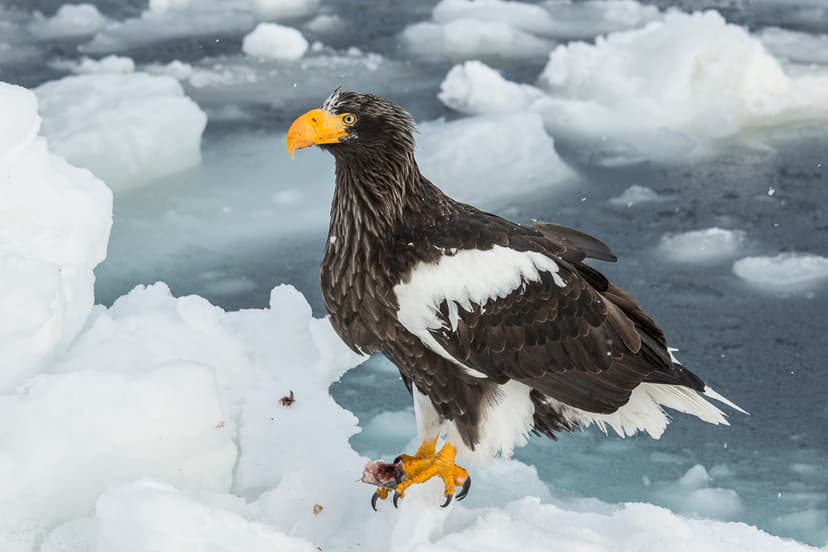
Haliaeetus pelagicus
The Steller's sea eagle (Haliaeetus pelagicus) is a massive diurnal bird of prey found in coastal northeastern Asia. It is distinguished by its dark brown plumage, white wings and tail, and a striking yellow beak and talons. While often the heaviest eagle, its size can vary, and it is a powerful predator primarily of fish and water birds.
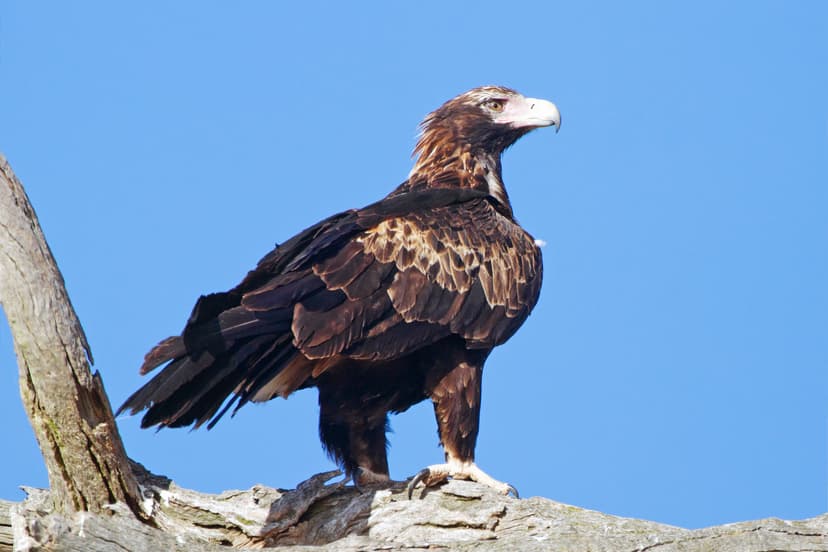
Aquila audax
The wedge-tailed eagle (Aquila audax) is Australia's largest bird of prey, also found in southern New Guinea and Tasmania. It is characterized by its long, broad wings, fully feathered legs, and distinctive wedge-shaped tail. As one of the most powerful avian predators, it is a generalist hunter, preying on mammals, birds, and reptiles, and is known for its resilience and adaptability to various habitats.

Aquila chrysaetos
The golden eagle (Aquila chrysaetos) is a large bird of prey found across the Northern Hemisphere, known for its powerful hunt and widespread distribution. It is characterized by its dark brown plumage with golden-brown feathers on its nape and is a prominent species in falconry and various ancient cultures. This eagle is the most widely distributed eagle species and is a member of the Accipitridae family.