
Capromyidae
Herbivorous, though some consume small animals·Threatened (for extant species other than Desmarest's hutia and prehensile-tailed hutia)
Hutias, scientifically known as Capromyidae, are a group of moderately large, cavy-like rodents native to the Caribbean islands. While at least half of the twenty identified species are now extinct, the surviving species are known for their stout bodies, large heads, and herbivorous diets, nesting in trees or rock crevices instead of burrows. Some species, like Desmarest's hutia, can become overpopulated in areas lacking natural predators and are sometimes referred to as "banana rats" due to their distinctive feces.
Key Facts
- ›Hutias are cavy-like rodents found exclusively in the Caribbean islands.
- ›At least half of the twenty identified species of hutia are now extinct.
- ›Desmarest's hutia and the prehensile-tailed hutia are the most common extant species.
- ›They typically nest in trees or rock crevices rather than burrowing underground.
- ›Some hutia species are hunted for food, particularly in Cuba.
- ›Desmarest's hutias at Guantanamo Bay are sometimes called "banana rats" because their feces resemble small bananas.
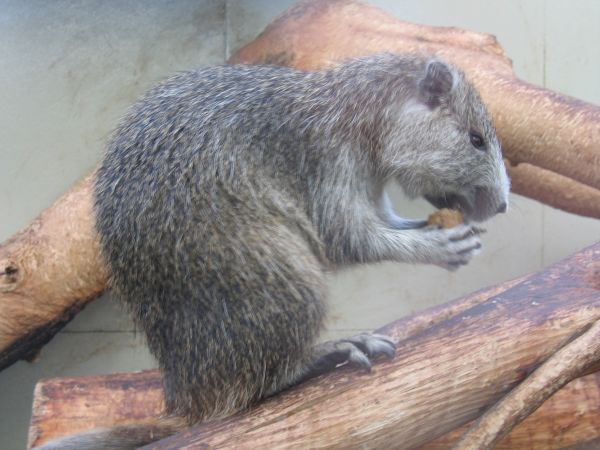
Hutia, JutíA
Caribbean Islands, Greater Antilles, Bahamas, Cuba, Honduras
- Moderately Large, Cavy-Like Rodents
- Stout Bodies
- Large Heads
- Tails Present, Varying From Vestiges To Prehensile
- Head-and-Body Length Typically 21 To 46 cm
- Desmarest's Hutia Can Reach 31 To 60 cm In Head-and-Body Length
- Nest In Trees Or Rock Crevices
- May Exhibit Overpopulation In Areas Lacking Natural Predators
- Desmarest's Hutias Are Known To Be Active At Night
Feces Resemble Small Bananas, Prehensile Tails, Nesting In Trees Or Rock Crevices
About Capromyidae
Hutias (Capromyidae)
Hutias, known in Spanish as jutía and scientifically classified within the subfamily Capromyinae, are a distinctive group of moderately large, cavy-like rodents that inhabit the Caribbean islands. Their name derives from Ancient Greek roots meaning "pig" and "mouse," hinting at their somewhat robust appearance. While twenty species have been identified, a significant number, at least half, have succumbed to extinction. The surviving species are primarily found in Cuba, though they also range across the Greater Antilles, the Bahamas, and formerly on Little Swan Island.
Physical Description and Habitat
Most hutia species exhibit a head-and-body length between 21 and 46 cm, typically weighing less than 2 kg. However, Desmarest's hutia is notably larger, with a head-and-body length ranging from 31 to 60 cm and weighing between 2.8 and 8.5 kg. They possess stout bodies and large heads, bearing a resemblance to the coypu. A defining characteristic is the presence of tails, which can vary from small vestiges to fully prehensile appendages. Instead of burrowing underground, hutias prefer to nest in trees or rock crevices, utilizing these elevated or sheltered locations for shelter and safety.
Diet and Behavior
The diet of hutias is predominantly herbivorous, consisting of plant matter. However, some species have been observed to supplement their diet with small animals. In Cuba, hutias are hunted for food and are often prepared with wild nuts and honey. In certain environments, such as the Guantanamo Bay Naval Base, an overabundance of hutias can occur due to ample food sources and a lack of natural predators. Desmarest's hutias at this location have earned the nickname "banana rats," not for their dietary habits, but because their feces bear a striking resemblance to small bananas. These rodents are known to be active primarily at night.
Phylogeny and Distribution
Molecular studies suggest that hutias are nested within the Neotropical spiny rats (Echimyidae) family. They colonized the Caribbean islands, reaching as far as the Bahamas, through oceanic dispersal from South America, a feat facilitated by prevailing ocean currents, as early as the Oligocene epoch. The systematic classification of hutias includes several genera such as Capromys, Geocapromys, Mesocapromys, and Mysateles, with various extinct tribes and genera also recognized.
Conservation and Cultural Significance
Currently, all extant hutia species, with the exception of Desmarest's hutia and the prehensile-tailed hutia, are considered threatened by the IUCN. Beyond their ecological role, hutias hold cultural significance. In Santería, a syncretic religion originating in Cuba, hutia powder (jutía ahumada) is utilized as a ritual offering, particularly to the deity Elegua.
Source: Wikipedia ↗
Frequently Asked Questions
What are hutias?
Hutias are moderately large, cavy-like rodents belonging to the subfamily Capromyinae. They are native to the Caribbean islands and are characterized by their stout bodies, large heads, and herbivorous diets.
Where do hutias live?
Hutias are found on the Caribbean islands, with most species restricted to Cuba. They are also known from the other Greater Antilles, the Bahamas, and formerly Little Swan Island.
Are there many species of hutias?
Twenty species of hutia have been identified, but at least half of them are now extinct. Only Desmarest's hutia and the prehensile-tailed hutia remain common, while other living species are considered threatened.
What do hutias eat?
Most hutia species are herbivorous, meaning they primarily eat plants. However, some species have been known to consume small animals as well.
Where do hutias make their homes?
Instead of digging burrows underground, hutias typically nest in trees or in rock crevices. This provides them with shelter and protection from predators.
Are hutias hunted by humans?
Yes, hutias are hunted for food in places like Cuba. They are often cooked with wild nuts and honey.
What is a "banana rat"?
The term "banana rat" is a nickname for Desmarest's hutias found at the Guantanamo Bay Naval Base. They are called this not because they eat bananas, but because their droppings resemble small versions of the fruit.
Are hutias active during the day or night?
Desmarest's hutias, also known as banana rats, are known to come out at night, indicating they are primarily nocturnal.
Related Rodent species

Dipodidae
Dipodidae, commonly known as jerboas, are a family of nocturnal, hopping desert rodents native to North Africa and Asia. They are distinct for their anatomy, which is highly adapted for saltatorial locomotion, featuring long hind legs, short forelimbs, and a tail longer than their body, enabling them to make erratic hops and sharp turns to evade predators.

Heteromyidae
Heteromyidae is a diverse family of rodents, commonly known as kangaroo rats, kangaroo mice, and pocket mice, primarily inhabiting the deserts and grasslands of western North America. A distinctive characteristic of this family is the presence of fur-lined cheek pouches used for transporting food to their burrows. Their closest relatives are the pocket gophers, and they exhibit adaptations for arid environments, including efficient water conservation.