
Ambystoma mexicanum
The axolotl (Ambystoma mexicanum) is a species of mole salamander native to the freshwater lakes of the Valley of Mexico. It is uniquely neotenic, meaning it retains its larval features, such as external gills, throughout adulthood and remains fully aquatic. This remarkable ability to regenerate lost body parts, including limbs and even parts of its brain, makes it a crucial subject in scientific research.
Key Facts
- ›Axolotls are neotenic mole salamanders, reaching sexual maturity without metamorphosis and remaining fully aquatic with external gills.
- ›They are native to the lakes and wetlands of the Valley of Mexico, with their natural habitat severely reduced by urban expansion and environmental degradation.
- ›Axolotls possess an extraordinary ability to regenerate lost body parts, including limbs, tail, gills, eyes, and brain tissue.
- ›The species is critically endangered in the wild due to habitat loss, pollution, and the introduction of invasive fish species.
- ›Due to their regenerative capabilities and ease of captive breeding, axolotls are widely used as model organisms in scientific research.
- ›The axolotl's genome is one of the largest animal genomes sequenced, providing insights into regeneration mechanisms.
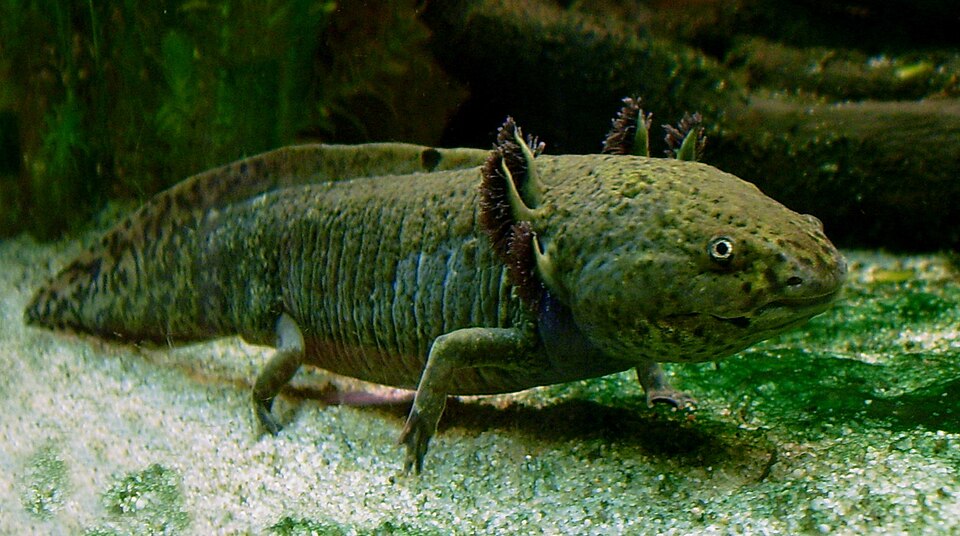
Mexican Axolotl
Freshwater Lakes, Wetlands, Water Channels
Mexico
- Adult Length Ranges From 15 To 45 Cm , With 23 Cm Being Common.
- Possess External Gills Originating From Behind the Head, Which Are Retained Into Adulthood.
- Wide Heads and Lidless Eyes.
- Underdeveloped Limbs With Long, Thin Digits.
- Four Gill Slits Lined With Gill Rakers.
- Males Have Swollen Cloacae; Gravid Females Have Wider Bodies.
- Wild Type Coloration Is Brown Or Tan With Gold Speckles and An Olive Undertone.
- Various Color Variants Exist Due To Mutations, Including Leucistic, Xanthic, Albinistic, and Melanistic Forms.
Mollusks, Worms, Aquatic Insects, Arthropods, Small Fish, Other Salamanders
- Fully Aquatic As Adults.
- Locate Food By Smell and Feed By Suction.
- May Use Buccal Pumping To Supplement Oxygen Intake.
- Reduced Activity In the Presence of Invasive Predators.
- Can Accept Transplants of Body Parts From Other Individuals.
- Habitat Loss
- Pollution
- Invasive Species
- Urban Expansion
- Loss of Genetic Diversity Due To Small Population Size
About Ambystoma mexicanum
What is the Axolotl?
The axolotl, scientifically known as Ambystoma mexicanum, is a remarkable species of mole salamander that has captivated scientists and the public alike. Its most striking characteristic is its neoteny, a biological phenomenon where it reaches sexual maturity without undergoing metamorphosis, retaining its larval features such as external gills and a fully aquatic lifestyle throughout its life. This trait, coupled with an extraordinary capacity for regeneration, makes the axolotl a subject of intense scientific study and a popular figure in popular culture.
Origin and Habitat
Originally, axolotls inhabited a system of interconnected lakes and wetlands in the highlands of Mexico, particularly the lakes of Xochimilco and Chalco. However, the natural habitat of the wild axolotl has been severely diminished due to the expansion of Mexico City and the desiccation of these water bodies. Today, wild populations are confined to a much smaller range, primarily the canals of Xochimilco, and face immense pressure from pollution and invasive species.
Remarkable Regeneration and Neoteny
The axolotl's ability to regenerate is legendary. It can regrow entire lost limbs, tails, gills, and even parts of its eyes and brain, a capability that holds immense promise for regenerative medicine. This regenerative prowess is intrinsically linked to its neotenic nature. Unlike most amphibians, axolotls lack the necessary hormonal triggers for metamorphosis, allowing them to retain juvenile traits and their remarkable regenerative capacity into adulthood. This makes them exceptionally valuable for research into tissue repair and development.
Conservation Status and Threats
Tragically, the wild axolotl population has been driven to the brink of extinction. The species is classified as Critically Endangered by the IUCN. Major threats include the severe degradation and pollution of its native lake systems, often exacerbated by agricultural and industrial runoff, and the introduction of invasive fish species like tilapia and carp, which prey on young axolotls and compete for food resources. The reduction in population has also led to a significant loss of genetic diversity, further imperiling its survival.
Axolotls in Research and Culture
Beyond their ecological significance, axolotls are extensively used as model organisms in scientific research. Their large, easily studied embryos and unparalleled regenerative abilities make them ideal for investigating developmental biology and the mechanisms of tissue repair. Historically, a shipment of axolotls to Paris in the 1863 led to their captive breeding and subsequent distribution for research, sparking early studies into neoteny. In contemporary culture, axolotls are celebrated for their unique appearance and regenerative powers, inspiring characters and themes in various media.
Source: Wikipedia ↗
Frequently Asked Questions
What makes axolotls unique among salamanders?
Axolotls are unique because they are neotenic, meaning they retain their larval characteristics, such as external gills, and remain fully aquatic even after reaching sexual maturity, without undergoing metamorphosis. This contrasts with most salamander species that transform into terrestrial adults.
Where do axolotls originally come from?
Axolotls are native to the freshwater lakes and wetlands of the Valley of Mexico, specifically inhabiting areas like Xochimilco and Chalco. However, their natural habitat has been significantly reduced due to the expansion of Mexico City.
Can axolotls regenerate body parts?
Yes, axolotls possess an exceptional ability to regenerate lost body parts. This includes limbs, tails, gills, and even parts of their eyes and brains, regenerating them without scarring.
What is the conservation status of the axolotl?
The axolotl is listed as critically endangered by the IUCN. Their wild populations have drastically declined due to habitat destruction, pollution, and the introduction of invasive species that prey on them or compete for food.
Why are axolotls important for scientific research?
Axolotls are extensively used in scientific research due to their remarkable regenerative abilities, which are not fully understood. Their large, manipulable embryos also make them valuable for studying vertebrate development and genetic pathways related to regeneration.
What do axolotls eat?
Axolotls are carnivorous and feed on small prey such as mollusks, worms, aquatic insects, crustaceans like crayfish, and small fish. They locate food by smell and use a vacuum-like suction to draw prey into their mouths.
What are the biggest threats to axolotls in the wild?
The primary threats to wild axolotls are the destruction and degradation of their natural habitat by urban expansion, pollution from industrial and agricultural runoff, and the introduction of invasive fish species like tilapia and carp, which prey on young axolotls and compete for food.
Related Salamander and Newt species

Andrias davidianus
The Chinese giant salamander (Andrias davidianus) is one of the largest salamanders and amphibians globally, endemic to the Yangtze river basin in China. It is a fully aquatic species known for its large size, dark, wrinkly skin, and distinctive vocalizations that resemble a human infant's cry, earning it the nickname "infant fish." Critically endangered in the wild, its populations have drastically declined due to habitat loss, pollution, and overcollection for food and traditional medicine.

Ambystoma dumerilii
The Lake Patzcuaro salamander, also known as achoque (Ambystoma dumerilii), is a paedomorphic salamander endemic to Lake Patzcuaro in Michoacán, Mexico. It is distinguished by retaining larval characteristics, such as prominent external gills, throughout its adult life. Historically used for food and traditional medicine by the Purépecha people, the species is now critically endangered due to severe habitat degradation and pollution.

Alpine newt
The alpine newt is a species of newt native to continental Europe, with introduced populations in Great Britain and New Zealand. Adults are typically dark grey to blue on their back and sides, with a vibrant orange belly and throat, with males displaying more striking coloration, especially during the breeding season. They are adaptable, inhabiting both lowlands and high altitudes, and are primarily nocturnal during their terrestrial phase.