
Andrias davidianus
The Chinese giant salamander (Andrias davidianus) is one of the largest salamanders and amphibians globally, endemic to the Yangtze river basin in China. It is a fully aquatic species known for its large size, dark, wrinkly skin, and distinctive vocalizations that resemble a human infant's cry, earning it the nickname "infant fish." Critically endangered in the wild, its populations have drastically declined due to habitat loss, pollution, and overcollection for food and traditional medicine.
Key Facts
- ›It is one of the largest salamanders and amphibians in the world.
- ›It is a fully aquatic species found in rocky mountain streams and lakes.
- ›Its common name in Chinese, "Wáwáyú" (娃娃鱼), translates to "infant fish" due to its cry-like vocalizations.
- ›It is considered a 'living fossil' and belongs to the ancient family Cryptobranchidae.
- ›The species is critically endangered due to habitat loss, pollution, and overcollection.
- ›Wild populations have declined by over 80% since the 1950s.

WáWáYú, Infant Fish
Rocky Mountain Streams, Lakes, Subterranean Rivers
China, Japan, Taiwan
- Large Head With A Wide Mouth
- Small, Round, Lidless Eyes
- Dark, Wrinkly Skin, Typically Dark Brown With Mottled Or Speckled Patterns, But Can Also Be Other Brownish Tones, Dark Reddish, Or Black
- Albinos Are White Or Orange
- Possesses A Line of Paired Sensory Tubercles From Head To Tail For Sensing Vibrations
- Produces A Sticky, White Skin Secretion That Repels Predators
Insects, Millipedes, Horsehair Worms, Amphibians, Freshwater Crabs, Shrimp, Fish, Asiatic Water Shrew, Plant Material, Gravel, Conspecifics
- Fully Aquatic
- Uses Sensory Nodes To Detect Vibrations Due To Poor Eyesight
- Primarily Active From Early Evening To Early Night
- Capable of Suction Feeding Using Wide Jaws
- Can Catch Prey On Land With An Asymmetrical Bite
- Can Swallow Large Food Items
- Capable of Fasting For Several Years
- Males and Females Maintain Territories
- Exhibits Various Courtship Displays Including Knocking Bellies, Leaning Side-To-Side, Riding, Mouth-To-Mouth Posturing, Chasing, Rolling Over, Inviting, and Cohabiting
- Vocalizes By Barking, Whining, Hissing, Or Crying
Habitat Loss, Pollution, Overcollection, Overhunting, Industrialization, Dam Construction, Siltation, Deforestation, Mining Activity, Pesticide and Chemical Runoff From Farming, Water Temperature Changes, Algal Blooms, Ranavirus Infection, Poaching, Introduction of Invasive Species
About Andrias davidianus
Chinese Giant Salamander (Andrias davidianus)
The Chinese giant salamander, scientifically known as Andrias davidianus, is a colossal amphibian native to the river systems of central China, primarily the Yangtze basin. It is recognized as one of the largest salamanders and amphibians in the world, a status it shares with its close relatives. This species is entirely aquatic, preferring the clear, cold waters of rocky mountain streams and lakes. Its appearance is striking, characterized by a large, flattened head, a wide mouth, small, lidless eyes, and dark, wrinkled skin that is typically mottled brown, but can range to reddish or black. A distinctive feature is the line of sensory nodes running along its body, which help it detect vibrations in its environment, compensating for its poor eyesight.
Key Characteristics and Behavior
Andrias davidianus is often referred to as a "living fossil" due to its ancient lineage, belonging to the family Cryptobranchidae, which dates back approximately 170 million years. It is known for its unique vocalizations, which can sound remarkably like a human infant's cry, leading to its common Chinese name, "Wáwáyú" (娃娃鱼), meaning "infant fish." Its diet is opportunistic and varied, including insects, fish, amphibians, and crustaceans. Notably, it is capable of suction feeding and can swallow surprisingly large prey, as well as fasting for extended periods.
Reproduction and Lifecycle
The breeding cycle is initiated when water temperatures reach around 20°C, with mating occurring between July and September. Females lay hundreds of eggs in underwater cavities, which are then guarded by the male until they hatch. The larvae are born small with external gills, which persist for several years as they grow. Maturity is typically reached around five to six years of age. While the maximum lifespan is unknown, individuals have lived for at least 60 years in captivity.
Distribution and Habitat
The native range of the Chinese giant salamander is fragmented across central, southwestern, and southern China, historically spanning basins of the Yangtze, Yellow, and Pearl Rivers. They are found at altitudes ranging from 100 to 1,500 meters, preferring streams with quick flow and little depth. Introduced populations exist in Japan, where they pose a threat to native species through hybridization. The species has also been found in subterranean river systems.
Conservation Concerns
The Chinese giant salamander faces severe threats and is listed as critically endangered. Wild populations have plummeted by over 80% since the 1950s due to extensive habitat destruction from industrialization, dam construction, siltation, and pollution from mining and agriculture. Overcollection for food and traditional Chinese medicine remains a significant driver of population decline. Efforts to conserve the species include the establishment of nature reserves and extensive farming operations, though the effectiveness of farming in reducing pressure on wild populations is debated, and disease outbreaks on farms pose additional risks.
Source: Wikipedia ↗
Frequently Asked Questions
What is the Chinese giant salamander?
The Chinese giant salamander (Andrias davidianus) is a species of salamander native to China, renowned for being one of the largest amphibians in the world. It is entirely aquatic and inhabits cold, rocky mountain streams and lakes within the Yangtze river basin.
Why is it called the "infant fish"?
This salamander is known in Chinese as "Wáwáyú" (娃娃鱼), which translates to "infant fish." This nickname comes from its vocalizations, which can sound remarkably like the crying of a human infant.
What does the Chinese giant salamander eat?
Its diet is varied and includes insects, amphibians, freshwater crabs, shrimp, and fish. Cannibalism is also frequent among individuals. They are adapted to sense vibrations to locate prey due to their poor eyesight.
What is the conservation status of the Chinese giant salamander?
The Chinese giant salamander is listed as critically endangered. Its wild populations have experienced a severe decline of over 80% since the 1950s, primarily due to habitat destruction, pollution, and overhunting for consumption and traditional medicine.
Where is the Chinese giant salamander found?
Its native range is the Yangtze river basin in central China, specifically in rocky mountain streams and lakes. It has also been introduced to Kyoto Prefecture in Japan and possibly Taiwan.
How large can Chinese giant salamanders get?
Adult Chinese giant salamanders typically weigh 25–30 kg (55–66 lb) and reach about 1.3 meters (4.3 ft) in length. They can grow even larger, with records of individuals reaching up to 50 kg (110 lb) and 1.8 meters (5.9 ft).
Related Salamander and Newt species

Ambystoma dumerilii
The Lake Patzcuaro salamander, also known as achoque (Ambystoma dumerilii), is a paedomorphic salamander endemic to Lake Patzcuaro in Michoacán, Mexico. It is distinguished by retaining larval characteristics, such as prominent external gills, throughout its adult life. Historically used for food and traditional medicine by the Purépecha people, the species is now critically endangered due to severe habitat degradation and pollution.
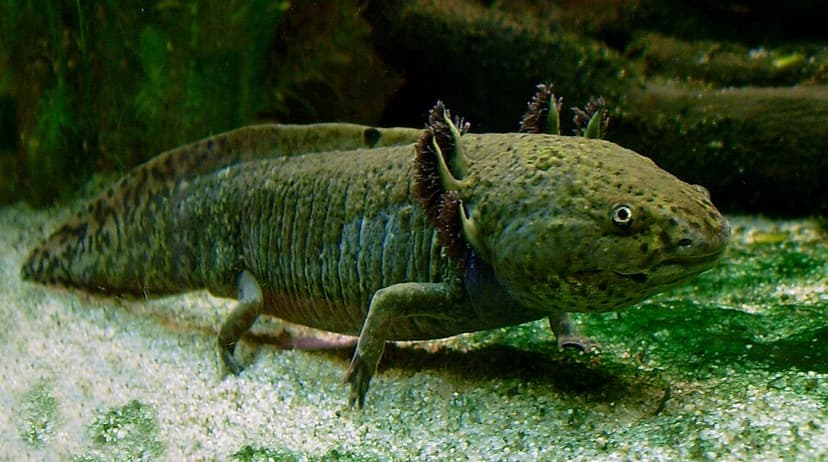
Ambystoma mexicanum
The axolotl (Ambystoma mexicanum) is a species of mole salamander native to the freshwater lakes of the Valley of Mexico. It is uniquely neotenic, meaning it retains its larval features, such as external gills, throughout adulthood and remains fully aquatic. This remarkable ability to regenerate lost body parts, including limbs and even parts of its brain, makes it a crucial subject in scientific research.

Alpine newt
The alpine newt is a species of newt native to continental Europe, with introduced populations in Great Britain and New Zealand. Adults are typically dark grey to blue on their back and sides, with a vibrant orange belly and throat, with males displaying more striking coloration, especially during the breeding season. They are adaptable, inhabiting both lowlands and high altitudes, and are primarily nocturnal during their terrestrial phase.