
Atlantic Coast slimy salamander
Secure
The Atlantic Coast slimy salamander (Plethodon chlorobryonis) is a species of salamander found in the southeastern United States, ranging from Virginia to northern Georgia. It primarily inhabits bottomland hardwood forests along the Atlantic coastal plain.
Key Facts
- ›This salamander is native to the southeastern United States.
- ›Its distribution extends from southeastern Virginia to northern Georgia.
- ›The species is largely found along the Atlantic coastal plain.
- ›Its primary habitat is bottomland hardwood forest.
- ›Natureserve considers its conservation status to be Secure.
- ›Declines have been observed in all populations that have been studied.

Bottomland Hardwood Forest
United States
About Atlantic Coast slimy salamander
The Atlantic Coast slimy salamander, scientifically known as Plethodon chlorobryonis, is a species of salamander belonging to the family Plethodontidae. It is a native inhabitant of the United States, with a distribution concentrated in the southeastern region of the country. Its natural range extends from southeastern Virginia southward to northern Georgia.
Habitat and Distribution
This species is predominantly found along the Atlantic coastal plain. While its primary habitat consists of bottomland hardwood forests, it also extends into the Piedmont region of Virginia and South Carolina, and reaches into the Blue Ridge Mountains in Georgia. These specific forest types offer the moist environments and protective cover essential for the salamander's life cycle.
Conservation
The conservation status of the Atlantic Coast slimy salamander is assessed as Secure by NatureServe. Despite this classification, there is an important caveat: observed declines have been noted across all populations that have undergone study. This suggests that while the species is not currently considered at immediate risk of extinction, ongoing monitoring and conservation efforts are warranted to address these observed population reductions.
Source: Wikipedia ↗
Frequently Asked Questions
What is the scientific name of the Atlantic Coast slimy salamander?
The scientific name of the Atlantic Coast slimy salamander is Plethodon chlorobryonis. This binomial name is used to classify it within the scientific community.
Where is the Atlantic Coast slimy salamander found?
The Atlantic Coast slimy salamander is endemic to the United States. Its range covers the southeastern United States, from southeastern Virginia down to northern Georgia.
What type of habitat does the Atlantic Coast slimy salamander prefer?
The habitat of the Atlantic Coast slimy salamander is largely restricted to bottomland hardwood forests. These areas provide the moist conditions and cover necessary for its survival.
What is the conservation status of the Atlantic Coast slimy salamander?
According to NatureServe, the conservation status of the Atlantic Coast slimy salamander is considered Secure. However, it is important to note that declines have been observed in all populations that have been studied.
Related Salamander and Newt species
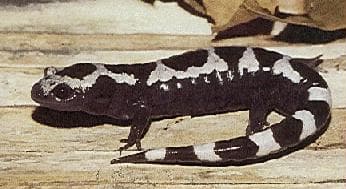
Ambystoma opacum
The marbled salamander (Ambystoma opacum) is a stout, terrestrial salamander found in the eastern United States, distinguished by its striking black and white banded pattern. Females typically have light gray bands, while males exhibit bright white bands, with males also possessing a larger proportion of white on their dorsal surface. This species spends most of its life under logs or in burrows and relies on seasonally flooded areas for breeding.
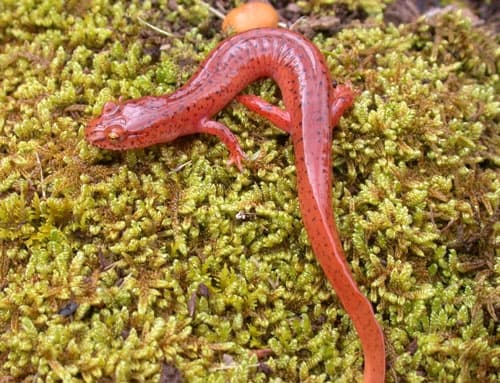
Blue Ridge spring salamander
The Blue Ridge spring salamander, a subspecies of the spring salamander (Gyrinophilus porphyriticus), is found in the southern Appalachian Mountains and adjacent Piedmont regions of the United States. This species is distinguished by a distinctive white line from its eye to its nostril, bordered by a dark line, and its varied dorsal coloration ranging from reddish to orange-yellow with black or brown spots. They inhabit cool springs, mountain springs, and moist forest areas, and are notable for their diet which can include other salamanders.
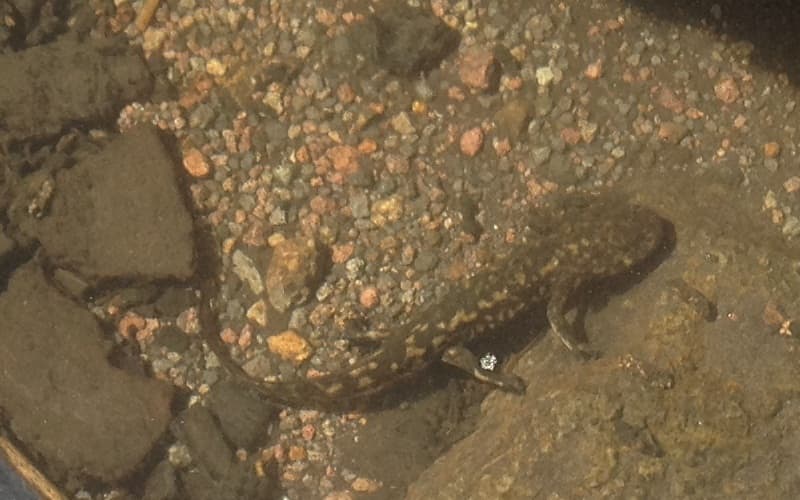
Ambystoma leorae
The Leora's stream salamander (Ambystoma leorae) is a critically endangered mole salamander endemic to a very small region within Mexico's Iztaccihuatl-Popocatepetl National Park. Its survival is threatened by its specific water quality requirements and human activities such as water extraction, cattle grazing, and direct consumption, leading to a single known population persisting on Mount Tlaloc.