
Austin blind salamander
The Austin blind salamander (Eurycea waterlooensis) is an endangered, fully aquatic salamander found only in Barton Springs in Austin, Texas. Its name originates from Waterloo, the former name of the city. This species is paedomorphic, meaning it retains juvenile characteristics throughout its adult life and does not metamorphose.
Key Facts
- ›It is an endangered species of salamander.
- ›Its scientific name is Eurycea waterlooensis.
- ›The species is endemic to Barton Springs in Austin, Texas, USA.
- ›It is a totally aquatic and paedomorphic species.
- ›It is less abundant than the Barton Springs salamander (E. sosorum).

Austin Blind Salamander
Subterranean Cavities, Spring Outlets
Austin, Texas, United States
- Typically Observed In Juvenile Form
- Retains Juvenile Characteristics Throughout Adult Life
Totally Aquatic, Paedomorphic
About Austin blind salamander
The Austin Blind Salamander
The Austin blind salamander, scientifically known as Eurycea waterlooensis, is a critically endangered amphibian endemic to the Barton Springs complex in Austin, Texas, United States. Its common name is derived from Waterloo, the original name for the city of Austin.
Biology and Habitat
This species is characterized by its paedomorphic nature, meaning it retains larval features throughout its life and does not undergo metamorphosis. As a result, the Austin blind salamander is entirely aquatic. While juveniles are occasionally observed at spring outlets, it is believed that the majority of the population resides within subterranean cavities. The species' total abundance is unknown, but it is considered to be significantly less numerous than the sympatric Barton Springs salamander (E. sosorum).
Conservation Status
The Austin blind salamander is listed as an endangered species, highlighting the urgent need for conservation efforts to protect its unique habitat and ensure its survival.
Source: Wikipedia ↗
Frequently Asked Questions
What is the scientific name of the Austin blind salamander?
The scientific name of the Austin blind salamander is Eurycea waterlooensis.
Where is the Austin blind salamander found?
The Austin blind salamander is found exclusively in Barton Springs in Austin, Texas, United States. It is endemic to this specific location.
What does it mean for a salamander to be paedomorphic?
A paedomorphic species, like the Austin blind salamander, retains juvenile features throughout its adult life and does not undergo metamorphosis. This means it remains in an aquatic, larval-like state even as a mature individual.
Is the Austin blind salamander common?
No, the Austin blind salamander is considered an endangered species. While juveniles are sometimes seen at spring outlets, the majority of the population is believed to live in subterranean cavities, and its total numbers are unknown but appear to be significantly lower than the sympatric Barton Springs salamander.
Related Salamander and Newt species
Blue Ridge spring salamander
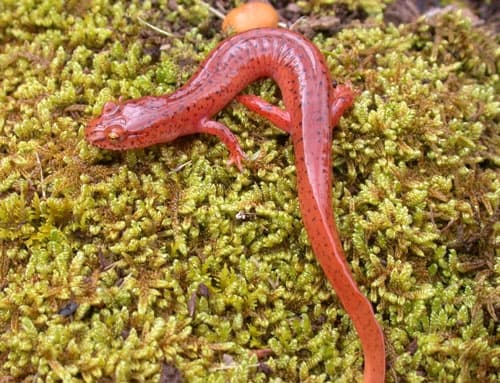
The Blue Ridge spring salamander, a subspecies of the spring salamander (Gyrinophilus porphyriticus), is found in the southern Appalachian Mountains and adjacent Piedmont regions of the United States. This species is distinguished by a distinctive white line from its eye to its nostril, bordered by a dark line, and its varied dorsal coloration ranging from reddish to orange-yellow with black or brown spots. They inhabit cool springs, mountain springs, and moist forest areas, and are notable for their diet which can include other salamanders.

Barton Springs salamander
The Barton Springs salamander (Eurycea sosorum) is an endangered lungless salamander endemic to Texas, USA. It is found in Barton Springs and other nearby springs within the Edwards Aquifer, characterized by its clear, constant-temperature waters. This species is distinctive for its neotenic nature, retaining gills throughout its adult life, and its mottled coloration.

Apalachicola dusky salamander
The Apalachicola dusky salamander is a species of salamander found in the Southeastern United States, specifically in Alabama, Florida, and Georgia. It inhabits temperate forests, intermittent rivers, and freshwater springs. This species is currently threatened by habitat loss.