
Batrachoseps campi
Assumed to reproduce without an aquatic larval stage
The Inyo Mountains salamander (Batrachoseps campi) is a species of salamander found exclusively in the Inyo Mountains of California. It is one of the larger species within the slender salamander genus, distinguished by its brown coloration with numerous gray speckles, giving it a silvery-gray appearance, and its four-toed hind feet.
Key Facts
- ›Endemic to the Inyo Mountains of California.
- ›One of the largest species in the slender salamander genus (Batrachoseps).
- ›Characterized by a brown body with dense gray speckles, often appearing silvery-gray.
- ›Possesses only four toes on its hind feet.
- ›Restricted to small permanent springs within steep canyons due to the arid environment.
- ›Listed as a California species of special concern.

Inyo Slender Salamander
Small Permanent Springs, Steep Canyons, Underground Habitats
Inyo Mountains, California, United States
- One of the Largest Slender Salamanders, Growing To Over 6 Cm In Length.
- Relatively Broad Head.
- Brown Coloration With Numerous Gray Speckles.
- Speckles Can Cover Most of the Body, Giving A Silvery-Gray Appearance.
- Four Toes On Hind Feet.
- No Dorsal Stripe.
Small Insects, Invertebrates
- Largely Restricted To Moist Microhabitats Due To Arid Surroundings.
- Underground Distribution May Be More Extensive Than Known Spring Habitats.
Montane, Springs, Canyon
Mining, Stream Diversions, Habitat Damage From Grazing Cattle
About Batrachoseps campi
Inyo Mountains Salamander (Batrachoseps campi)
The Inyo Mountains salamander, scientifically known as Batrachoseps campi and also referred to as the Inyo slender salamander, is a species native to the Inyo Mountains of California. This salamander belongs to the family Plethodontidae, a group characterized by lungless respiration.
Description and Characteristics
Batrachoseps campi stands out as one of the larger members of the slender salamander genus (Batrachoseps), capable of reaching lengths exceeding 6 centimeters. Its physical appearance includes a relatively broad head and a coloration of brown adorned with numerous gray speckles. These speckles are often so dense that they impart an overall silvery-gray hue to the salamander. A notable anatomical feature, shared with other Batrachoseps species, is the presence of only four toes on its hind feet. It also lacks a dorsal stripe, a trait it shares only with Batrachoseps gabrieli within its genus.
Distribution and Habitat
This species is endemic to the Inyo Mountains in eastern California, with its known occurrences limited to approximately 20 specific localities within Inyo County. It inhabits a wide range of elevations, from 1,800 to 8,040 feet. The Inyo Mountains are characterized by extreme dryness, particularly at lower elevations. Consequently, Batrachoseps campi is largely confined to small, permanent springs found within steep canyons on both sides of the mountain range. While these spring sites are its primary known habitat, pitfall traps have captured individuals far from these water sources, suggesting that the species may utilize underground habitats more extensively than previously understood.
Ecology and Reproduction
The diet of the Inyo Mountains salamander primarily consists of small insects and other invertebrates. Direct observation of eggs has not occurred, but it is widely assumed that, like all other Batrachoseps slender salamanders, this species reproduces without an aquatic larval stage, implying direct development.
Taxonomy and Conservation
There are no described subspecies of Batrachoseps campi. However, the isolated nature of its spring habitats, separated by vast, arid desert terrain, has led to significant genetic divergence in some subpopulations. Genetically, it is most closely related to Batrachoseps robustus and Batrachoseps wrighti. The species is recognized for its conservation status, being listed as a California species of special concern and a sensitive species by the Bureau of Land Management. The remote nature of its habitat, largely on public lands managed by the Bureau of Land Management and the Inyo National Forest, limits threats from private development. Nevertheless, historical impacts from mining and stream diversions, as well as habitat damage caused by grazing cattle, have posed challenges to certain subpopulations.
Source: Wikipedia ↗
Frequently Asked Questions
What is the Inyo Mountains salamander?
The Inyo Mountains salamander, scientifically known as Batrachoseps campi, is a species of salamander found only in the Inyo Mountains of California. It belongs to the Plethodontidae family.
Where does the Inyo Mountains salamander live?
This salamander is endemic to the Inyo Mountains in eastern California, specifically found in Inyo County. It occupies a range of elevations from 1,800 to 8,040 feet, largely restricted to small springs within steep canyons.
What does the Inyo Mountains salamander look like?
Batrachoseps campi is one of the larger slender salamanders, reaching over 6 cm in length. It features a relatively broad head and is colored brown with numerous gray speckles that can make it appear silvery-gray. A distinctive trait is its four toes on each hind foot.
What does Batrachoseps campi eat?
The diet of the Inyo Mountains salamander consists of small insects and invertebrates.
How does the Inyo Mountains salamander reproduce?
While no eggs have been directly observed, it is believed that Batrachoseps campi reproduces similarly to other slender salamanders, meaning it likely does not have an aquatic larval stage.
What are the conservation concerns for this species?
The Inyo Mountains salamander is listed as a California species of special concern and a sensitive species. Threats include habitat damage from grazing cattle and historical impacts from mining and stream diversions.
Related Salamander and Newt species
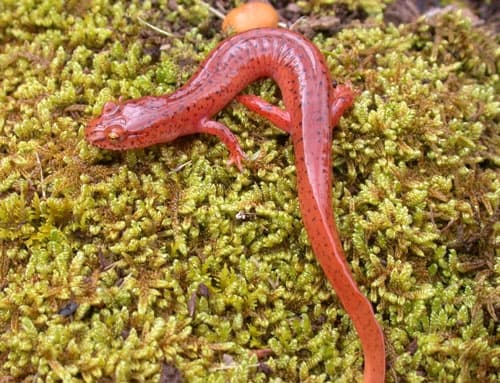
Blue Ridge spring salamander
The Blue Ridge spring salamander, a subspecies of the spring salamander (Gyrinophilus porphyriticus), is found in the southern Appalachian Mountains and adjacent Piedmont regions of the United States. This species is distinguished by a distinctive white line from its eye to its nostril, bordered by a dark line, and its varied dorsal coloration ranging from reddish to orange-yellow with black or brown spots. They inhabit cool springs, mountain springs, and moist forest areas, and are notable for their diet which can include other salamanders.

Ambystoma granulosum
The granular salamander (Ambystoma granulosum), also known as ajolote, is a species of mole salamander endemic to central Mexico. It inhabits high-altitude grasslands, marshes, and ponds, and is distinguished by its susceptibility to threats from habitat loss and skin scaling.
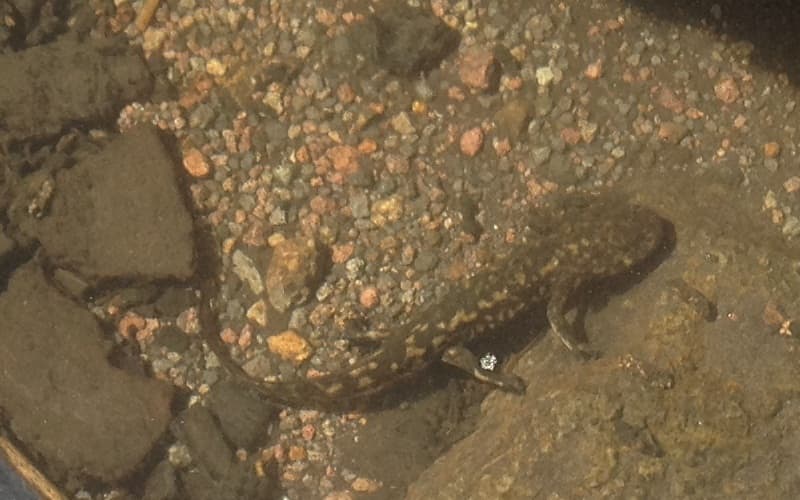
Ambystoma leorae
The Leora's stream salamander (Ambystoma leorae) is a critically endangered mole salamander endemic to a very small region within Mexico's Iztaccihuatl-Popocatepetl National Park. Its survival is threatened by its specific water quality requirements and human activities such as water extraction, cattle grazing, and direct consumption, leading to a single known population persisting on Mount Tlaloc.