
Batrachoseps gabrieli
Batrachoseps gabrieli·Plethodontidae·3-5 cm
The San Gabriel slender salamander (Batrachoseps gabrieli) is a species of salamander found exclusively in the San Gabriel Canyon system of the San Gabriel Mountains in Los Angeles County. It is distinguished by its worm-like body, large head and limbs, and a tail that is less than 1.5 times its body length.
Key Facts
- ›It is a species of salamander.
- ›Found only in the San Gabriel Canyon system.
- ›Typically lives above 850 meters elevation.
- ›Adults measure between 3 and 5 CM in length.
- ›Features a black dorsum with white, coppery, or orange blotches.
- ›Has an immaculate black venter and may have red spots on its tail.
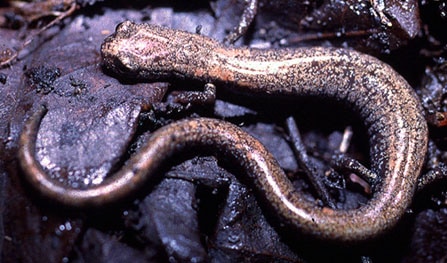
San Gabriel Slender Salamander
San Gabriel Canyon System
- San Gabriel Mountains, Los Angeles County, California, Usa
- Worm-Like Body
- Large Head
- Large Limbs
- Elongate Cylindrical Tail of Less Than 1.5 Times Body Length
- Adult Length Between 3 and 5 Cm
- Black Dorsum With White, Coppery, and Orange Blotches
- Immaculate Black Venter
- May Have Red Spots On Tail
About Batrachoseps gabrieli
San Gabriel Slender Salamander
What it is
The San Gabriel slender salamander (Batrachoseps gabrieli) is a species of salamander characterized by its distinct physical traits and limited geographic range. It belongs to the Plethodontidae family, known for lungless salamanders.
Habitat and Distribution
This species is endemic to the San Gabriel Canyon system, situated within the San Gabriel Mountains of Los Angeles County, California. It is typically found at elevations exceeding 850 meters, indicating a preference for montane environments.
Physical Characteristics
Adult San Gabriel slender salamanders possess a striking appearance. They have a worm-like body, a relatively large head, and substantial limbs. Their tail is elongate and cylindrical, measuring less than 1.5 times the length of their body. Adults generally range from 3 to 5 cm in total length. The coloration of the dorsum is black, adorned with blotches of white, coppery, and orange hues. In contrast, the venter is an immaculate black. Some individuals may also exhibit red spots on their tails.
Similar Species
Batrachoseps gabrieli shares similarities with related species such as Batrachoseps pacificus and Batrachoseps nigriventris, making precise identification crucial for ecological studies.
Source: Wikipedia ↗
Frequently Asked Questions
What are the physical characteristics of the San Gabriel slender salamander?
The San Gabriel slender salamander has a worm-like body, a large head and large limbs, and an elongate cylindrical tail that is less than 1.5 times its body length. Adults typically range from 3 to 5 cm in length. Its dorsum is black with white, coppery, and orange blotches, while its venter is an immaculate black. Red spots may also be present on the tail.
Where is the San Gabriel slender salamander found?
This species is known only from the San Gabriel Canyon system, located within the San Gabriel Mountains of Los Angeles County. It is typically found at elevations above 850 meters.
How large do San Gabriel slender salamanders get?
Adult San Gabriel slender salamanders are relatively small, measuring between 3 and 5 cm in length.
What is the coloration of the San Gabriel slender salamander?
The dorsum of the San Gabriel slender salamander is black and features blotches of white, coppery, and orange. Its underside, or venter, is entirely black. The tail may also display red spots.
Related Salamander and Newt species
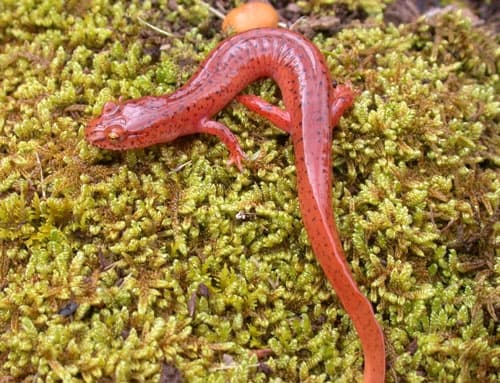
Blue Ridge spring salamander
The Blue Ridge spring salamander, a subspecies of the spring salamander (Gyrinophilus porphyriticus), is found in the southern Appalachian Mountains and adjacent Piedmont regions of the United States. This species is distinguished by a distinctive white line from its eye to its nostril, bordered by a dark line, and its varied dorsal coloration ranging from reddish to orange-yellow with black or brown spots. They inhabit cool springs, mountain springs, and moist forest areas, and are notable for their diet which can include other salamanders.

Ambystoma granulosum
The granular salamander (Ambystoma granulosum), also known as ajolote, is a species of mole salamander endemic to central Mexico. It inhabits high-altitude grasslands, marshes, and ponds, and is distinguished by its susceptibility to threats from habitat loss and skin scaling.
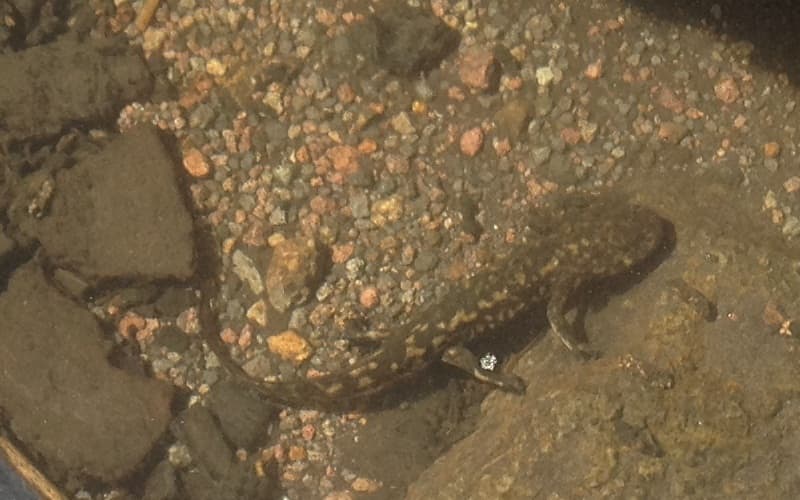
Ambystoma leorae
The Leora's stream salamander (Ambystoma leorae) is a critically endangered mole salamander endemic to a very small region within Mexico's Iztaccihuatl-Popocatepetl National Park. Its survival is threatened by its specific water quality requirements and human activities such as water extraction, cattle grazing, and direct consumption, leading to a single known population persisting on Mount Tlaloc.