
Bolitoglossa rufescens
The northern banana salamander (Bolitoglossa rufescens) is a small, terrestrial and arboreal salamander found in the Atlantic slopes of Meso-America, from Mexico through Guatemala, Belize, and northern Honduras. It is distinctive for its lungless respiration and its adaptation to life within bromeliads in tropical and subtropical moist lowland rain forests and mountain ecosystems.
Key Facts
- ›Species: Bolitoglossa rufescens, also known as the northern banana salamander.
- ›Habitat: Tropical and subtropical moist lowland rain forests, mountain ecosystems, citrus orchards, banana plantations, and pine plantations.
- ›Diet: primarily ants, beetles, weevils, collembolans, and arachnids.
- ›Reproduction: Biennial reproduction with internal fertilization; eggs develop entirely on land.
- ›Physical traits: Small size (35–36 MM snout-vent length), robust body, webbed digits, and truncate snout.
- ›Respiration: Lungless, breathing through skin and mouth lining.

Northern Banana Salamander, Common Dwarf Salamander, Rufescent Salamander
- Tropical and Subtropical Moist Lowland Rain Forests
- Mountain Ecosystems
- Citrus Orchards
- Banana Plantations
- Pine Plantations
- Bromeliads
Mexico, Guatemala, Belize, Honduras
- Small Terrestrial, Arboreal Salamanders.
- Dorsally Pale Brown To Tan Brown, Sometimes With Dorsal Longitudinal Streaks Or Specks.
- Ventral Area Is Grey Or Paler Than Dorsal Color, Sometimes Uniform.
- Dark Brown Streak Usually Runs From Behind the Eyes Towards the Posterior.
- Robust Body With 11 Costal Grooves Between Legs and 3 Additional Costal Grooves Between Limbs.
- Webbed Fingers and Toes.
- 4 Digits On Front Limbs, 5 Digits On Hind Limbs.
- Truncate Snout, Slightly Projected On Anterior Dorsal View.
Ants, Beetles, Weevils, Collembolans, Arachnids
- Responds To Predator Attacks By Elevating Or Undulating Its Tail.
- More Responsive To Stimulation To the Head Than Tail Or Trunk During Predator Attacks.
About Bolitoglossa rufescens
Northern Banana Salamander (Bolitoglossa rufescens)
The northern banana salamander, scientifically classified as Bolitoglossa rufescens, is a small species of lungless salamander belonging to the family Plethodontidae. Its common names include the common dwarf salamander and the rufescent salamander. This species is native to the Atlantic slopes of Meso-America, with documented occurrences in San Luis Potosi, Veracruz, and northern Chiapas in Mexico, extending into the southern parts of Guatemala, Belize, and northern Honduras. However, the precise extent of its range south of Mexico remains uncertain, as some historical records may pertain to different species.
Description and Ecology
Bolitoglossa rufescens is characterized by its small size, with adults typically measuring between 35–36 mm in snout-vent length and 65–70 mm in total length. These salamanders are terrestrial and arboreal, inhabiting tropical and subtropical moist lowland rain forests and mountain ecosystems. They are frequently found within bromeliads in these wet forest environments. Additionally, they have adapted to human-modified landscapes, appearing in citrus orchards, banana plantations, and pine plantations.
Physically, the northern banana salamander displays a pale brown to tan brown dorsal coloration, which can sometimes feature longitudinal streaks or specks. The ventral side is generally grey or paler than the dorsal surface, though some individuals exhibit uniform coloring. A distinctive dark brown streak often runs from behind the eyes and extends posteriorly, sometimes reaching halfway down the body or further. The species possesses a robust body with numerous costal grooves that aid in water transportation, respiration, and thermoregulation. Their digits are webbed, with four on the front limbs and five on the hind limbs, and they have a truncate snout that is slightly projected when viewed from the anterior dorsal side. A notable characteristic of Bolitoglossa rufescens, like all members of the Plethodontidae family, is that they are lungless and respire entirely through their skin and the lining of their mouths.
Diet
As predominantly arboreal salamanders, their diet is influenced by their size and habitat. Research indicates that Bolitoglossa rufescens primarily feeds on small invertebrates. Their diet is significantly composed of ants, followed by beetles and weevils (Coleoptera), collembolans, and arachnids.
Behavior
When faced with predator attacks, Bolitoglossa rufescens exhibits specific defensive behaviors. Studies have shown that these salamanders are more reactive to stimuli directed at their head compared to their tail or trunk. Their response typically involves elevating or undulating their tail as a deterrent.
Reproduction
The reproductive cycle of the northern banana salamander is biennial. Internal fertilization occurs after a successful courtship, during which males develop enlarged courtship glands to stimulate females. Following fertilization, eggs are laid in moist terrestrial locations, and direct development takes place entirely on land. The average clutch size is approximately 13.5 eggs, with an average egg diameter of 1.9 mm. Sexual dimorphism between males and females is minimal.
Source: Wikipedia ↗
Frequently Asked Questions
What is the northern banana salamander?
The northern banana salamander, scientifically known as Bolitoglossa rufescens, is a species of lungless salamander. It is characterized by its small size and its adaptation to arboreal life in tropical and subtropical forests.
Where can the northern banana salamander be found?
This species is found in the Atlantic slopes of Meso-America, specifically in regions of Mexico (San Luis Potosi, Veracruz, Chiapas), Guatemala, Belize, and northern Honduras. Its exact distribution south of Mexico is not definitively established.
What does the northern banana salamander eat?
The diet of Bolitoglossa rufescens consists mainly of small invertebrates. Research indicates a significant portion of their diet comprises ants, followed by beetles, weevils, collembolans, and arachnids.
How does the northern banana salamander reproduce?
Northern banana salamanders reproduce biennially through internal fertilization. After courtship, eggs are laid in moist terrestrial locations and undergo direct development on land.
What are the physical characteristics of Bolitoglossa rufescens?
They are small salamanders, measuring between 35–36 mm in snout-vent length and 65–70 mm in total length. They have a robust body, webbed fingers and toes with four digits on the front limbs and five on the hind limbs, and a truncate snout.
What makes the northern banana salamander unique in its breathing?
Bolitoglossa rufescens is a lungless salamander, meaning it lacks lungs entirely. It breathes solely through its skin and the lining of its mouth.
Related Salamander and Newt species
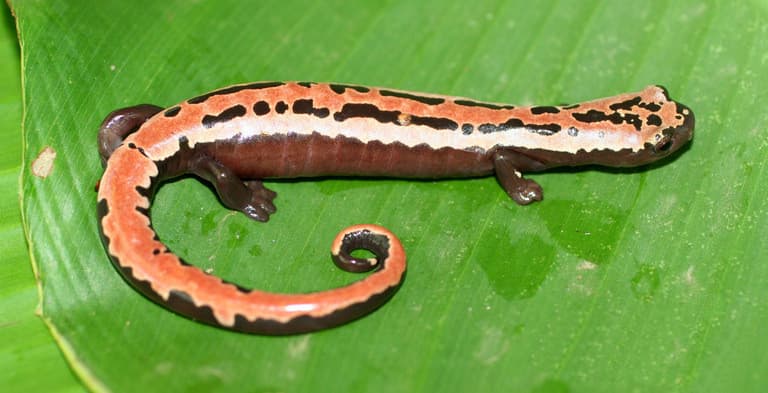
Bolitoglossa mexicana
The Mexican climbing salamander (Bolitoglossa mexicana) is a lungless salamander species found in Central America, inhabiting diverse forests and gardens. It is distinguished by its direct development, where young hatch as miniature adults, and its reliance on cutaneous respiration, necessitating moist environments.

Batrachoseps gregarius
The gregarious slender salamander (Batrachoseps gregarius) is a species of salamander native to California. It is characterized by its small, slender build, narrow head, short limbs, and a long, tapering tail. This species primarily inhabits chaparral, woodlands, and grasslands in the foothills of the Sierra Nevada and the eastern Central Valley.
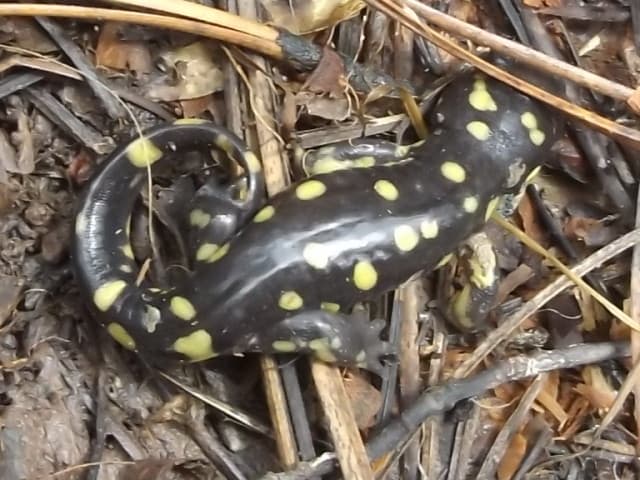
Ambystoma rosaceum
The Tarahumara salamander (Ambystoma rosaceum) is a freshwater mole salamander species endemic to Mexico, found in temperate and montane forests, grasslands, and various aquatic habitats. It is distinguished by its medium size, variable coloration of yellow spots or streaks on a dark background in adults, and the potential for paedomorphosis, where individuals retain larval features. While generally considered Least Concern, it faces threats from habitat loss and introduced species.