
Batrachoseps simatus
The Kern Canyon slender salamander, scientifically known as Batrachoseps simatus, is a lungless salamander found exclusively in the forested areas of southern California's Sierra Nevada mountains. This species is distinguished by its dark brown coloration with bronze and reddish spots and its reliance on moist environments for survival.
Key Facts
- ›Endemic to Kern County, California, in the western United States.
- ›Found in forested regions of the southern Sierra Nevada, south of the Lower Kern River.
- ›Possesses dark brown skin with bronze and reddish spots.
- ›Lacks lungs and breathes entirely through its skin, requiring moist conditions.
- ›Considered an endangered species by both California and the IUCN Red List.

Kern Canyon Slender Salamander
Damp Leaf Litter, Forested Regions, Underground Holes and Crevices
California, Usa, Kern County
2-Inch Length, Dark Brown Coloration, Bronze Spots, Reddish Spots
- Emerges During High Humidity Or Rain
- Stays Dormant In Underground Holes and Crevices During the Dry Season
- Breathes Through Skin
About Batrachoseps simatus
Kern Canyon Slender Salamander
The Kern Canyon slender salamander, scientifically classified as Batrachoseps simatus, is a species of plethodontid salamander native to a very specific region of California. Its distribution is strictly limited to Kern County in the western United States, primarily found within the forested areas of the southern Sierra Nevada mountains, south of the Lower Kern River.
Physical Characteristics and Biology
This salamander is characterized by its relatively small size, reaching an average length of about 2 inches. Its coloration is predominantly dark brown, adorned with distinctive bronze and reddish spots across its body. A key biological feature of Batrachoseps simatus, shared with other plethodontids, is its lack of lungs. Consequently, it relies entirely on cutaneous respiration, breathing through its skin, which necessitates a consistently moist environment for survival.
Habitat and Behavior
The Kern Canyon slender salamander thrives in damp leaf litter, where it can maintain the moisture required for its skin respiration. During periods of high humidity or rainfall, these salamanders become more active and emerge from their sheltered locations. Conversely, they enter a state of dormancy in underground holes and crevices to escape the arid conditions of the dry season.
Conservation Status
The species faces significant conservation challenges. Batrachoseps simatus is recognized as an endangered species by the state of California and is also listed as endangered on the IUCN Red List. Furthermore, it has been the subject of petitions by the United States Fish and Wildlife Service to be officially designated as a threatened species, highlighting the precariousness of its populations and the need for protective measures.
Source: Wikipedia ↗
Frequently Asked Questions
Where is the Kern Canyon slender salamander found?
The Kern Canyon slender salamander is endemic to Kern County in California, specifically in the forested regions of the southern Sierra Nevada mountains, south of the Lower Kern River. Much of its habitat is located within the Sequoia National Forest.
What does the Kern Canyon slender salamander look like?
This salamander is typically 2 inches in length and is dark brown in color. Its skin is covered with bronze and reddish spots.
How does the Kern Canyon slender salamander breathe?
Like other plethodontid salamanders, Batrachoseps simatus lacks lungs. It breathes directly through its skin, which must be kept moist to facilitate gas exchange.
What are the habitat requirements for this salamander?
The Kern Canyon slender salamander lives in damp leaf litter and requires moist environments. It emerges during periods of high humidity or rain and retreats to underground holes and crevices during dry seasons.
What is the conservation status of the Kern Canyon slender salamander?
Batrachoseps simatus is listed as an endangered species by the state of California. Its status is also recognized as endangered by the IUCN Red List. There has also been a petition to list it as threatened by the United States Fish and Wildlife Service.
Related Salamander and Newt species
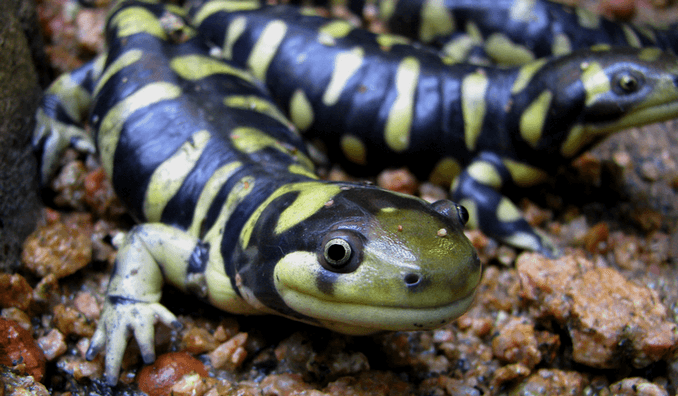
Ambystoma tigrinum
The tiger salamander (Ambystoma tigrinum) is one of the largest terrestrial salamanders native to North America. It is characterized by its distinctive yellow or greenish-yellow markings on a black or dark brown body, and it emits a bright fluorescence under UV light. These amphibians spend much of their lives in burrows and are primarily terrestrial as adults, returning to water only to breed.

Ambystoma maculatum
The spotted salamander (Ambystoma maculatum) is a species of mole salamander native to eastern North America. It is distinguished by its black body adorned with two rows of yellow or orange spots running from its head to its tail. This amphibian is notable for the symbiotic algae that inhabit its egg masses, a unique relationship among vertebrates.

Ambrosi's cave salamander
Ambrosi's cave salamander, also known as the Spezia cave salamander, is a species of salamander endemic to a small region of northwestern Italy. It inhabits temperate forests, rocky areas, caves, and subterranean environments, distinguishing itself with a variable coloration ranging from brown to black, often with marbling or mottling. This species is critically endangered due to habitat loss and its very restricted range.